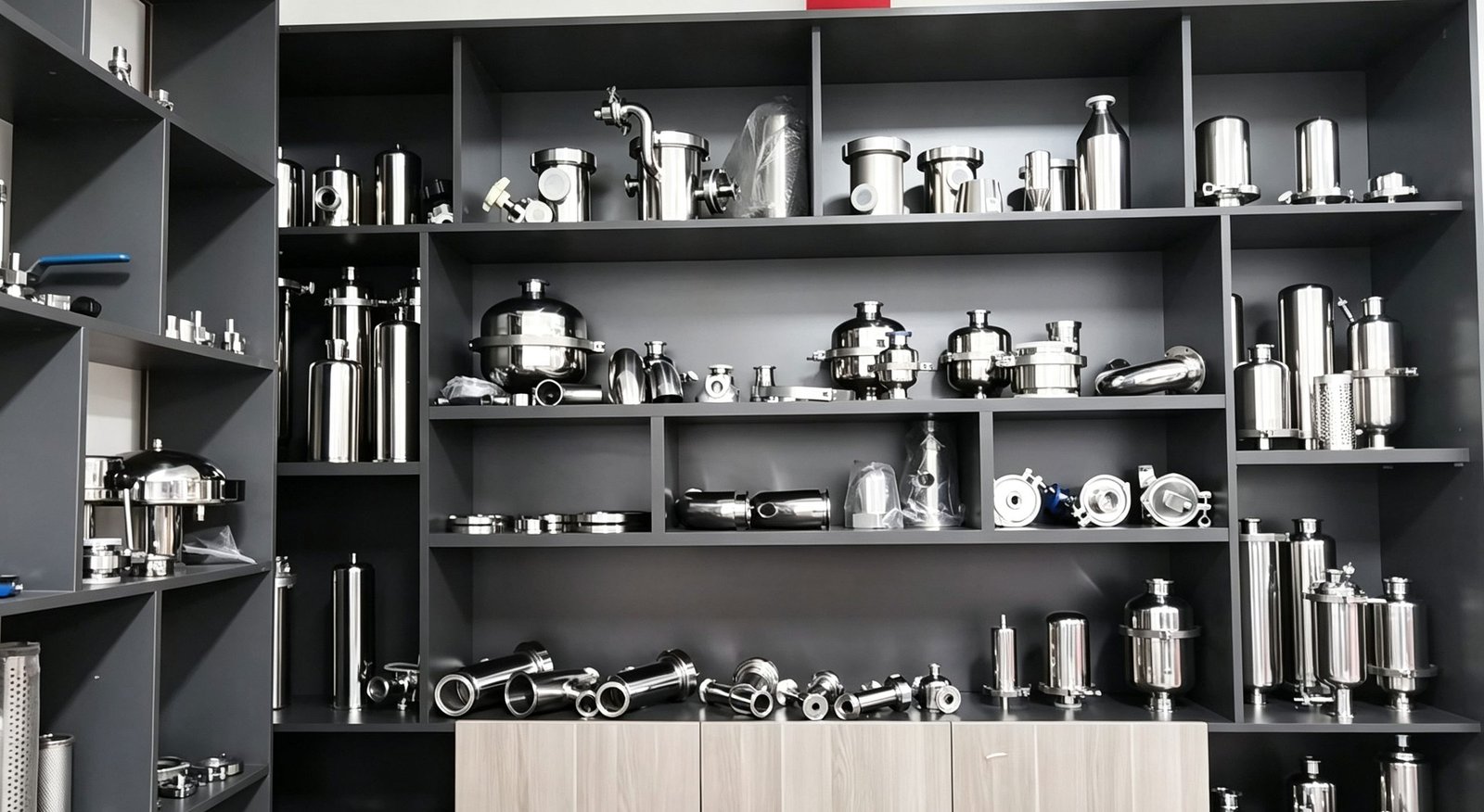
Choosing the right sanitary strainer depends on more than the connection size or mesh opening. Different strainer designs are intended for different piping layouts, flow conditions, maintenance requirements, and liquid-processing applications.
In hygienic processing systems, common stainless steel sanitary strainer types include Y-strainers, inline strainers, pipeline strainers, and dual mesh strainers. Understanding how these designs differ can help engineers and equipment buyers select a suitable configuration for their process.
What Is a Sanitary Strainer?
A sanitary strainer is a stainless steel component used to separate unwanted solid particles from a liquid process stream.
Unlike fine cartridge filtration systems, a strainer is commonly used for particle separation, equipment protection, and pre-filtration. It can help protect pumps, valves, instruments, heat exchangers, filling equipment, and other downstream components from larger particles or process debris.
Sanitary strainers are commonly used in food and beverage processing, dairy systems, fermentation, liquid culture, and other hygienic liquid-processing applications.
The most suitable strainer depends on factors such as:
- Flow direction
- Pipeline layout
- Flow rate
- Particle size
- Mesh opening
- Pressure
- Connection type
- Available installation space
- Cleaning and maintenance requirements
Common Types of Sanitary Strainers
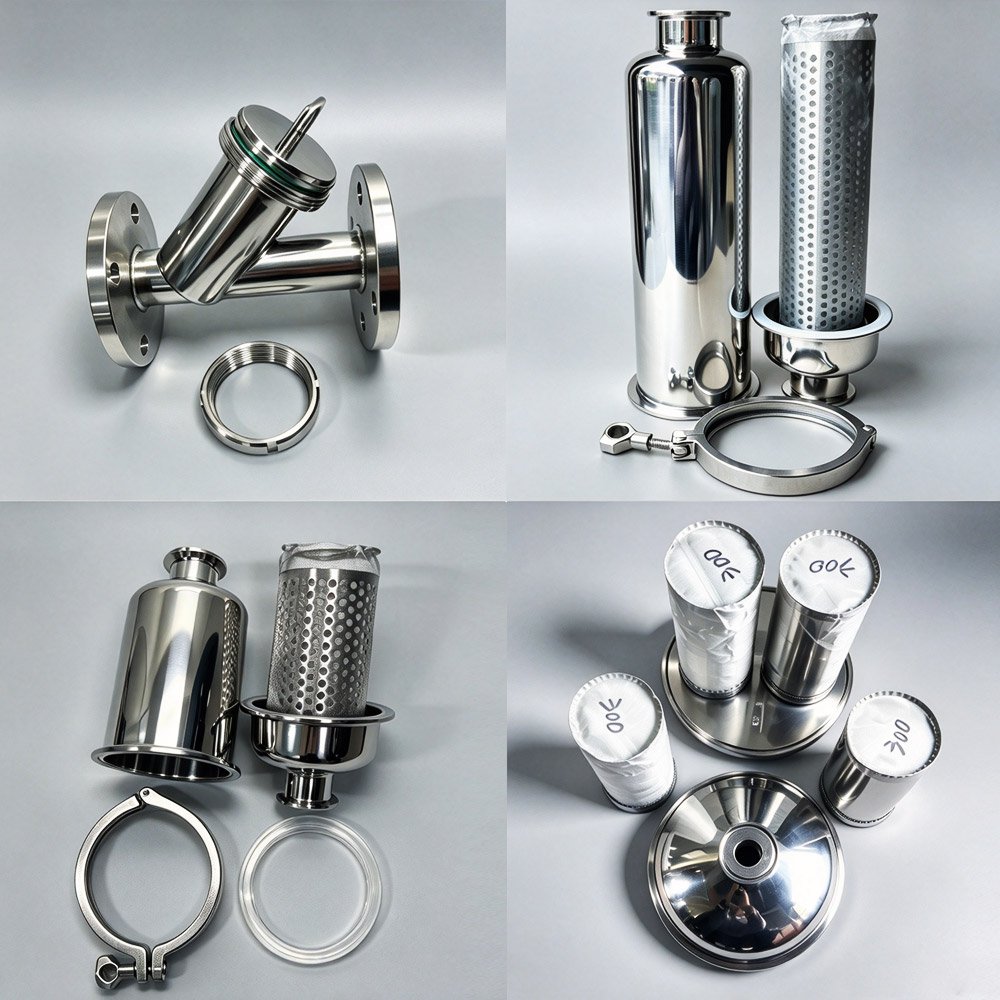
Although sanitary strainers can have different body and screen configurations, four useful types for hygienic liquid processing are Y-strainers, inline strainers, pipeline strainers, and dual mesh strainers.
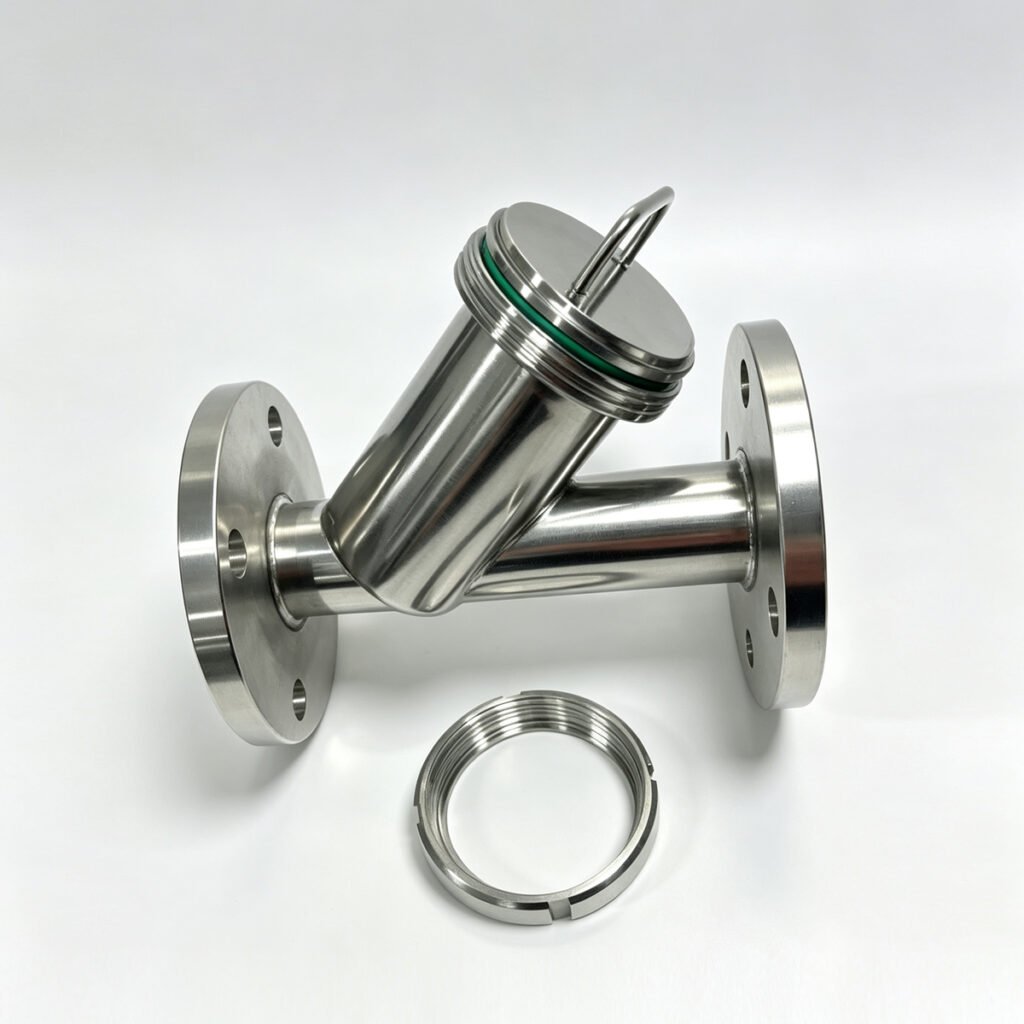
Sanitary Y-Strainer
A sanitary Y-strainer has a Y-shaped body with the screening section positioned at an angle to the main flow path.
This design provides a practical way to remove particles from a liquid line while allowing the screen or straining element to be accessed for cleaning.
Y-strainers are commonly considered when:
- A compact straining arrangement is required
- The process piping layout allows an angled screen section
- Regular screen cleaning or inspection is required
- The system needs basic particle separation before downstream equipment
For more information about the working principle and applications of this design, see our guide to the [sanitary Y-strainer].
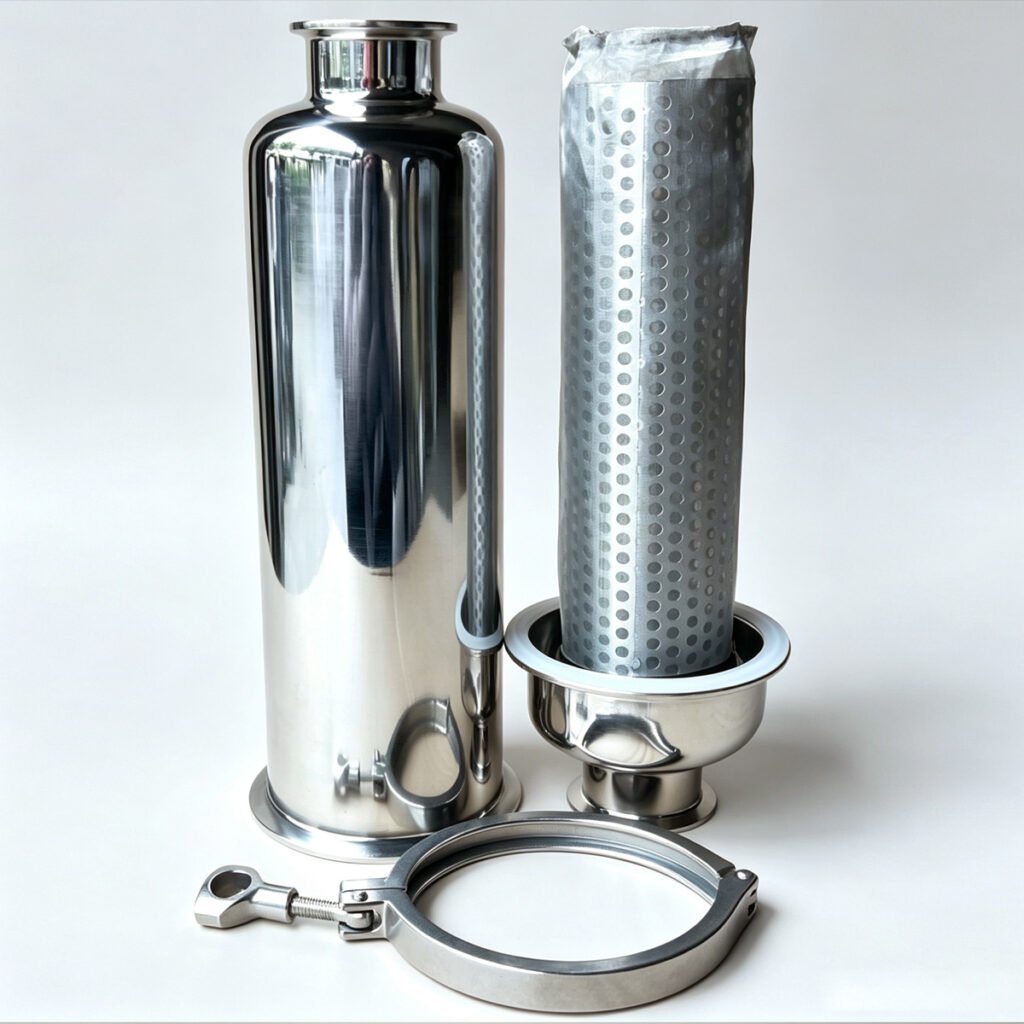
Sanitary Inline Strainer
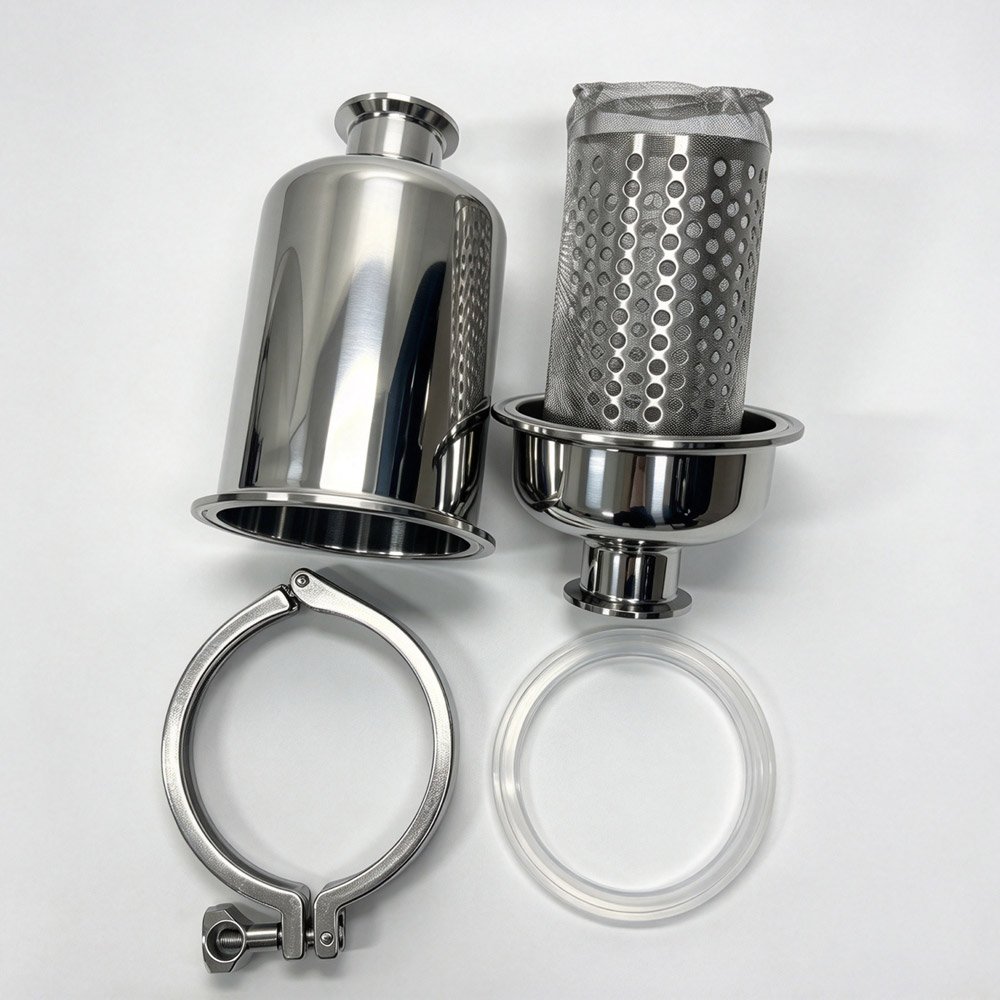
A sanitary inline strainer uses a more direct, straight-through flow path.
This configuration can be useful when the strainer needs to be installed directly within a sanitary process pipeline without creating a large change in the piping direction.
Inline strainers may be suitable when:
- Straight-through installation is preferred
- Available space around the pipeline is limited
- The process requires convenient integration into an existing sanitary line
- A removable mesh screen is needed for particle separation
The required mesh opening should be selected according to the particle size that needs to be removed and the acceptable pressure drop across the strainer.
See our guide on [how to choose the right mesh for a sanitary Tri-Clamp inline strainer] for more information.
Sanitary Pipeline Strainer
A sanitary pipeline strainer is designed around the requirements of sanitary process piping and can be used where a larger or more pipeline-oriented configuration is required.
Compared with a compact Y-strainer, a pipeline strainer may be more appropriate when the process line, flow volume, or installation arrangement calls for a different housing configuration.
Typical considerations include:
- Pipeline diameter
- Flow rate
- Available installation space
- Required mesh opening
- Connection configuration
- Cleaning access
For larger sanitary liquid-processing lines, the [304 stainless steel sanitary pipeline strainer] can be considered as one available configuration.
Sanitary Dual Mesh Strainer
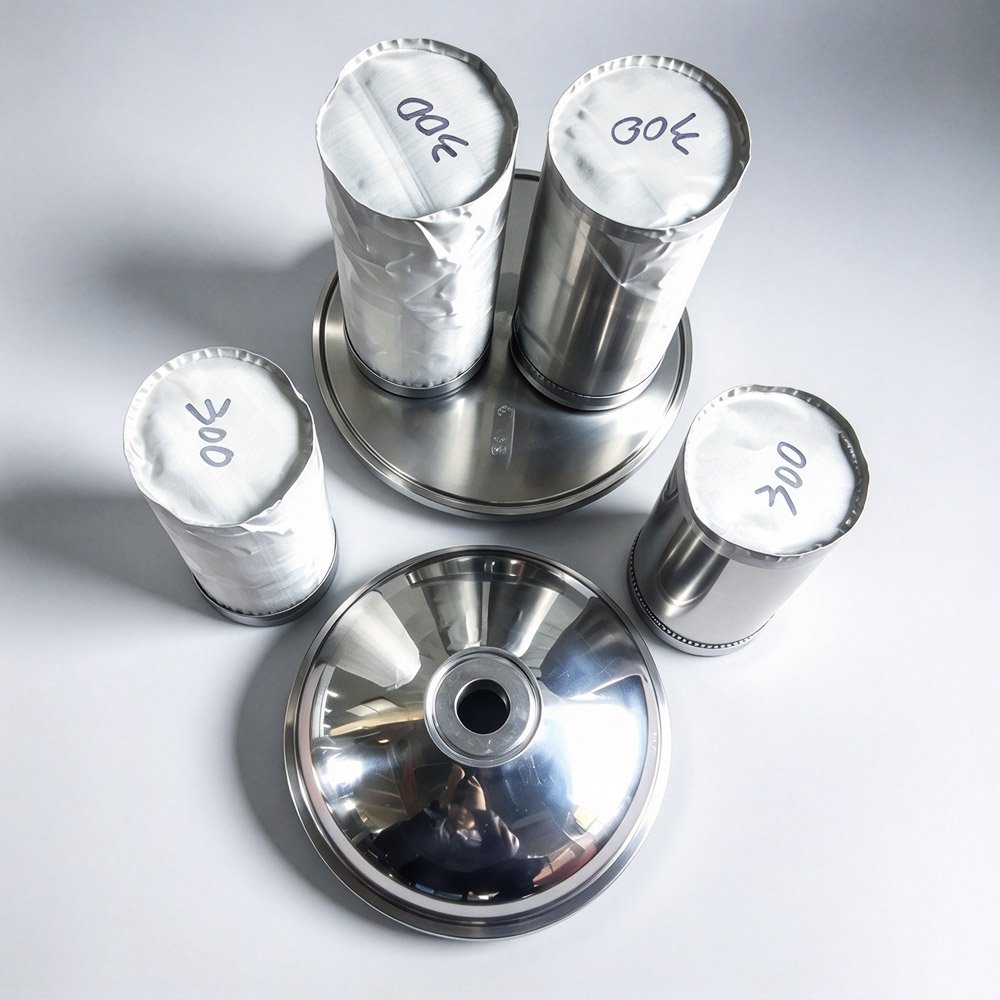
A sanitary dual mesh strainer uses two cylindrical stainless-steel mesh elements installed side by side inside one SS304 housing.
This is different from a multi-cartridge filter housing. The filtration elements are stainless-steel mesh elements rather than disposable PP or other cartridge media.
A dual mesh configuration can be considered when the process requires:
- Two cylindrical mesh elements in one housing
- Stainless-steel reusable screening elements
- A larger screening arrangement than a simple single-element design
- Hygienic liquid processing
- Easy access for inspection and cleaning
Our [304 stainless steel sanitary dual mesh strainer] uses an SS304 housing with two cylindrical stainless-steel mesh elements installed side by side.
Sanitary Strainer Types Compared
| Strainer Type | Main Design | Typical Advantage | Typical Application |
|---|---|---|---|
| Y-Strainer | Y-shaped body | Compact and practical | Hygienic process piping |
| Inline Strainer | Straight-through body | Easy inline installation | Liquid processing lines |
| Pipeline Strainer | Pipeline-oriented body | Suitable for larger sanitary lines | Food, dairy and liquid processing |
| Dual Mesh Strainer | Two mesh elements in one housing | Larger screening arrangement | Hygienic liquid processing |
There is no single sanitary strainer design that is suitable for every process. The correct choice depends on the actual piping arrangement, flow conditions, filtration requirement, and maintenance method.
How to Choose the Right Sanitary Strainer Type
1. Consider the Flow Direction
Start by looking at how the liquid moves through the existing process pipeline.
A Y-strainer, inline strainer, pipeline strainer, and dual mesh configuration can have different flow-path and installation requirements. The strainer should fit naturally into the process rather than forcing unnecessary changes to the piping.
2. Check the Available Installation Space
Installation space is particularly important around the screen or mesh element.
The strainer should have enough clearance for:
- Removing the screen
- Cleaning the mesh
- Inspecting the internal components
- Reinstalling the element
A compact Y-strainer may be useful in some layouts, while an inline or pipeline configuration may be more convenient in others.
3. Match the Pipeline and Connection Size
The connection size should match the sanitary piping system.
Depending on the equipment configuration, the connection may involve sanitary clamp connections, welded connections, or other hygienic connection methods.
For Tri-Clamp systems, make sure the selected clamp size and connection specification match the mating components.
4. Select the Appropriate Mesh Opening
Mesh selection directly affects particle separation and flow resistance.
A smaller opening can retain smaller particles, but it may also increase resistance to flow and become loaded with particles more quickly.
A larger opening generally allows greater flow through the screen but provides less particle retention.
For an explanation of mesh and micron terminology, see our guide to [mesh size and micron rating].
5. Consider Flow Rate and Pressure Drop
The required flow rate is an important part of strainer selection.
Pressure drop can be affected by:
- Flow rate
- Mesh opening
- Screen area
- Fluid viscosity
- Particle loading
- Strainer geometry
A strainer should therefore be selected according to the actual process conditions rather than only the nominal pipe size.
6. Consider Cleaning and Maintenance
Sanitary process equipment is often cleaned and inspected regularly.
Before selecting a strainer, consider how the screen will be removed and cleaned.
For applications with frequent particle loading, convenient access to the mesh element can be especially important.
7. Consider the Process Fluid
The process fluid can affect the required strainer configuration.
For example, food, beverage, dairy, fermentation, and liquid culture systems may have different flow characteristics and particle-loading conditions.
When selecting a sanitary strainer, consider:
- Liquid viscosity
- Solid particle characteristics
- Temperature
- Pressure
- Flow rate
- Cleaning procedure
- Material compatibility
Sanitary Strainer vs. Cartridge Filter Housing
A sanitary strainer and a cartridge filter housing are not the same type of filtration equipment.
A sanitary strainer generally uses a mesh or screening element for particle separation and equipment protection.
A cartridge filter housing uses a replaceable filter cartridge and is normally selected when a finer or more controlled filtration process is required.
In a liquid-processing system, a strainer can also be used as an upstream protection or pre-filtration stage before finer cartridge filtration.
If you are deciding between the two, see our guide on [sanitary filter vs. strainer].
For cartridge filtration applications, you can also review our guide to [304 stainless steel filter housing and filter cartridge selection].
Where Are Sanitary Strainers Used?
Sanitary stainless steel strainers can be used in many hygienic liquid-processing environments, including:
- Food and beverage processing
- Dairy processing
- Fermentation systems
- Liquid culture systems
- Hygienic process piping
- Liquid transfer systems
- Pump protection
- Equipment protection
- Pre-filtration applications
The actual configuration should always be selected according to the process requirements rather than the application name alone.
Sanitary Strainer Selection Checklist
Before ordering a sanitary strainer, it is useful to confirm the following information:
- Fluid type
- Flow rate
- Pipeline size
- Connection type
- Required mesh opening
- Target particle size
- Operating pressure
- Operating temperature
- Cleaning method
- Required material
- Available installation space
- Screen removal and maintenance requirements
Providing this information makes it easier to determine whether a Y-strainer, inline strainer, pipeline strainer, or dual mesh strainer is appropriate for the application.
Conclusion
Y-strainers, inline strainers, pipeline strainers, and dual mesh strainers all provide sanitary particle-separation solutions, but their designs and installation requirements are different.
The right choice should be based on the actual process conditions, including flow rate, pipeline layout, particle size, mesh opening, connection size, pressure, and maintenance requirements.
For hygienic liquid-processing systems, selecting the correct strainer configuration can help protect downstream equipment while maintaining a practical and serviceable process design.
If you are unsure which sanitary strainer configuration fits your process, provide the fluid type, flow rate, connection size, required filtration level, and available installation space. Our engineering team can help identify a suitable configuration.