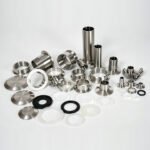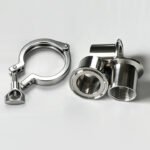
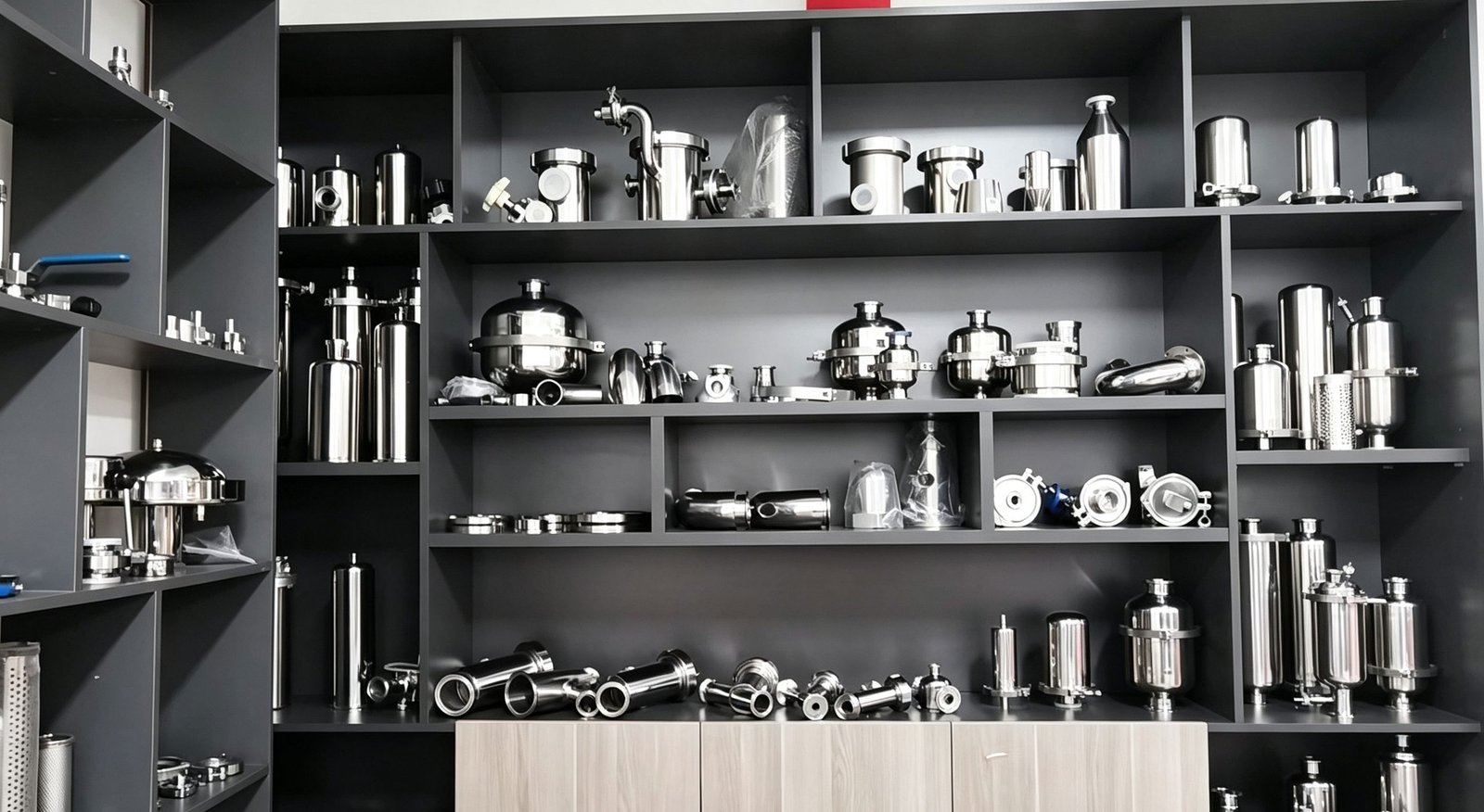
In hygienic liquid processing systems, a sanitary strainer helps remove unwanted particles before they reach pumps, valves, nozzles or other downstream equipment.
However, choosing a sanitary inline strainer is not only about selecting the correct pipe connection or stainless steel grade. The mesh screen is one of the most important factors.
A screen that is too coarse may allow unwanted particles to pass through, while a screen that is too fine can increase flow resistance and require more frequent cleaning.
This article explains how a sanitary Tri-Clamp inline mesh strainer works and how to choose the appropriate mesh according to particle size, flow requirements and application conditions.
What Is a Sanitary Tri-Clamp Inline Strainer?
A sanitary Tri-Clamp inline strainer is a straight-through straining device installed directly in a hygienic process pipeline.
Its main purpose is to capture unwanted particles from liquid streams and provide basic protection for downstream equipment.
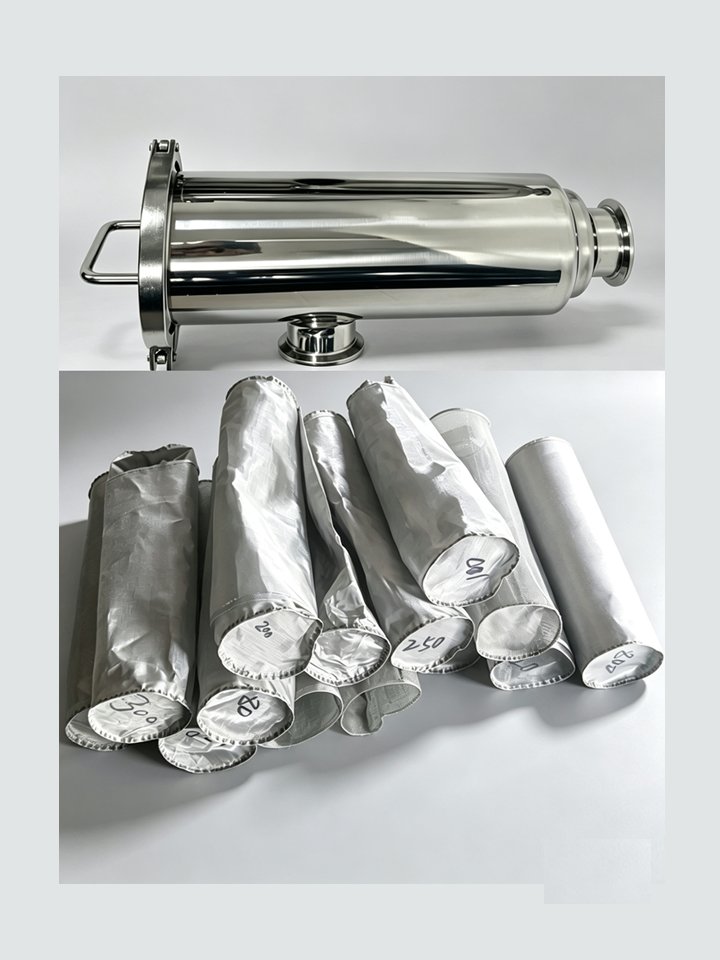
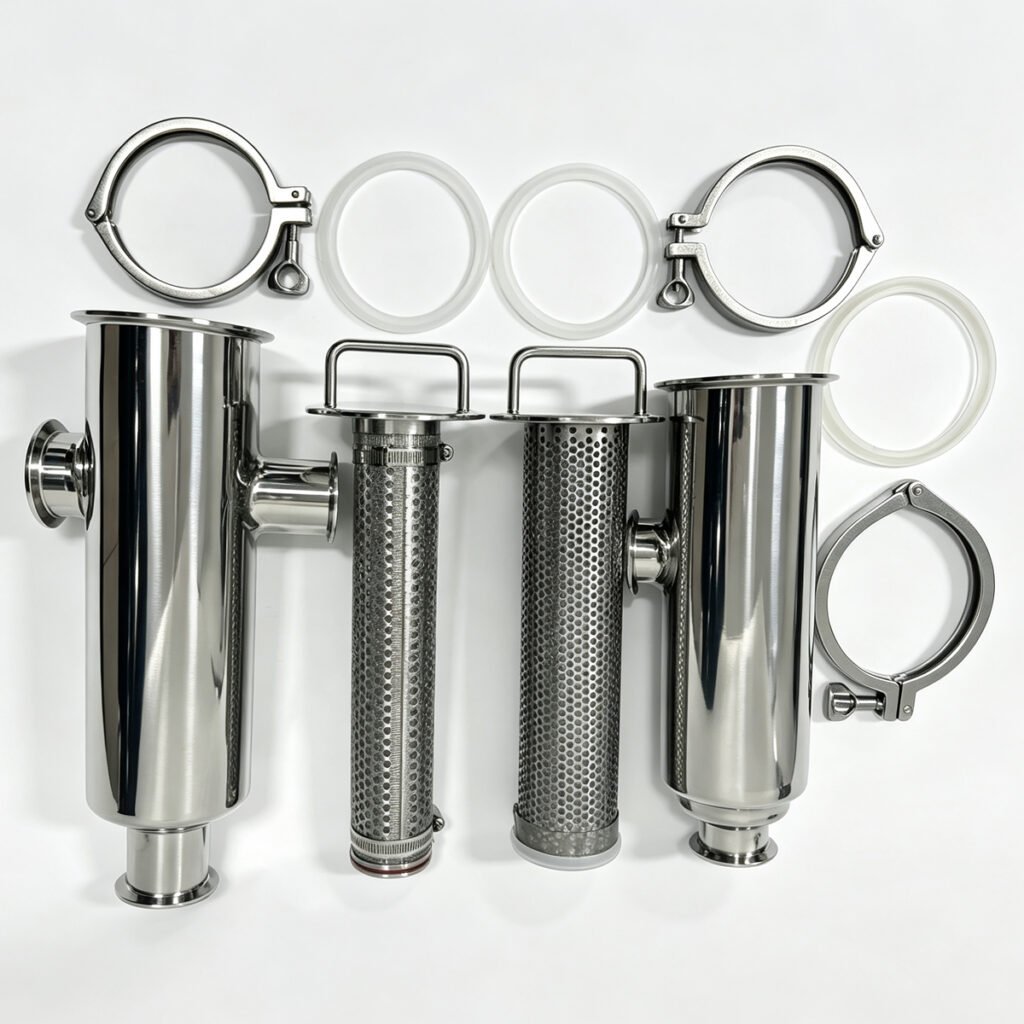
The Haoqintech 304 SS Sanitary Tri-Clamp Inline Mesh Strainer uses a 304 stainless steel body, sanitary Tri-Clamp connection and a removable perforated or mesh screen. The top lid can be released through the Tri-Clamp connection, allowing the screen to be inspected and cleaned without complicated disassembly.
Typical applications include:
- Food and beverage processing
- Dairy processing
- Brewing
- Liquid culture systems
- Hygienic liquid transfer
- Pipeline protection before pumps and valves
What Does an Inline Strainer Do?
The main function of an inline strainer is particle removal and equipment protection.
During liquid processing, unwanted particles may come from:
- Raw materials
- Ingredients
- Process residues
- Pipe scale
- Equipment wear
- Particles introduced during transfer or processing
Installing a strainer upstream can help prevent larger particles from reaching sensitive components.
For example, a sanitary inline strainer can be installed before:
- Pumps
- Valves
- Spray nozzles
- Filling equipment
- Heat exchangers
- Other downstream process equipment
The goal is not always to achieve extremely fine filtration. In many applications, the primary purpose is simply to remove particles large enough to cause operational problems while maintaining practical flow conditions.
Why Does Mesh Selection Matter?
The mesh screen determines how large a particle can pass through the strainer.
In general:
Coarser mesh → larger openings → lower resistance and higher flow capacity
Finer mesh → smaller openings → greater particle retention but potentially higher resistance
This means a finer screen is not automatically better.
If the screen is unnecessarily fine, it may:
- Increase pressure drop
- Reduce effective flow
- Become blocked more quickly
- Require more frequent cleaning
Therefore, the correct mesh should be selected according to the actual process rather than simply choosing the finest available option.
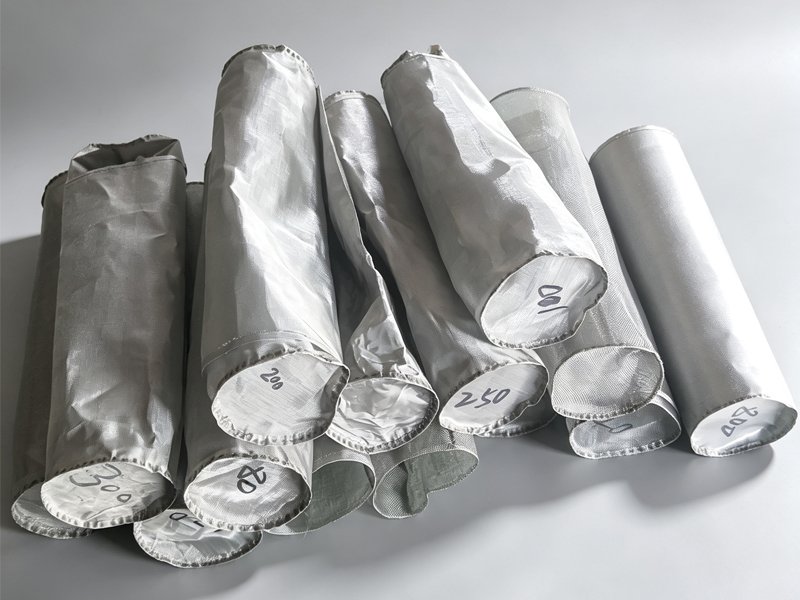
Coarse Mesh: When Should You Use It?
A coarse mesh is generally suitable when the main objective is to remove relatively large particles and protect downstream equipment.
Typical applications include:
- Pump protection
- Valve protection
- Nozzle protection
- General pipeline particle removal
- Processes containing relatively large suspended particles
The main advantage of a coarse screen is that it normally provides less resistance to liquid flow and is less likely to become blocked quickly.
For processes where high flow and equipment protection are more important than fine particle retention, a coarse mesh can be a practical choice.
Medium Mesh: A Balanced Choice
A medium mesh can provide a balance between particle retention and flow performance.
It may be suitable when the process requires more particle control than a coarse screen but does not require very fine straining.
This type of selection can be useful for:
- General food processing
- Beverage processing
- Dairy applications
- Brewing
- Liquid transfer systems
The actual choice should still be based on the particle size that needs to be removed and the required flow rate.
Fine Mesh: When Is It Appropriate?
Fine mesh is designed to retain smaller particles.
It may be appropriate when downstream equipment or the process requires better control of smaller suspended particles.
However, fine mesh usually requires more attention to:
- Flow rate
- Pressure drop
- Fluid viscosity
- Particle concentration
- Screen cleaning frequency
A fine screen can become blocked faster when the liquid contains a significant amount of solids.
Therefore, before selecting a fine mesh, it is important to consider not only what size particle you want to remove, but also how much material the screen will collect during operation.
How to Choose the Right Mesh
There is no single mesh size that is ideal for every hygienic process.
Consider the following factors.
1. Particle Size
First determine the approximate size of the particles that need to be removed.
If the particles are relatively large, a coarse screen may be sufficient.
If smaller particles must be retained, a finer screen may be required.
The screen should therefore be selected according to the target particle size, rather than choosing the finest mesh by default.
2. Required Flow Rate
Flow rate is another important consideration.
As the screen becomes finer, resistance to liquid flow can increase, particularly when the screen begins to accumulate particles.
For high-flow applications, an unnecessarily fine mesh may create operational problems.
3. Fluid Viscosity
Water-like liquids and viscous liquids behave differently when passing through a mesh screen.
Higher-viscosity fluids generally require greater attention to pressure drop and flow resistance.
If the process fluid is thick or contains suspended solids, a coarse or medium screen may be more practical than an extremely fine one.
4. Amount of Solids
Consider how much material the strainer is expected to collect.
A process with a relatively clean liquid may allow the use of a finer screen.
If the liquid contains a large amount of particles, a fine screen may become blocked quickly.
In such cases, a coarser screen or a staged filtration approach may provide better overall performance.
5. Downstream Equipment
The equipment after the strainer also matters.
If the main purpose is to protect a pump or valve from larger particles, a coarse or medium screen may be sufficient.
If downstream equipment has tighter particle requirements, a finer screen may be appropriate.
Mesh Selection Is a Balance
The most important principle is:
Choose the finest mesh that meets the particle-removal requirement without creating unnecessary flow resistance or maintenance problems.
This approach is generally more practical than simply selecting the finest available mesh.
A good strainer selection should balance:
Particle retention + Flow rate + Pressure drop + Cleaning frequency + Equipment protection
This is particularly important in continuous hygienic processing systems.
Easy Cleaning and Maintenance
A sanitary strainer should not only perform well during operation. It should also be easy to inspect and clean.
The Haoqintech inline mesh strainer uses a removable screen and Tri-Clamp connection, allowing the lid and screen to be removed quickly for inspection and cleaning. Its polished 304 stainless steel construction is designed for hygienic process applications.
Regular inspection is important because accumulated particles can gradually restrict flow.
A practical maintenance routine should include:
- Checking the screen for blockage
- Inspecting the screen for damage
- Cleaning the screen when necessary
- Checking the gasket
- Inspecting the Tri-Clamp connection
- Reinstalling the screen correctly before operation
The cleaning frequency depends on the fluid, particle load and operating conditions.
304 Stainless Steel and Sanitary Tri-Clamp Connection
Material and connection design are also important in hygienic applications.
This inline strainer is constructed from 304 stainless steel, with 316L available on request. It uses a sanitary Tri-Clamp connection and food-grade silicone gasket. The product is available for several tube OD sizes, including 3/4″, 1″, 1-1/4″, 1-1/2″, 2″ and 2-1/2″.
The Tri-Clamp connection allows quick installation and disassembly, which is particularly useful when the screen needs regular inspection or cleaning.
Where Is a Sanitary Inline Strainer Used?
Sanitary Tri-Clamp inline strainers can be used in many hygienic liquid processing applications.
Common examples include:
Food & Beverage
For removing unwanted particles from liquid ingredients and process streams.
Dairy Processing
For protecting downstream equipment in hygienic dairy processing lines.
Brewing
For particle control and equipment protection in brewing and fermentation-related processes.
Liquid Culture Systems
For protecting process lines and downstream components during hygienic liquid culture handling.
General Hygienic Fluid Handling
For applications where removable particle protection is required in a sanitary pipeline.
The current Haoqintech product page specifically lists food, beverage, dairy, brewing, pharmaceutical and liquid culture systems among its application areas
Sanitary Strainer vs. Fine Filtration
It is also important to understand that a mesh strainer and a precision filtration system are not necessarily the same thing.
A sanitary inline mesh strainer is particularly useful for:
- Removing larger particles
- Protecting equipment
- Maintaining pipeline cleanliness
- Providing simple and accessible particle control
For applications requiring very precise filtration or microbiological control, a different filtration technology may be more appropriate.
The correct solution depends on the required particle retention and overall process design.
Final Checklist for Choosing a Mesh Strainer
Before ordering a sanitary Tri-Clamp inline strainer, consider:
- What particle size needs to be removed?
- What is the required flow rate?
- How viscous is the process fluid?
- How much solid material is expected?
- What equipment needs protection?
- How much pressure drop can the system tolerate?
- How frequently can the screen be cleaned?
- What pipe size and Tri-Clamp connection are required?
- Is 304 stainless steel suitable, or is 316L preferred?
Once these factors are clear, selecting the appropriate mesh becomes much easier.
Conclusion
A sanitary Tri-Clamp inline strainer is a simple but important component in hygienic liquid processing systems.
The key to choosing the right strainer is not simply selecting the finest mesh available. Instead, the mesh should match the particle size, flow rate, fluid characteristics, downstream equipment and maintenance requirements.
Coarse mesh can provide efficient particle removal with relatively low flow resistance, while finer mesh can provide greater particle retention when the process requires it. The best choice is the one that provides the required protection without creating unnecessary pressure drop or cleaning problems.
Haoqintech’s 304 SS Sanitary Tri-Clamp Inline Mesh Strainer combines a 304 stainless steel sanitary body, removable mesh screen and quick-release Tri-Clamp connection for hygienic liquid processing applications.
For specific mesh requirements, pipe sizes or custom configurations, contact Haoqintech to discuss your application.
5. Common Mistakes We See in the Field
- Installing the filter after the pump instead of before it
- Using a screen that is too fine for the product
- Forgetting to check differential pressure regularly
- Reusing damaged silicone gaskets
- Mounting the filter in a hard-to-reach position
Any of these can turn a simple component into a recurring maintenance headache.
6. Quick Selection Checklist
Before ordering, confirm:
- Exact Tri-Clamp size (φ32, φ38, φ51, φ63, etc.)
- Preferred body style (straight or angle)
- Required filtration level
- Material (304 is standard; 316L for higher corrosion resistance)
- Expected cleaning frequency
Providing these details upfront usually results in a better-performing installation.
Final Thought
A sanitary tri-clamp filter is a small component, but its placement, screen choice and accessibility have a direct impact on uptime and product consistency. Treating it as a simple “add-on” often leads to unnecessary problems later.
When specified correctly, it becomes one of the easiest and most cost-effective ways to protect both equipment and product quality.
Need help selecting the right size or screen?
Send us your line size, product type and cleaning frequency — we can recommend a suitable configuration.