
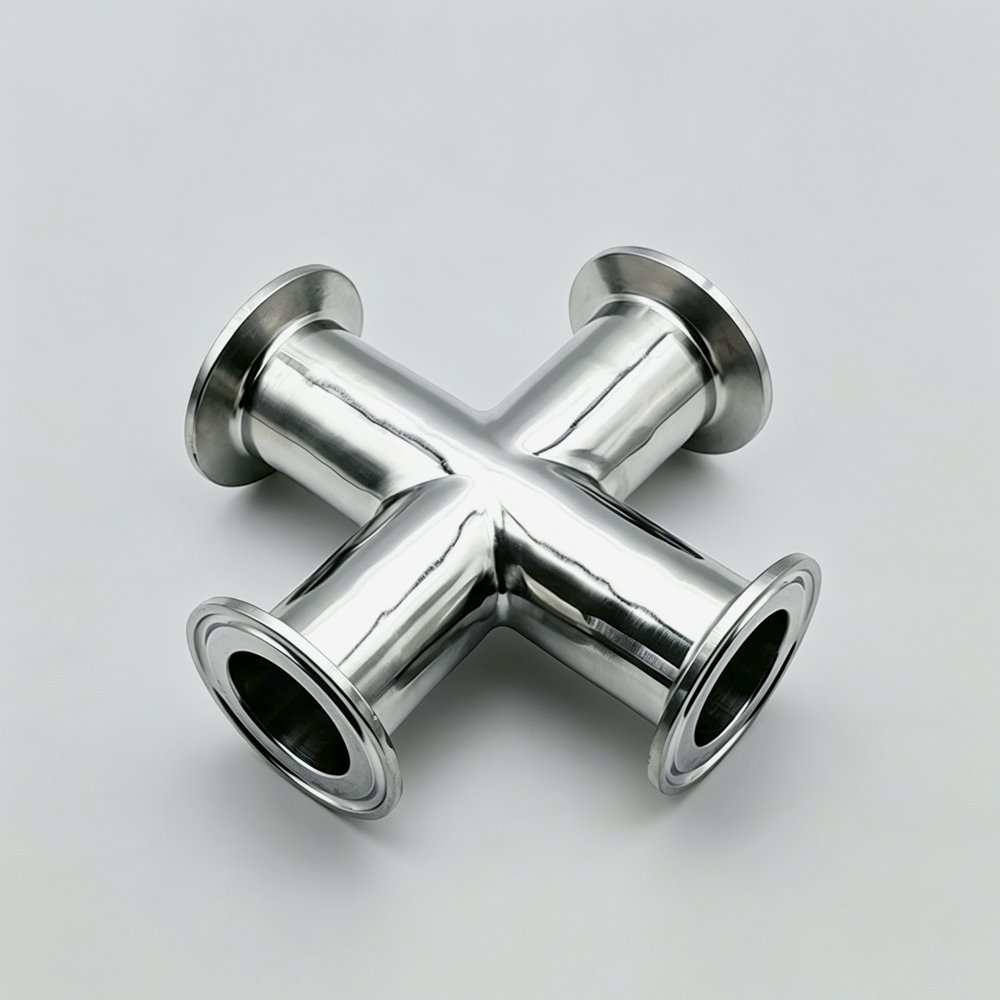
In sanitary process piping, a single pipeline sometimes needs to connect with several branches. A four-way cross fitting provides a compact way to connect four pipe sections at one junction, helping engineers organize fluid distribution and collection within a hygienic piping system.
Sanitary four-way cross fittings are commonly used in food and beverage processing, dairy production, brewing, pharmaceutical equipment, and other hygienic applications.
However, selecting a cross fitting involves more than checking its pipe size. The connection type, branch arrangement, material, cleaning requirements, and maintenance access should all be considered.
This guide explains how sanitary four-way cross fittings work, where they are used, and how to choose between quick-clamp and welded connections.
What Is a Sanitary Four-Way Cross Fitting?
A sanitary four-way cross fitting is a pipe connector with four openings arranged around a central junction. It allows four pipeline sections to connect at one point.
Unlike a sanitary tee, which typically connects three pipe openings, a cross fitting provides an additional connection in the opposite direction.
In a typical equal four-way cross, all four connection ends are designed for the same nominal tube size. This makes it suitable for piping layouts where four lines of matching dimensions need to meet.
The fitting can be used in different configurations depending on the process design. For example, it may connect a main pipeline with two branches, join several process lines, or provide a common junction for fluid transfer.
It is important to understand that the fitting itself does not control flow direction or isolate individual branches. Valves and other control components are required when independent flow regulation is needed.
How Does a Four-Way Cross Work in Process Piping?
A four-way cross creates a shared connection point between four pipeline sections.
Depending on the piping arrangement, it can support several functions:
- Fluid distribution: A supply line can connect to multiple downstream branches when the system is designed with appropriate flow control.
- Pipeline connection: Separate process lines can be joined at a common junction.
- Equipment integration: The fitting can connect piping sections around tanks, pumps, filters, or other process equipment.
- System layout flexibility: Four connection points can help simplify certain compact piping arrangements.
The actual flow pattern depends on the operating system, including pressure differences, valve positions, pipe dimensions, and equipment configuration. A cross fitting should not be assumed to distribute fluid equally between branches without proper hydraulic design.
Where Are Sanitary Four-Way Cross Fittings Used?
Four-way cross fittings are useful when multiple sanitary pipeline sections need to meet at a common point.
Food and Beverage Processing
In food and beverage facilities, a cross fitting may be used in product transfer lines, ingredient distribution systems, and equipment connection assemblies.
The quick-clamp design can be convenient when a pipeline section needs to be opened for inspection, cleaning, or maintenance.
Dairy Processing
Dairy processing systems often contain interconnected pipelines for product transfer, cleaning, and equipment connections.
A sanitary cross can provide a connection point between different sections of a piping layout. The fitting material, internal finish, gasket, and installation arrangement should be compatible with the cleaning procedure.
Brewing and Beverage Equipment
Brewing systems may contain several connected process lines around tanks, pumps, filters, and transfer equipment.
A four-way cross can be used where the piping design requires four connections at one junction. The final arrangement should consider drainage, cleaning access, and the possibility of product retention around the junction.
Pharmaceutical and Hygienic Process Equipment
In pharmaceutical and other hygienic processing applications, connection geometry and cleanability are particularly important.
The cross fitting should be selected as part of the complete piping design. Its internal geometry, surface condition, connection method, and cleaning requirements should be evaluated together.
Quick-Clamp vs. Welded Four-Way Cross Fittings
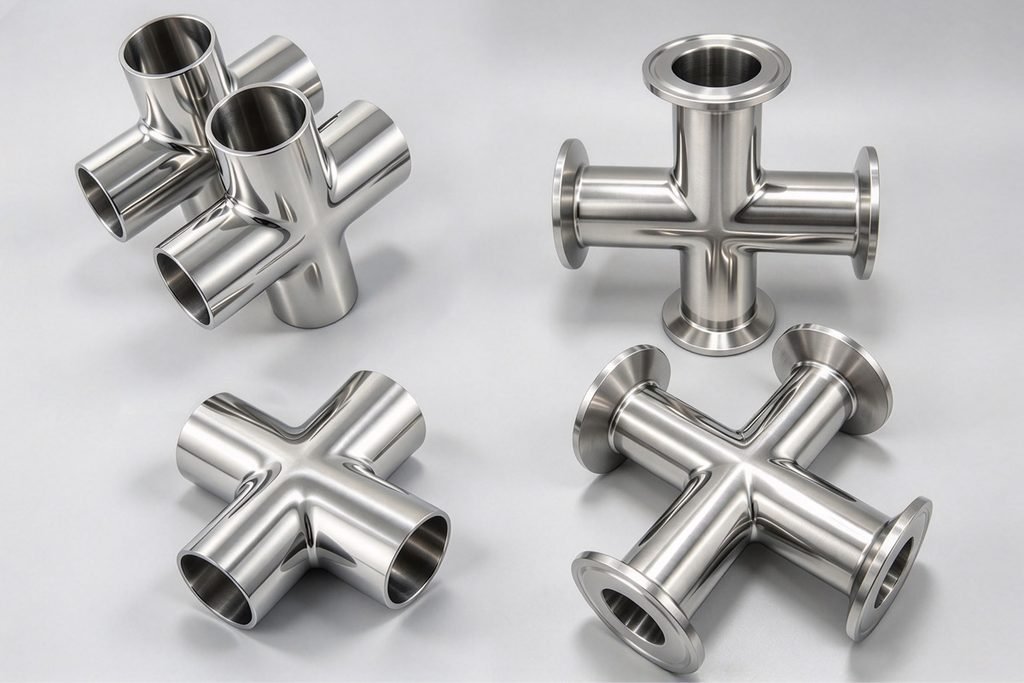
One important selection decision is whether to use a removable quick-clamp connection or a permanent welded connection.
Both methods can be suitable for sanitary piping systems, but they serve different installation and maintenance requirements.
Quick-Clamp Four-Way Cross
A sanitary quick-clamp cross typically uses Tri-Clamp connections at its four ends. Each connection is assembled with compatible ferrules, a gasket, and a clamp.
The main advantage is that the connection can be opened without cutting or rewelding the pipe.
A quick-clamp four-way cross is particularly useful when:
- The fitting may need to be removed for inspection.
- The connected equipment requires regular maintenance.
- The piping layout may be modified in the future.
- The system uses modular equipment assemblies.
- Access to the connection is important for cleaning or servicing.
However, the gasket and clamp must be compatible with the operating conditions. Correct assembly and regular inspection are also important.
Welded Four-Way Cross
A welded four-way cross is designed to be permanently joined to the surrounding stainless steel piping through welding.
It is generally more suitable for fixed pipeline sections where frequent disassembly is not expected.
A welded connection may be preferred when:
- The piping route is already finalized.
- The fitting is part of a permanent pipeline installation.
- Routine removal of the fitting is not required.
- The system design favors continuous welded pipe sections.
Weld quality is an important consideration. Poor welding can create internal irregularities, surface defects, or areas that are difficult to clean. Hygienic welding procedures and appropriate inspection are therefore necessary.
Which Connection Should You Choose?
| Selection factor | Quick-Clamp | Welded |
|---|---|---|
| Connection type | Removable | Permanent |
| Disassembly | Convenient | Requires cutting or rework |
| Maintenance access | Easier | More difficult |
| System modification | More flexible | Less flexible |
| Installation | Clamp and gasket assembly | Requires welding |
| Typical use | Modular or serviceable sections | Fixed piping sections |
In practical sanitary piping systems, the two connection methods can also be used together.
For example, a facility may use welded pipe sections for long, fixed pipeline runs while using quick-clamp connections around filters, valves, pumps, and fittings that may need to be removed.
The choice should depend on the function and maintenance requirements of each pipeline section rather than applying one connection method throughout the entire system.
What Should You Consider When Selecting a Four-Way Cross?
Before choosing a sanitary four-way cross fitting, consider the following points.
1. Equal or Reducing Cross
An equal cross has four connection ends of the same nominal size. It is suitable when all connected pipeline sections use matching dimensions.
A reducing cross has different connection sizes and may be required when the branch lines and main pipeline have different dimensions.
Confirm the required configuration before ordering. Do not assume that all four-way crosses have identical connection sizes.
2. Tube Size and Connection Standard
Check the actual tube outside diameter and the connection standard used by the existing piping system.
For Tri-Clamp connections, confirm that the ferrule dimensions, clamp, and gasket are compatible. Nominal pipe size and clamp dimensions should not be treated as interchangeable without checking the applicable standard.
3. Material Selection
SS304 stainless steel is commonly used in many food, beverage, and general sanitary processing applications.
For more demanding corrosive environments, SS316L may be considered depending on the process fluid, cleaning chemicals, temperature, and operating conditions.
Material selection should be based on the actual application rather than the industry name alone.
4. Surface Finish and Cleanability
The internal surface condition can affect product retention and cleaning performance.
When selecting a sanitary cross fitting, consider:
- Internal surface finish
- Weld quality, if applicable
- Internal geometry around the junction
- Drainage and installation orientation
- Compatibility with the cleaning procedure
A sanitary connection alone does not guarantee that the complete pipeline will be easy to clean. The surrounding piping layout also matters.
5. Operating Conditions
Confirm the process temperature, working pressure, fluid characteristics, and cleaning or sterilization requirements.
The allowable operating conditions depend on the complete assembly, including the fitting, clamps, gaskets, connected pipes, and installation.
Always confirm the applicable pressure and temperature limits before use.
6. Installation Space and Maintenance Access
A four-way cross connects four pipeline sections at one location, so installation space should be considered before selecting the fitting.
Check whether there is enough room to install or remove the clamps, inspect the connections, and access nearby valves or equipment.
For removable connections, maintenance access is especially important.
Sanitary Quick-Clamp Four-Way Cross from Haoqintech
Haoqintech offers a 304 stainless steel sanitary quick-clamp four-way cross designed for hygienic piping systems.
The product features an equal four-way configuration and Tri-Clamp connections, allowing it to be assembled and disassembled with compatible sanitary clamps and gaskets.
It is suitable for applications in food processing, beverage production, dairy processing, brewing, and other sanitary process systems.
Available product options include:
- Material: 304 stainless steel
- Connection: Sanitary Tri-Clamp / Quick-Clamp
- Design: Equal four-way cross
- Available tube sizes: 3/4″ to 4″
- Application: Sanitary piping systems
For dimensions and configuration details, see our 304 SS Sanitary Quick-Clamp Four-Way Cross.
If you are planning a new piping layout or replacing an existing fitting, please confirm the tube size, connection standard, material, and operating conditions before ordering.
Frequently Asked Questions
What is the difference between a sanitary tee and a four-way cross?
A sanitary tee has three connection openings and is commonly used to create one branch from a main pipeline. A four-way cross has four openings and connects four pipeline sections at a common junction.
Is a quick-clamp four-way cross better than a welded cross?
Neither connection is universally better. Quick-clamp connections are more convenient when a fitting needs to be removed or inspected. Welded connections are generally more suitable for fixed pipeline sections where regular disassembly is not required.
Can a four-way cross be used for CIP systems?
It can be used in a CIP-compatible piping system, provided the fitting geometry, installation orientation, flow conditions, and surrounding pipeline design support effective cleaning and drainage. The fitting alone does not guarantee complete CIP coverage.
Does a four-way cross distribute fluid equally between four outlets?
Not necessarily. Flow distribution depends on the system pressure, pipe dimensions, valve positions, and hydraulic design. A cross fitting provides a connection junction, not automatic flow balancing.
Should I choose 304 or 316L stainless steel?
The choice depends on the process fluid, cleaning chemicals, temperature, and corrosion exposure. SS304 is common in many general sanitary applications, while SS316L may be more appropriate in certain more corrosive environments.
Conclusion
A sanitary four-way cross fitting provides a practical connection point for four pipeline sections in hygienic process systems.
When selecting one, consider the connection type, tube dimensions, material, internal finish, operating conditions, and maintenance requirements.
For pipeline sections that require regular access or future modification, a quick-clamp cross can offer greater convenience. For permanent installations, a welded connection may be more appropriate.
The best solution is the one that fits the actual piping layout and the operating requirements of the complete process system.