For mushroom farms planning to produce their own liquid spawn, choosing the right fermentation tank configuration is an important investment decision.
Some growers may only need a relatively small amount of liquid spawn for their current production. Others may be planning to expand their cultivation capacity over time.
In either situation, installing more fermentation tanks than necessary at the beginning can increase equipment investment and operating complexity.
A modular liquid mushroom spawn production system offers another approach: configure the number of fermentation tanks according to current production requirements, while allowing the system to expand when demand increases.
This article explains how to plan a flexible fermentation tank configuration, what to consider when using 400L tanks, and how adjustable liquid spawn dispensing can support different inoculation requirements.
1. Calculate Liquid Spawn Demand Before Selecting Fermentation Tanks
The first step is to estimate how much liquid spawn your cultivation operation requires.
A useful starting point is the number of cultivation bags produced each day and the amount of liquid spawn used for each bag.
For many commercial mushroom cultivation applications, a typical inoculation volume is approximately 25–30 mL per bag.
Using this as a planning reference:
| Daily cultivation bags | Estimated liquid spawn requirement |
|---|---|
| 500 | 12.5–15 L/day |
| 1,000 | 25–30 L/day |
| 2,000 | 50–60 L/day |
| 5,000 | 125–150 L/day |
These figures are calculated using a 25–30 mL reference volume. They are not universal inoculation recommendations. The actual quantity should be determined according to the mushroom species, strain, substrate, and cultivation process.
This calculation provides an initial estimate of daily demand. It does not yet determine the required fermentation tank volume.
To configure the tanks properly, other factors must also be considered, including batch size, fermentation duration, working volume, cleaning, sterilization, and production scheduling.
2. Why Consider 400L Fermentation Tanks?
A 400L stainless steel fermentation tank can serve as one modular unit in a liquid mushroom spawn production system.
Rather than automatically installing a large number of tanks, the configuration can be adjusted according to the customer’s production objectives.
For example:
- A farm with lower liquid spawn demand may begin with fewer fermentation tanks.
- A growing operation may add more tanks when its cultivation capacity increases.
- A larger operation may use multiple tanks to organize different production batches and schedules.
The advantage is flexibility. Customers can evaluate their initial equipment requirements without automatically committing to a much larger tank configuration than they currently need.
However, 400L refers to the nominal tank capacity, not necessarily the usable liquid volume.
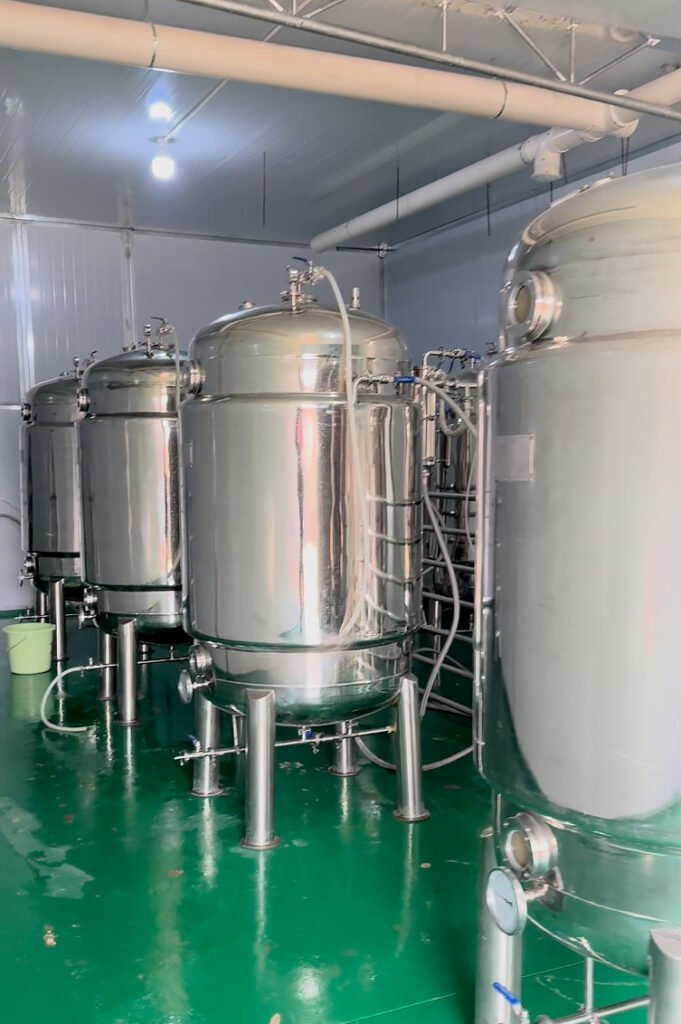
The actual working volume depends on the tank design, required headspace, aeration, mixing, and the fermentation process.
For this reason, the number of tanks should not be selected simply by dividing daily liquid spawn demand by 400L.
3. How Many Fermentation Tanks Does Your Operation Need?
The appropriate number of tanks depends on more than daily inoculation demand.
Several factors should be evaluated together:
Daily liquid spawn demand
Estimate the amount of liquid spawn required for the downstream cultivation process.
Fermentation cycle
Determine how long each batch takes to complete under the intended cultivation procedure.
Working volume
Confirm the usable liquid volume of each tank rather than relying only on its nominal capacity.
Batch scheduling
Consider how batches are prepared, fermented, transferred, and made available for inoculation.
Cleaning and sterilization
Allow for the time and equipment required to clean and prepare tanks between production cycles.
Production continuity
Consider whether the operation needs overlapping batches or reserve capacity to maintain its production schedule.
These factors help determine whether one tank or multiple tanks are more appropriate.
For example, two farms with the same daily liquid spawn demand may need different tank configurations if their fermentation cycles and production schedules are different.
The final tank quantity should therefore be determined through process planning rather than a simple volume calculation.
4. Adjustable Liquid Spawn Dispensing for Different Inoculation Requirements
The amount of liquid spawn used per cultivation bag can vary according to the production process.
For many commercial applications, 25–30 mL per bag is a common reference. However, some customers may require a different dispensing volume.
Haoqintech’s liquid spawn dispensing arrangement uses a time-controlled discharge method.
Its operating principle is based on two parameters:
- Tank internal pressure is maintained within a working range of 0.05–0.1 MPa.
- The discharge volume is adjusted by changing the dispensing time.
With this arrangement, the dispensing quantity can be adjusted within an approximate range of 5–500 mL, depending on the application requirements.
This provides flexibility for different cultivation processes without restricting the operator to a single fixed dispensing volume.
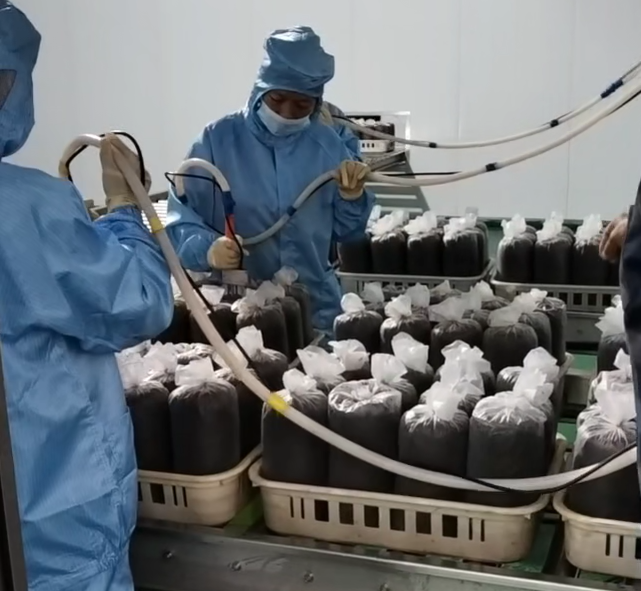
For example, a customer using a typical 25–30 mL inoculation volume can configure the dispensing time accordingly. Other applications requiring a smaller or larger quantity can be evaluated within the available adjustment range.
The actual dispensing time should be calibrated under the intended operating conditions. Consistency also depends on the liquid properties, piping arrangement, and dispensing components.
5. Do Not Overlook Supporting Utilities
Adding fermentation tanks is not simply a matter of purchasing additional vessels.
The supporting systems must also be considered.
Depending on the configuration, a liquid mushroom spawn production facility may require:
Steam supply
Used for sterilization of culture medium and process equipment, according to the selected sterilization arrangement.
Compressed air and filtration
Required for the intended fermentation aeration and other process functions. The compressor, air treatment, filtration, and distribution arrangement should be evaluated together.
Cooling capacity
Additional fermentation capacity may increase the cooling requirement. The cooling system should be checked against the actual heat load and operating schedule.
Electrical supply
Pumps, mixing equipment, compressors, controls, and other supporting machines contribute to the total electrical load.
Water and drainage
Water supply, equipment cleaning, drainage, and wastewater handling should be included in facility planning.
A modular tank configuration can make production expansion more flexible, but it does not mean the existing utility systems will automatically have enough capacity for additional tanks.
These supporting systems should be evaluated during the initial design, especially when future expansion is expected.
6. Plan for Expansion Without Rebuilding the Entire System
A modular approach is most useful when future growth is considered from the beginning.
A production facility can be planned in stages.
Initial configuration
- Install the number of 400L fermentation tanks required for the initial production target.
- Configure the necessary culture preparation and sterilization equipment.
- Provide the required air supply, cooling, and process connections.
- Select an inoculation arrangement suitable for the current operation.
Production expansion
- Add fermentation tanks as liquid spawn demand increases.
- Review steam, compressed air, cooling, and electrical capacity.
- Extend process piping and supporting equipment where necessary.
- Improve transfer and inoculation automation according to operational needs.
Further development
- Introduce more advanced process monitoring.
- Improve batch scheduling and production management.
- Evaluate additional automation where it provides practical benefits.
The initial equipment layout should therefore consider available space, piping routes, utility connections, and possible future tank positions.
This can help reduce unnecessary modifications when production capacity increases.
7. What Information Is Needed Before Configuring a System?
Before preparing a fermentation tank configuration, it is useful to understand the customer’s production process.
The following information provides a starting point:
- Intended mushroom species and strains
- Daily cultivation bag production
- Expected liquid spawn volume per bag
- Fermentation duration and batch schedule
- Required number of operating batches
- Available laboratory and preparation facilities
- Existing steam, compressed air, cooling, and electrical supply
- Desired level of automation
- Expected future production expansion
Not every customer needs to provide all these details at the beginning.
A preliminary technical discussion can help identify the missing information and evaluate a suitable starting configuration.
Conclusion: Choose the Tank Configuration Around Your Production Needs
A liquid mushroom spawn production system does not have to begin with a large number of fermentation tanks.
For growers with lower initial production requirements, a modular configuration can provide a more flexible way to establish liquid spawn production capacity.
A 400L fermentation tank can serve as one equipment option, while the number of tanks can be adjusted according to the required working volume, fermentation cycle, batch schedule, and daily production demand.
The inoculation arrangement can also be adapted to different production processes. A typical reference of 25–30 mL per bag can be used for initial planning, while the time-controlled dispensing system provides an adjustable output range of approximately 5–500 mL under a tank internal pressure of 0.05–0.1 MPa.
The key is to plan the fermentation equipment, inoculation method, utilities, and future expansion as parts of one coordinated system.
Haoqintech provides liquid mushroom spawn production equipment and integrated project solutions based on the customer’s intended mushroom species, production objectives, and site conditions.
Planning a liquid mushroom spawn production system?
Share your mushroom species, daily cultivation target, and current production setup with our team. We can discuss a suitable fermentation tank configuration and the supporting equipment required for your project.