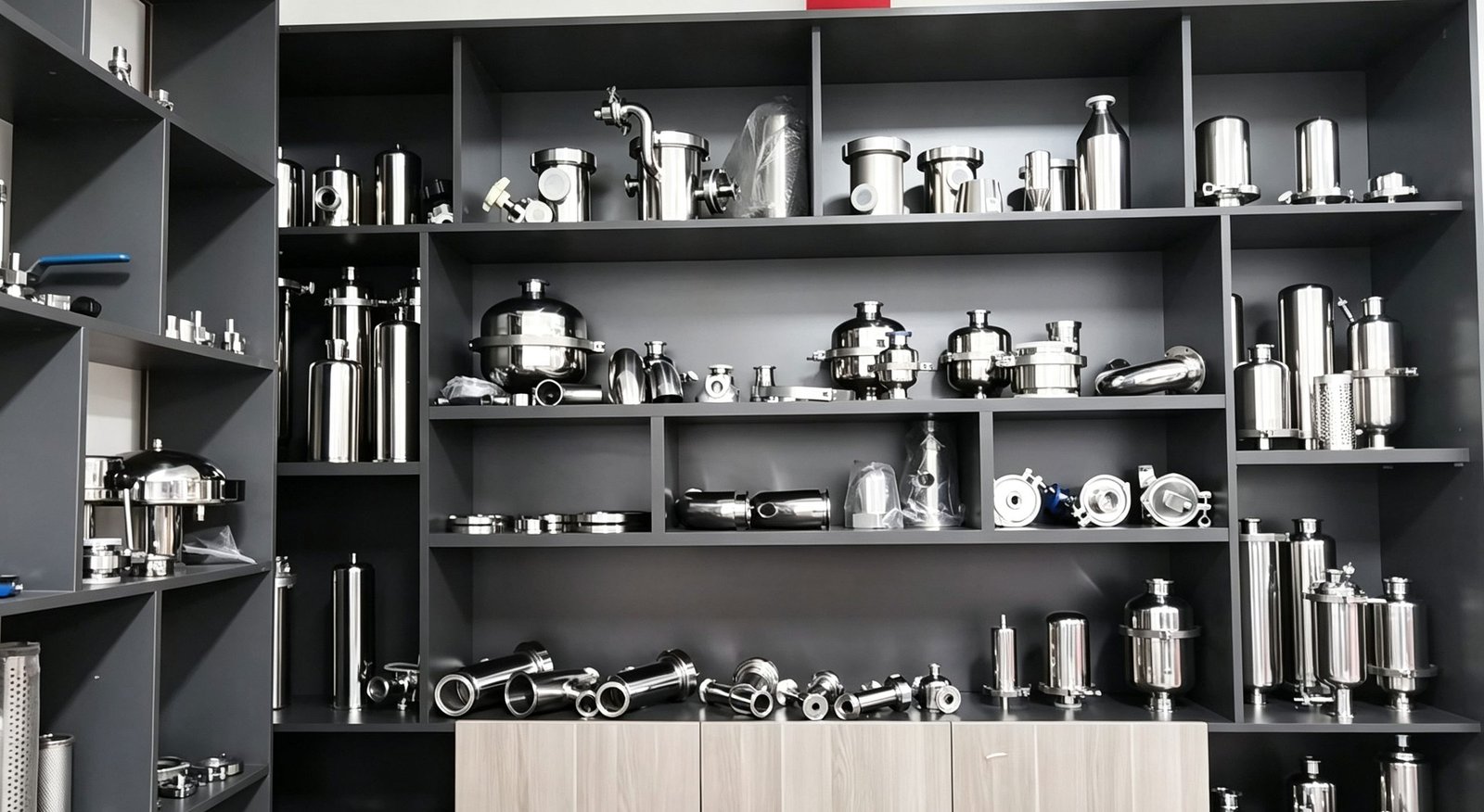
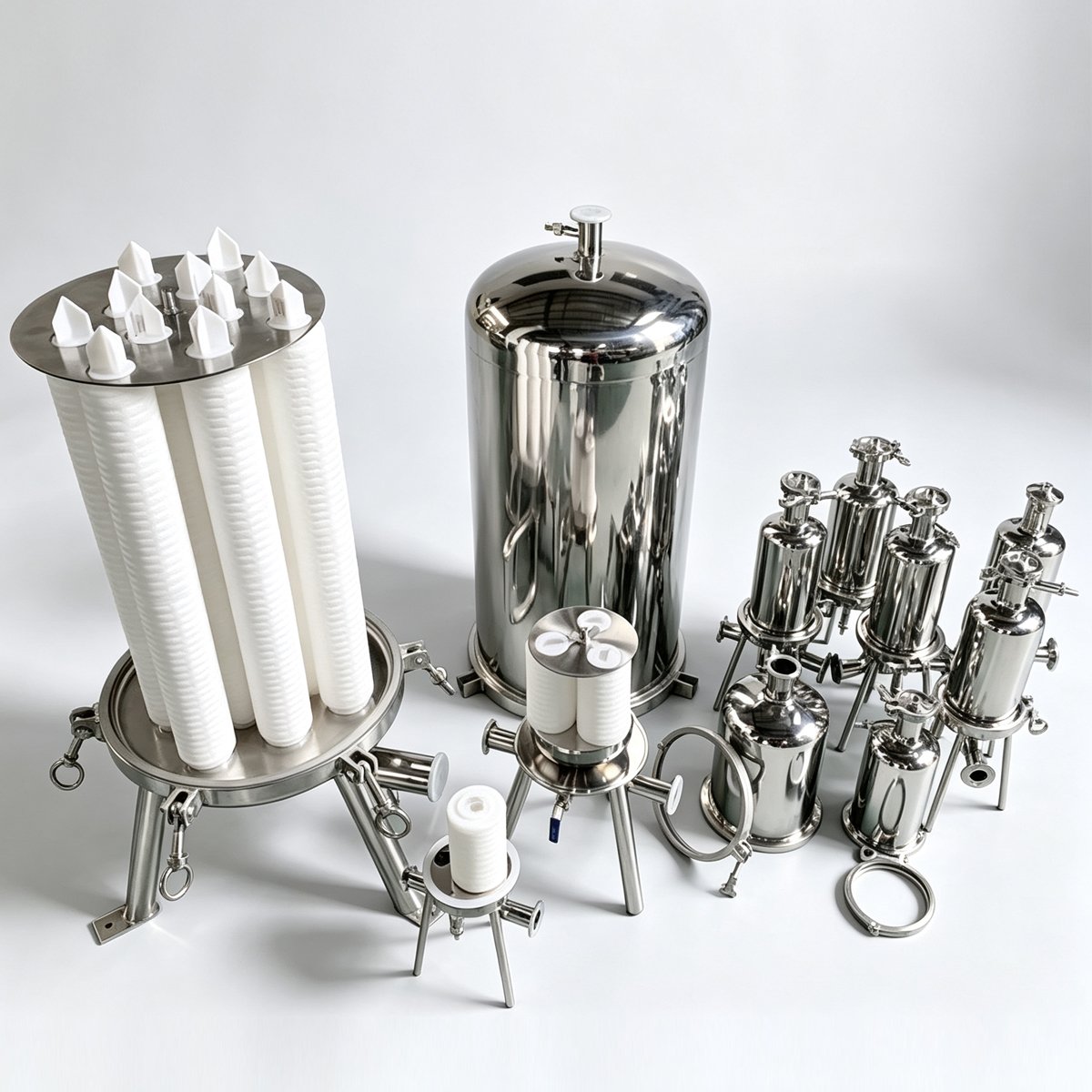
Choosing the right sanitary filter size is not simply a matter of matching the filter connection to the existing process pipe.
For hygienic liquid processing systems, the required flow rate, filtration area, fluid characteristics, filtration rating, pressure drop, and operating conditions all affect filter selection. A filter that is too small may create excessive pressure drop or require frequent cleaning, while an unnecessarily large filter can increase equipment cost and installation space.
Before sizing a sanitary filter, it is important to understand the differences between sanitary strainers, cartridge filter housings, and other filtration configurations. For a broader overview of filter and strainer selection, see our Sanitary Stainless Steel Filters & Strainers Selection Guide.
This guide explains how to approach sanitary filter sizing from an engineering perspective and what information should be considered before selecting a filter or strainer.
1. Why Flow Rate Matters When Sizing a Sanitary Filter
Flow rate is one of the first parameters to determine when selecting a sanitary filter.
For example, a process may require a continuous flow of 1,000 L/h, while another system may operate at 5,000 L/h or more. These applications cannot necessarily use the same filter configuration even if they use the same pipe connection size.
The required flow rate affects:
- Required filtration area
- Fluid velocity through the filter
- Pressure drop
- Filter loading rate
- Cleaning or cartridge replacement frequency
- Required filter housing or strainer size
It is also important to distinguish between normal flow and peak flow.
If a system normally operates at 2,000 L/h but occasionally reaches 3,000 L/h, the filter should not automatically be selected only for the normal operating point. The peak operating condition should also be considered.
Pipe size is not the same as filter capacity
A common mistake is to select a filter simply because its connection matches the process pipe.
For example, a DN25 connection does not automatically mean that every DN25 filter is suitable for every DN25 process line.
Two filters with the same connection size may have different internal structures, filtration areas, mesh sizes, cartridge configurations, and pressure-drop characteristics.
The pipe connection is therefore only one part of the selection process.
2. The Main Factors That Determine Sanitary Filter Size
Flow rate is important, but it is not the only factor.
A practical sanitary filter selection should consider the following parameters.
| Factor | Why It Matters |
|---|---|
| Flow rate | Determines the required filtration capacity |
| Peak flow | Helps prevent excessive resistance during high-flow operation |
| Filter area | Affects loading and pressure drop |
| Filtration rating | Finer filtration can increase resistance |
| Particle load | Determines how quickly the filter may become loaded |
| Fluid viscosity | Higher viscosity can increase pressure drop |
| Temperature | Can change fluid viscosity and affect material selection |
| Operating pressure | Must remain within the filter’s rated conditions |
| Connection size | Must be compatible with the process piping |
| Cleaning method | Important for CIP, manual cleaning, or cartridge replacement |
| Filter material | 304 or 316L may be selected according to the application |
The correct filter size is therefore the result of several parameters rather than one specification.
3. Filter Size vs. Filtration Area
One of the most important concepts in filter sizing is filtration area.
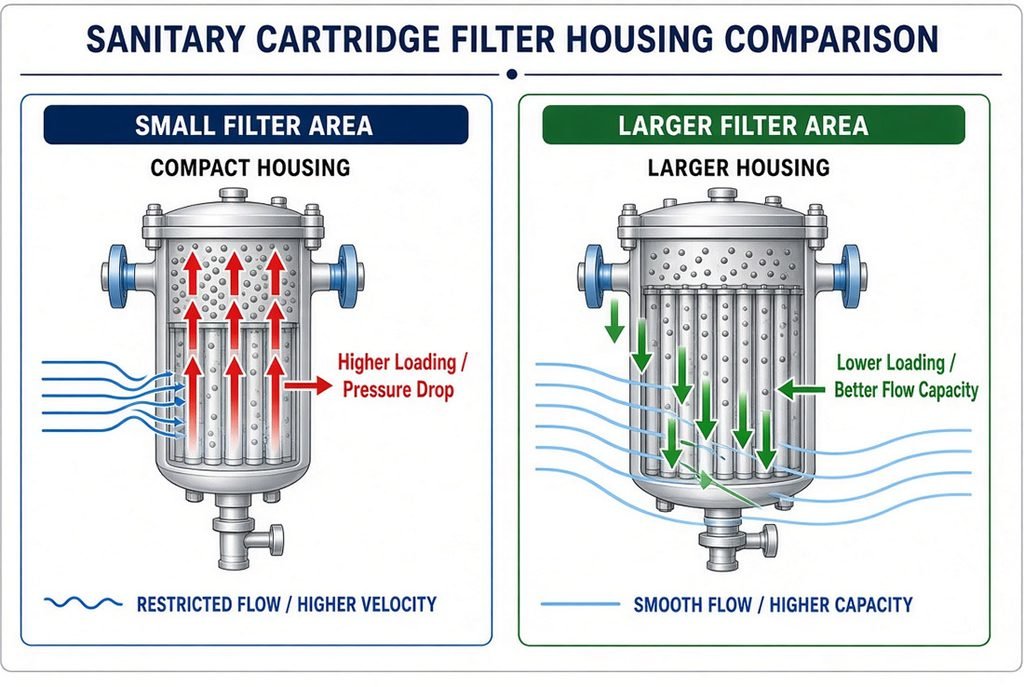
A larger filter body may provide more available filtration area, depending on its internal design. Increasing the effective filtration area can help distribute the process flow across a larger filtering surface.
This can be particularly important when the process contains a significant amount of suspended particles.
For sanitary strainers
A sanitary strainer normally uses a reusable perforated or mesh screen.
Its effective filtration performance can be influenced by:
- Screen size
- Mesh opening
- Screen surface area
- Flow rate
- Particle concentration
- Fluid viscosity
A larger screen area can help reduce the loading rate of the filtering surface under the same process conditions.
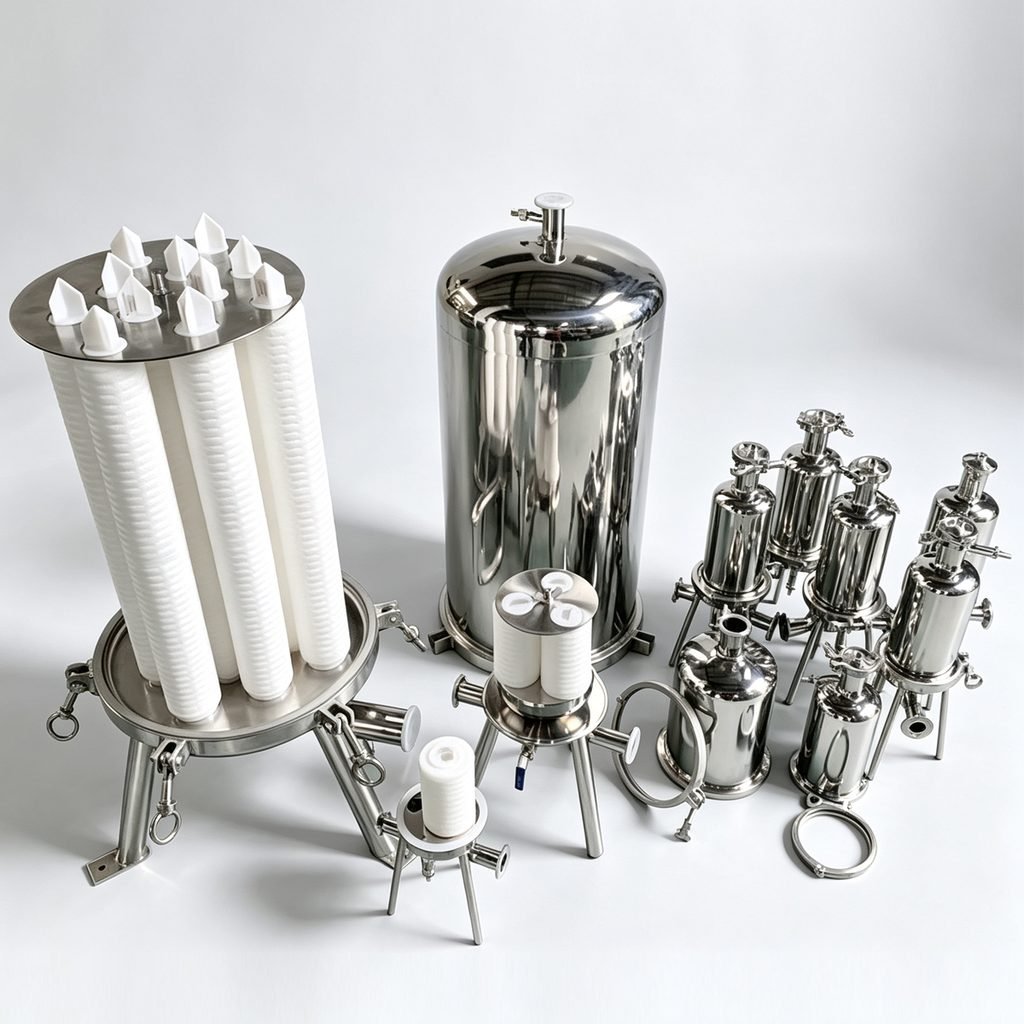
For cartridge filter housings
Cartridge filter sizing is different because the available filtration area depends on the filter cartridge configuration.
For a multi-cartridge housing, for example, the total filtration capacity is related to factors such as:
Number of cartridges × cartridge length × effective filtration area
The actual capacity still depends on the cartridge media, filtration rating, fluid, temperature, viscosity, and manufacturer performance data.
This is why cartridge housing selection should not be based only on the number of cartridges.
4. How to Estimate the Required Sanitary Filter Size
There is no single filter-sizing formula that can be applied to every hygienic process.
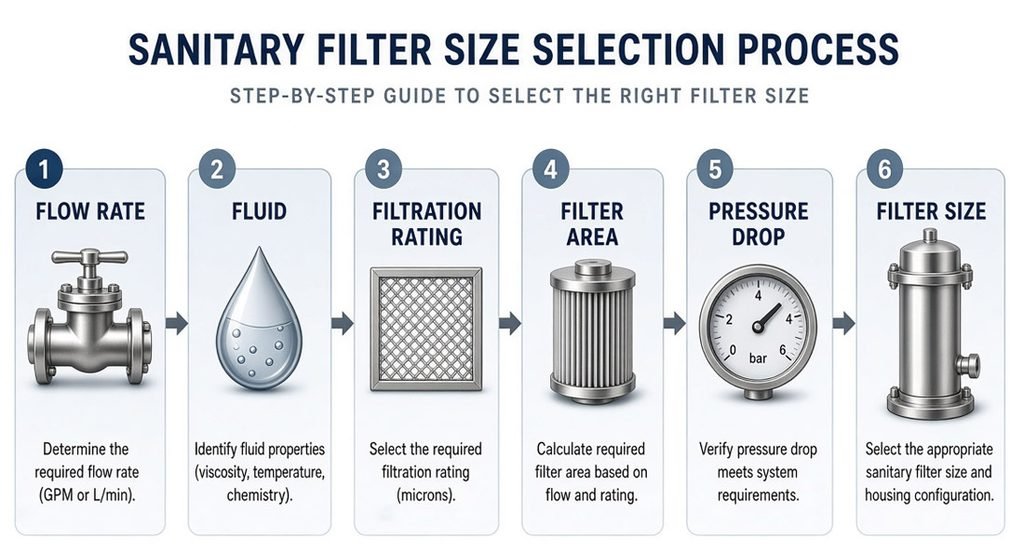
A practical selection normally starts with the following sequence.
Step 1: Determine the required flow rate
Identify:
- Normal flow rate
- Maximum or peak flow rate
- Continuous or intermittent operation
For example, a process may operate at 2,000 L/h under normal conditions but require a higher capacity during certain production stages.
Step 2: Identify the fluid
The fluid being filtered has a direct influence on filter selection.
Important information may include:
- Liquid type
- Viscosity
- Temperature
- Suspended solids
- Particle concentration
- Chemical characteristics
Water-like liquids and higher-viscosity process fluids may behave very differently through the same filter.
Step 3: Define the required filtration rating
Determine what the filter is expected to remove.
For strainers, this may involve selecting an appropriate mesh or opening size.
For cartridge filtration, the required filtration rating may be expressed in microns.
The filtration requirement should be defined according to the process objective rather than simply choosing the finest available filter.
A finer filtration rating can increase resistance and may reduce flow if the filter area is not sufficient.
Step 4: Evaluate the required filtration area
Once the flow rate and filtration requirement are known, consider how much effective filtration area is appropriate.
Higher flow rates, higher particle loads, or more demanding filtration requirements may require a larger filtration area or a different filter configuration.
For cartridge housings, this may mean increasing cartridge length or cartridge quantity.
For strainers, a larger screen area or different body configuration may be more appropriate.
Step 5: Check pressure drop
Pressure drop is an important part of sanitary filter sizing.
A filter creates resistance as fluid passes through its filtering element. Pressure drop can increase when:
- Flow rate increases
- Filtration becomes finer
- The filter becomes loaded with particles
- Fluid viscosity increases
- Available filtration area is insufficient
The filter should therefore be evaluated under realistic operating conditions rather than only at the initial clean-filter condition.
Step 6: Select the connection and body configuration
After the process requirements have been established, select the appropriate:
- Pipe connection
- Tri-Clamp size
- Filter body size
- Cartridge configuration
- Screen configuration
- Material
- Drain or vent arrangement, where required
For hygienic systems, the connection and internal configuration should also be compatible with the cleaning and maintenance requirements of the process.
5. How Pressure Drop Affects Filter Sizing
Pressure drop is one of the main reasons a filter may need to be larger than the process pipe connection alone would suggest.
Consider a simplified example.
If a filter has a relatively small effective filtration area and the process requires a high flow rate, fluid velocity through the filtering element may become high. This can increase pressure drop.
As the filter collects particles, the available flow path can become more restricted, causing the pressure drop to increase further.
This can lead to:
Higher flow → higher resistance → higher pressure drop
and, as the filter becomes loaded:
Particle loading → reduced open area → increasing pressure drop
For this reason, filter sizing should consider both the clean filter condition and the expected operating condition during the filtration cycle.
The actual pressure-drop curve should be checked against the filter manufacturer’s performance data whenever available.
6. Choosing Between a Sanitary Strainer and Cartridge Filter Housing
Filter sizing also depends on what type of filtration device is appropriate for the process.
Sanitary Strainer
A sanitary strainer is often used when the primary objective is to remove relatively larger particles or protect downstream equipment.
Typical applications include:
- Pre-filtration
- Pump protection
- Protection of valves and other components
- Removal of larger suspended particles
- Reusable filtration applications
Inline strainers and Y-strainers are common configurations in hygienic process piping.
Cartridge Filter Housing
A cartridge filter housing is generally used when a more defined filtration rating or finer filtration is required.
Typical considerations include:
- Required micron rating
- Liquid cleanliness
- Cartridge material
- Cartridge length
- Number of cartridges
- Required flow rate
- Cartridge replacement frequency
The choice between a strainer and a cartridge housing should therefore be based on the process objective rather than simply the pipe size.
7. Common Mistakes When Choosing a Sanitary Filter Size
Mistake 1: Selecting the filter only by pipe diameter
Matching the connection is necessary, but it does not prove that the filter has sufficient filtration capacity.
Mistake 2: Using only the normal flow rate
Peak flow should also be considered when the process has significant flow fluctuations.
Mistake 3: Choosing the finest filtration rating available
Finer filtration is not automatically better.
If the filtration rating is unnecessarily fine for the application, pressure drop and filter loading may increase.
Mistake 4: Ignoring fluid viscosity
A filter that performs well with water may behave differently when used with a more viscous process liquid.
Mistake 5: Ignoring particle loading
A filter may perform well when clean but experience significantly higher pressure drop after collecting particles.
Mistake 6: Selecting a cartridge housing only by cartridge quantity
Two housings with the same number of cartridges can have different performance depending on cartridge type, length, filtration rating, and operating conditions.
8. What Information Should You Provide When Requesting a Sanitary Filter?
If you are requesting a sanitary filter or strainer for a specific process, providing the following information can make the selection much more accurate:
- Required flow rate
- Maximum or peak flow rate
- Fluid being filtered
- Operating temperature
- Operating pressure
- Fluid viscosity, if known
- Required filtration rating
- Expected particle load
- Existing pipe size
- Connection type
- 304 or 316L material requirement
- CIP or cleaning requirements
- Continuous or intermittent operation
For cartridge filtration, it is also useful to specify the required cartridge length and whether the system should use a single-cartridge or multi-cartridge configuration.
The more complete the process information, the easier it is to determine whether a particular filter configuration is suitable.
9. Sanitary Filter Sizing: A Practical Selection Workflow
For a quick engineering review, the selection process can be summarized as:
Flow Rate
↓
Fluid Characteristics
↓
Required Filtration Rating
↓
Particle Load
↓
Required Filtration Area
↓
Pressure Drop
↓
Filter / Strainer Configuration
↓
Connection & Material
↓
Cleaning & Maintenance Requirements
This approach is more reliable than selecting a filter based on pipe diameter alone.
10. Need Help Selecting a Sanitary Filter?
For a sanitary filter or strainer used in food, beverage, dairy, pharmaceutical, fermentation, liquid culture, or other hygienic fluid-processing applications, the required filter size should be evaluated according to the actual process conditions.
At Haoqintech, we supply sanitary stainless steel filters, strainers, filter housings, and related components in 304 and 316L stainless steel configurations.
When requesting a filter recommendation, provide your flow rate, fluid, filtration requirement, pipe size, operating conditions, and cleaning requirements. These parameters allow the appropriate filter configuration and connection size to be evaluated for the application.