A sanitary T-port 3-way ball valve provides a compact way to manage fluid connections in hygienic process piping. Instead of installing multiple separate valves and fittings for every routing arrangement, a three-way valve can bring several pipe connections together in one valve body.
For food, beverage and dairy processing systems, the valve must be selected not only for its connection size but also for material compatibility, piping layout, cleaning requirements and the intended operating arrangement.
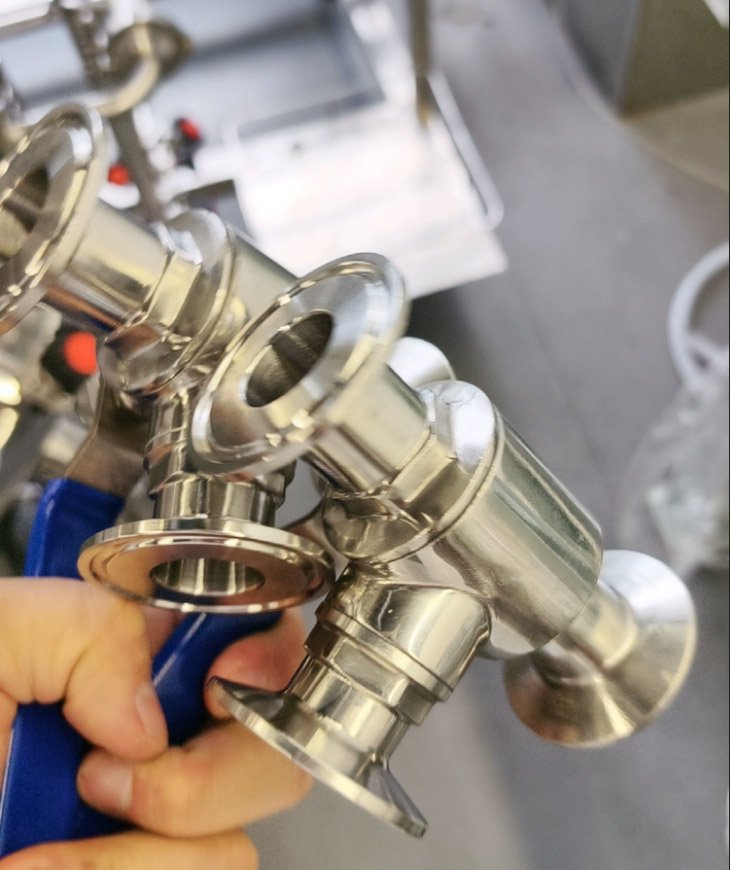
Haoqintech supplies a sanitary T-port 3-way ball valve with three Tri-Clamp connections, a manual lever handle, and 304 or 316 stainless steel options. This guide explains the product’s main features, available sizes, material considerations and the information buyers should confirm before ordering.
What Is a Sanitary T-Port 3-Way Ball Valve?
A three-way ball valve has three connection ports and an internal ball that controls communication between the connected flow paths. In a T-port design, the internal passage has a T-shaped configuration.
The actual flow paths available depend on the internal port geometry and the valve’s permitted handle positions. These details should be confirmed using the manufacturer’s valve diagram rather than assumed from the product name alone.
When evaluating a T-port valve, buyers should check:
- The internal flow-path diagram.
- The permitted handle positions.
- Which ports communicate in each position.
- Whether the required routing arrangement matches the process piping design.
These checks are particularly important when the valve is being integrated into an existing process line or an automated production system.
Three Tri-Clamp Connections for Hygienic Piping
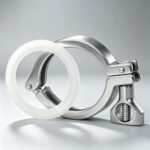
This valve has three Tri-Clamp connections, allowing it to be connected to compatible sanitary process piping using the appropriate clamps and gaskets.
Tri-Clamp connections are widely used in hygienic processing because they can be disassembled for inspection, maintenance and cleaning. However, compatibility depends on matching the actual connection dimensions and the associated components.
Before ordering, confirm:
- The required pipe outside diameter and corresponding clamp size.
- The dimensions of all three valve connections.
- Compatibility with the existing clamps and gaskets.
- Available installation space for the valve body and manual handle.
- Whether the valve can be accessed conveniently for operation and maintenance.
Do not select a valve based only on a nominal size label. Verify the connection standard and dimensions against the actual piping system.
304 vs. 316 Stainless Steel: Which Material Should You Choose?
The Haoqintech sanitary T-port 3-way ball valve is available in both 304 and 316 stainless steel options.
Both grades are used in industrial equipment, but they are not interchangeable in every process environment. The appropriate choice depends on the fluid, cleaning chemicals, operating conditions and the plant’s material requirements.
304 Stainless Steel
304 stainless steel is a common option for general food and beverage processing equipment. It may be suitable where the fluid and cleaning environment are compatible with the material.
When evaluating 304 stainless steel, consider the composition of the product being processed, the cleaning procedure and any material requirements specified by the plant.
316 Stainless Steel
316 stainless steel offers improved resistance to certain corrosive environments compared with 304, particularly in environments involving chlorides. Actual suitability still depends on the concentration, temperature, exposure time and other operating conditions.
It may be worth considering when the process fluid or cleaning environment places greater demands on corrosion resistance.
How to Make the Choice
Do not choose a material solely because one grade is generally described as more corrosion-resistant. Review the actual process conditions and confirm the material requirements with your engineering or quality team.
If the equipment is intended for a regulated or validated production process, verify any applicable material documentation and customer specifications before purchase.
Available Sizes and Material Options
The sanitary T-port 3-way ball valve is available in nine size options, with both 304 and 316 stainless steel versions.
| Available size | Material options |
|---|---|
| Φ19 | 304 / 316 stainless steel |
| Φ25 | 304 / 316 stainless steel |
| Φ32 | 304 / 316 stainless steel |
| Φ38 | 304 / 316 stainless steel |
| Φ51 | 304 / 316 stainless steel |
| Φ63 | 304 / 316 stainless steel |
| Φ76 | 304 / 316 stainless steel |
| Φ89 | 304 / 316 stainless steel |
| Φ102 | 304 / 316 stainless steel |
These are the available product size options. Before ordering, confirm the dimensional convention used for the selected size and its compatibility with the pipe and Tri-Clamp connection standard at your facility.
The required size should be determined from the actual piping dimensions and process design, rather than from the nominal diameter alone.
Manual Operation and Installation Considerations
The valve uses a manual lever handle. This provides a direct way for an operator to position the valve, but the permitted operating positions and corresponding flow paths must be verified for the specific valve design.
During installation planning, consider the following:
Handle clearance: Allow enough space to move and operate the handle without interference from nearby pipes, supports or equipment.
Flow-path verification: Check the manufacturer’s port diagram and confirm that the valve’s permitted positions meet the intended process requirements.
Connection alignment: Make sure the three connections match the piping layout and that the valve can be installed without introducing unnecessary strain into the pipework.
Gasket and clamp compatibility: Use compatible connection components and follow the equipment manufacturer’s installation guidance.
Cleaning and maintenance access: Ensure that the valve can be accessed for inspection and servicing. Confirm the applicable cleaning procedure and disassembly requirements with the supplier.
The correct installation depends on the specific valve design and the requirements of the process line. Do not assume a particular flow arrangement or cleaning procedure without checking the manufacturer’s documentation.
Applications in Food, Beverage and Dairy Processing
Sanitary three-way valves may be considered for hygienic liquid-processing lines where several pipe connections need to be managed within a compact installation.
Potential application areas include:
- Food-processing liquid transfer lines.
- Beverage production and ingredient handling.
- Dairy processing equipment.
- Hygienic process piping and associated utility arrangements, where the valve is suitable for the service.
The presence of a Tri-Clamp connection does not, by itself, establish that a valve is suitable for every hygienic or sanitary application. Suitability also depends on the wetted materials, seals, surface finish, cleaning requirements and process conditions.
For applications with strict hygiene, regulatory or validation requirements, confirm the relevant documentation and product specifications before selecting the valve.
What to Confirm Before Ordering
To reduce the risk of ordering an incompatible valve, buyers should confirm the following information with the supplier:
- Required size: Identify the correct size from the existing piping dimensions.
- Material grade: Select 304 or 316 stainless steel according to the process and cleaning environment.
- Connection dimensions: Verify all three Tri-Clamp connections against the required connection standard.
- Flow-path arrangement: Request the manufacturer’s diagram showing the permitted handle positions and corresponding port connections.
- Seal specifications: Confirm the seal material and compatibility with the process fluid and cleaning chemicals.
- Operating conditions: Request the applicable pressure and temperature limits for the exact valve configuration.
- Cleaning and maintenance: Confirm the recommended inspection, cleaning and servicing procedure.
- Documentation requirements: Identify any material certificates or other documents required by the facility.
Pressure ratings, temperature limits, seal materials and flow-path positions should be confirmed for the specific product configuration. They should not be inferred from general descriptions of three-way ball valves.
Frequently Asked Questions
What is the difference between a T-port and an L-port 3-way ball valve?
The main distinction is the geometry of the internal ball passage. A T-port has a T-shaped passage, while an L-port has an L-shaped passage. Their available flow arrangements and permitted operating positions can differ. Always check the manufacturer’s port diagram before choosing between them.
Is this valve available in both 304 and 316 stainless steel?
Yes. The listed product options include both 304 and 316 stainless steel in sizes Φ19, Φ25, Φ32, Φ38, Φ51, Φ63, Φ76, Φ89 and Φ102.
Does the valve use Tri-Clamp connections?
Yes. All three connections are specified as Tri-Clamp. Buyers should still verify the exact connection dimensions and compatibility with the clamps, gaskets and piping at the installation site.
Can the valve be used in food and dairy processing?
It may be suitable for compatible hygienic liquid-processing applications. Final suitability depends on the actual fluid, cleaning conditions, wetted materials, seals and required documentation. Confirm these details before use.
What pressure and temperature can the valve withstand?
The applicable limits have not been specified in this guide. Request the manufacturer’s pressure and temperature ratings for the exact size, material and configuration before selecting the valve.
Conclusion
A sanitary T-port 3-way ball valve can provide a compact option for managing multiple connections in hygienic process piping. When selecting one, buyers should evaluate the internal flow arrangement, Tri-Clamp connection dimensions, stainless steel grade, seal compatibility and operating conditions together.
Haoqintech offers this valve in 304 and 316 stainless steel, with nine available size options and three Tri-Clamp connections. For help matching a size and material to your piping requirements, contact our team with your required dimensions, process fluid and application details.
View the product: Sanitary T-Port 3-Way Ball Valve