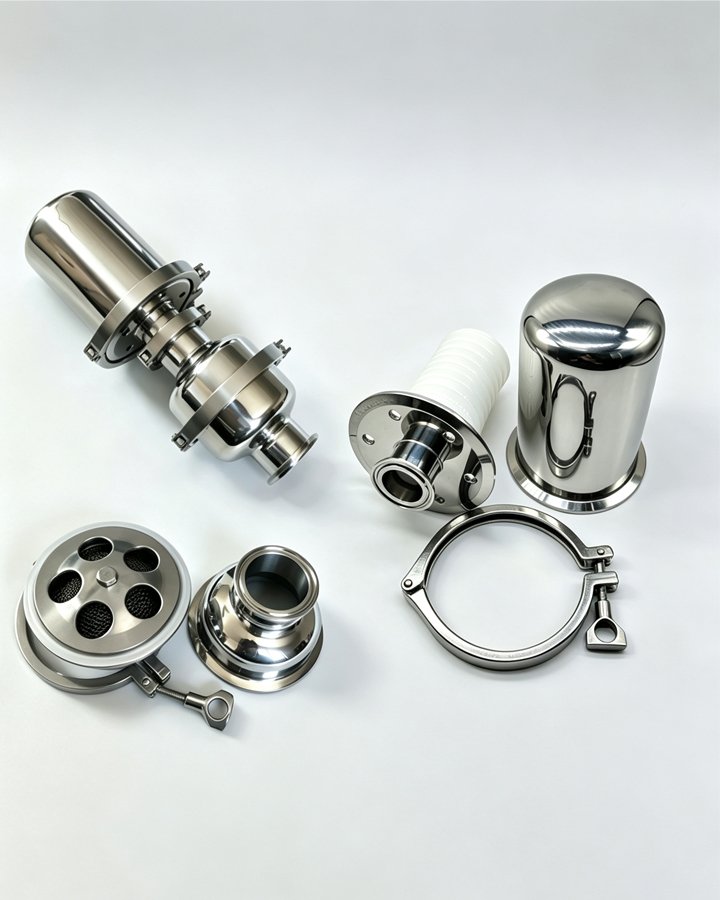
Tank breather filters and breather valves are both used on tanks and process vessels, but they are designed to perform different functions.
A tank breather filter primarily focuses on air filtration and contamination protection, while a breather valve primarily focuses on controlling pressure and vacuum conditions inside the tank.
In some sanitary processing systems, these components may be used separately. In other applications, a system may require both filtration and pressure protection.
Understanding the difference can help you select the appropriate tank venting solution for your process.
What Is a Tank Breather Filter?
A tank breather filter, also called a tank vent filter or sanitary breather filter, allows air to enter or leave a tank while helping prevent airborne particles and contaminants from entering the vessel.
When liquid is added to a tank, the displaced air needs to leave. When liquid is removed, air needs to enter to compensate for the change in internal volume.
The breather filter provides a controlled path for this air exchange while filtering the air passing through the system.
Sanitary tank breather filters are commonly used in food, beverage, pharmaceutical, fermentation and other hygienic processing applications.
What Is a Breather Valve?
A breather valve is primarily a pressure-control device.
It is designed to help protect a tank from excessive positive or negative pressure by allowing gas or air to enter or leave the vessel when predetermined pressure conditions are reached.
Depending on the design, a breather valve may provide:
- Pressure relief
- Vacuum relief
- Controlled tank venting
- Protection against excessive internal pressure
- Protection against excessive vacuum
The valve’s primary function is therefore pressure and vacuum management, rather than fine air filtration.
Tank Breather Filter vs. Breather Valve
The easiest way to understand the difference is to look at their primary functions.
| Feature | Tank Breather Filter | Breather Valve |
|---|---|---|
| Primary function | Air filtration and tank breathing | Pressure and vacuum control |
| Air filtration | Yes, depending on filter element | Not normally the primary function |
| Pressure control | Limited / application dependent | Primary function |
| Vacuum protection | Application dependent | Primary function |
| Contamination protection | Yes | Not its primary purpose |
| Filter element | Usually included | Usually not the main component |
| Common use | Hygienic air exchange | Tank pressure protection |
The two components therefore solve different process requirements.
How Does a Tank Breather Filter Work?
A tank breather filter provides a filtered path for air movement.
Consider a process tank during filling.
As liquid enters the vessel, the air volume inside the tank decreases. The displaced air must escape through the venting system.
During discharge, the opposite occurs. As liquid leaves the vessel, air needs to enter to compensate for the reduction in liquid volume.
A breather filter allows this air exchange while helping prevent airborne contaminants from entering the tank.
For more information about selecting a tank breather filter, see:
[How to Choose a Sanitary Tank Breather Filter for Your Process Tank]
You can also read:
[How to Choose the Right Tank Breather Filter Size: 2.5″, 5″ or 10″?]
How Does a Breather Valve Work?
A breather valve operates according to pressure or vacuum conditions.
When the internal tank pressure reaches the valve’s specified pressure setting, the valve can open to release pressure.
When the internal pressure drops below the specified vacuum setting, the valve can open to allow air or gas to enter.
This provides a means of protecting the tank against pressure conditions that could otherwise affect the vessel.
The actual operating principle and pressure settings depend on the specific valve design and process requirements.
Can a Tank Breather Filter Replace a Breather Valve?
Not necessarily.
A tank breather filter and a breather valve are designed for different purposes.
A breather filter is primarily concerned with air filtration and contamination control, while a breather valve is primarily concerned with pressure and vacuum protection.
Whether one component can be used without the other depends on the tank design, operating conditions and process requirements.
For example, a hygienic process may require filtered incoming air but may also need dedicated pressure and vacuum protection.
In such a system, the two functions should be considered separately.
Can a Breather Valve Replace a Tank Breather Filter?
A breather valve should not automatically be considered a replacement for a tank breather filter.
A valve can control the movement of air or gas according to pressure conditions, but pressure control and air filtration are different functions.
If contamination control is an important part of the process, an appropriate filtration solution may still be required.
This is particularly relevant for sanitary applications where maintaining hygienic conditions is important.
When Is a Tank Breather Filter Commonly Used?
Tank breather filters are particularly relevant when the process requires controlled air exchange and protection against airborne contamination.
Typical applications include:
- Food processing tanks
- Beverage tanks
- Pharmaceutical process vessels
- Fermentation tanks
- Liquid culture systems
- Hygienic storage tanks
- Sanitary process vessels
The filter configuration should be selected according to the required airflow, filtration rating, tank conditions and connection requirements.
Haoqintech offers sanitary Tri-Clamp tank breather filter configurations in 2.5″, 5″ and 10″ filter lengths.
Need help choosing the right filter size?
Read our guide to compare 5″, 10″ and 20″ tank breather filters and find the right configuration for your application.
When Is a Breather Valve Commonly Used?
Breather valves are generally considered when controlling tank pressure and vacuum is an important requirement.
They can be used on:
- Storage tanks
- Process tanks
- Hygienic vessels
- Fermentation systems
- Chemical processing equipment
- Other vessels requiring controlled pressure or vacuum relief
The required valve configuration depends on the vessel design and operating conditions.
What About a Flame Arrester?
A flame arrester is another type of tank venting and safety component.
Its primary purpose is different from both a tank breather filter and a standard breather valve.
A flame arrester is designed to help prevent flame propagation through a gas or vapor path under applicable operating conditions.
For tanks or process systems where flammable gases or vapors may be present, flame arresters can form part of the overall venting and safety design.
Some products combine breather valve and flame arrester functions into one assembly.
For example, a sanitary breather valve with a flame arrester may provide pressure/vacuum control together with flame protection.
See also:
[Sanitary Tri-Clamp Flame Arrester: Solving Flame Flashback and Pressure Risks in Hygienic Process Systems]
Tank Breather Filter, Breather Valve and Flame Arrester: Three Different Functions
These three components can be understood by their main purpose:
| Component | Main Purpose |
|---|---|
| Tank Breather Filter | Filter air entering or leaving the tank |
| Breather Valve | Control tank pressure and vacuum |
| Flame Arrester | Help prevent flame propagation |
In some systems, more than one function may be required.
For example, a process tank may require filtered air for hygienic protection while also requiring pressure/vacuum protection.
The final configuration should therefore be determined from the complete process requirements rather than selecting a component based only on its name.
How to Choose the Right Tank Venting Solution
Before selecting a tank breather component, consider the following:
1. What Is the Main Requirement?
Is the primary requirement:
- Air filtration?
- Pressure relief?
- Vacuum relief?
- Flame protection?
- Or a combination of these functions?
2. What Is the Process?
Food, beverage, pharmaceutical, fermentation and chemical processes can have different requirements.
The process conditions should determine the appropriate materials, connections, filtration and pressure-control configuration.
3. What Are the Operating Conditions?
Consider:
- Tank volume
- Filling rate
- Discharge rate
- Operating pressure
- Vacuum conditions
- Temperature
- Gas or vapor characteristics
- Required filtration level
4. What Connection Is Required?
Sanitary systems commonly use hygienic connection methods such as Tri-Clamp connections.
The connection size and configuration should match the tank nozzle and piping system.
5. Is Flame Protection Required?
If the process involves potentially flammable gases or vapors, flame protection requirements should be evaluated separately.
A flame arrester may be required depending on the process and system design.
Choosing the Right Component
There is no single component that is suitable for every tank venting application.
A tank breather filter is generally selected when filtered air exchange and contamination protection are important.
A breather valve is generally selected when pressure and vacuum control are required.
A flame arrester is selected when flame propagation protection is part of the system requirements.
In some applications, these functions may need to work together.
The best configuration should therefore be based on the tank, process, airflow, pressure conditions and safety requirements.
Related Haoqintech Products
Haoqintech provides sanitary stainless steel components for tank venting, air filtration and hygienic process systems.
Tank Breather Filters
- [2.5″ 304 SS Sanitary Tri-Clamp Tank Breather Filter]
- [5″ 304 SS Sanitary Tri-Clamp Tank Breather Filter]
- [10″ 304 SS Sanitary Tri-Clamp Tank Breather Filter]
- [304 Sanitary Breather Filter Housing with 226 Cartridge]
Breather Valves and Flame Arresters
- [304 SS Sanitary Breather Valve with Flame Arrestor]
- [304 SS Sanitary Dual-Element Flame Arrester Breather Valve]
These products can be configured for different sanitary processing and tank venting requirements.
Conclusion
Tank breather filters and breather valves are related to tank venting, but they serve different primary functions.
A tank breather filter focuses on filtered air exchange and contamination protection, while a breather valve focuses on pressure and vacuum control.
A flame arrester provides another function by helping prevent flame propagation where applicable.
Understanding these differences makes it easier to determine which components may be required for a particular tank or process system.
For sanitary applications, the final selection should consider the complete process requirements, including airflow, filtration, pressure, vacuum, connection type, materials and safety requirements.
Need Help Selecting the Right Tank Venting Component?
Not sure whether your application requires a tank breather filter, breather valve, flame arrester, or a combination of components?
Send Haoqintech your tank and process requirements, and our team can help you identify a suitable configuration.
For a faster quotation or technical recommendation, provide details such as:
- Tank volume
- Filling and discharge rate
- Operating pressure and vacuum
- Required filtration level
- Connection size and type
- Process temperature
- Gas or vapor conditions
- Required quantity