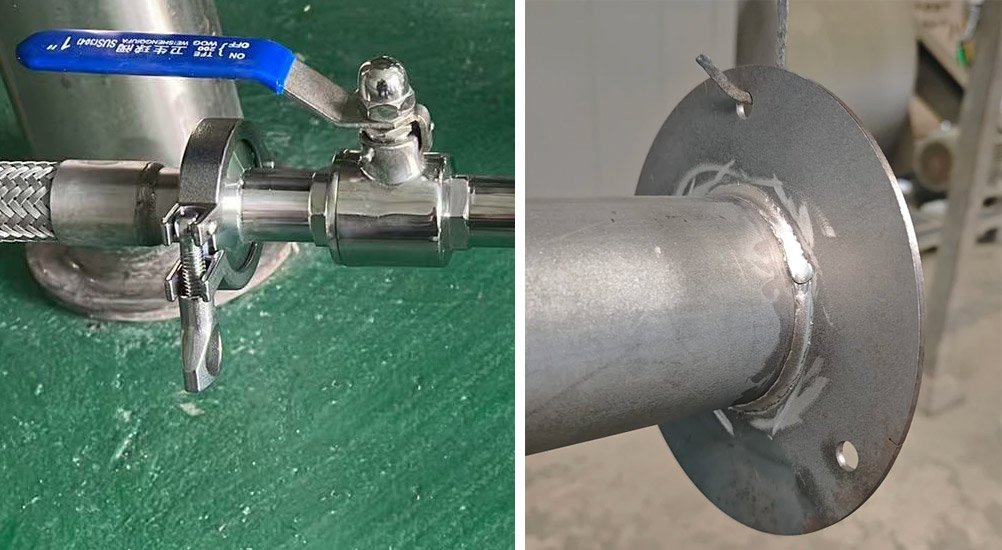
In a hygienic piping system, the connection method affects much more than how two components are joined.
The choice between Tri-Clamp and welded connections can influence equipment access, maintenance, cleanability, CIP performance, system modification, installation time, and long-term operating convenience.For another common connection-method comparison, see our guide to Tri-Clamp vs. Threaded Connections.
For this reason, there is no universal rule that says a hygienic process system should use only Tri-Clamp connections or only welded connections.
In many practical sanitary systems, both methods are used together.
A typical system may use permanently welded pipe sections while using Tri-Clamp connections around filters, valves, pumps, tanks, and other components that may need to be removed or serviced.
This article explains the practical differences between Tri-Clamp and welded connections and how to choose the appropriate connection method for different parts of a hygienic piping system.
Tri-Clamp vs Welded Connections: The Basic Difference
The main difference is whether the connection is intended to be removable or permanent.
A Tri-Clamp connection normally uses:
- Two sanitary ferrules
- A hygienic gasket
- A Tri-Clamp
- A clamping mechanism
The connection can be opened without cutting or welding the piping.
A welded connection, by contrast, creates a permanent mechanical joint by welding the stainless steel components together.
This makes welded piping particularly useful for fixed process lines where components are not expected to be frequently removed.
The practical difference can be summarized as:
| Feature | Tri-Clamp Connection | Welded Connection |
|---|---|---|
| Connection type | Removable | Permanent |
| Disassembly | Easy | Requires cutting or additional work |
| Equipment access | Convenient | More difficult |
| Maintenance | Suitable for frequent access | Better for fixed installations |
| Installation | Relatively fast | Requires welding |
| System modification | Easier | More involved |
| Fixed piping runs | Possible | Often preferred |
| Component replacement | Convenient | More difficult |
| CIP compatibility | Good when properly designed | Good when properly welded |
| Long-term system changes | Flexible | Less flexible |
However, this comparison is only the starting point.
The correct choice depends on where the connection is located and what function it performs within the system.
Tri-Clamp Connections: Where They Work Best
Tri-Clamp connections are particularly useful where components may need to be removed, inspected, replaced, or reconfigured.
This is common around sanitary process equipment such as:
- Sanitary filters
- Filter housings
- Strainers
- Valves
- Pumps
- Tank outlets
- Sampling points
- Instrument connections
- Removable process equipment
- Temporary or modular piping sections
For example, a sanitary filter housing may require regular cartridge replacement or inspection.
Using a removable Tri-Clamp connection allows the housing or connected piping section to be opened without cutting the pipe.
This can significantly simplify maintenance.
Easy Equipment Removal
One of the main advantages of Tri-Clamp connections is accessibility.
If a component needs to be replaced, the operator can disconnect the clamp, separate the sanitary connection, inspect the gasket and component, and reconnect the system.
This is especially useful when the process contains components that require regular maintenance.
Flexible System Modification
Tri-Clamp connections can also make a sanitary process system easier to modify.
For example, a manufacturer may later need to:
- Add a filter
- Replace a valve
- Change a pump
- Add an instrument
- Modify a tank connection
- Change the piping route
A removable connection can make these changes easier than modifying a fully welded piping section.
Welded Connections: Where They Work Best
Welded connections are commonly used for fixed sections of sanitary piping where frequent disassembly is not required.
A properly executed hygienic weld can provide a continuous stainless steel connection with no mechanical clamp or gasket at the welded joint.
This can be particularly useful for:
- Long fixed piping runs
- Permanently installed process lines
- Fixed tank piping
- Structural piping sections
- Areas where components are not expected to be removed frequently
For a permanent installation, welding can provide a clean and stable connection with fewer removable components.
However, the quality of the welding process becomes important.
Poor welding practices can create problems such as:
- Rough internal surfaces
- Weld irregularities
- Contamination
- Poor drainage
- Localized corrosion
- Areas that are more difficult to clean
Therefore, choosing welded construction does not automatically guarantee better hygienic performance.
The welding quality and overall piping design still matter.
Tri-Clamp vs Welded Connections: Engineering Comparison
The best way to choose between the two connection methods is to look at the actual operating requirements of the system.
1. Installation
Tri-Clamp connections can generally be installed without on-site welding.
This can be useful when equipment needs to be assembled quickly or when the piping system is modular.
Welded connections require appropriate welding equipment, qualified procedures, preparation, and inspection.
For large fixed piping systems, welding may be practical and efficient once the system layout has been finalized.
For modular equipment assemblies, Tri-Clamp connections can provide greater installation flexibility.
2. Maintenance
Maintenance is one of the clearest differences between the two methods.
A Tri-Clamp connection can be opened relatively easily when access to a component is required.
For example:
Filter → Tri-Clamp → Valve
can be disconnected without cutting the pipe.
A fully welded connection does not provide the same level of accessibility.
If a welded component needs to be removed, the pipe generally has to be cut and subsequently repaired or rewelded.
Therefore:
Frequent maintenance → Tri-Clamp is usually more convenient.
Permanent installation → Welding may be more appropriate.
3. Cleanability
Both Tri-Clamp and welded connections can be suitable for hygienic processing systems when properly designed.
The connection method itself is not the only factor determining cleanability.
Other important factors include:
- Internal surface condition
- Drainability
- Pipe orientation
- Dead-leg control
- Gasket design
- Internal geometry
- Welding quality
- Flow conditions
- CIP procedure
A welded connection eliminates a removable gasket at the welded joint, but the weld itself must be properly executed.
A Tri-Clamp connection introduces a gasket and mechanical joint, so the connection needs to be correctly assembled and maintained.
Therefore, neither connection should automatically be considered “more hygienic” without considering the complete piping design.
4. CIP Cleaning
CIP, or Cleaning-in-Place, is an important consideration in hygienic process systems.
A well-designed CIP system should allow cleaning solution to reach relevant internal surfaces and drain effectively after cleaning.
For both welded and Tri-Clamp piping, designers should consider:
- Flow velocity
- Drainability
- Pipe orientation
- Connection geometry
- Dead legs
- Gasket position
- Internal surface condition
- Equipment configuration
Tri-Clamp connections can be particularly useful around equipment that may need to be removed or isolated from the process.
Welded piping can be advantageous for fixed sections where the process layout is stable.
The key point is that CIP performance depends on the complete hygienic system design rather than simply choosing one connection method.
5. SIP and Sterilization
In systems that use steam-in-place or other high-temperature sanitation procedures, the connection method must be selected together with the requirements of the equipment and gasket materials.
Tri-Clamp connections can be used in systems requiring frequent access, provided the selected components and gaskets are appropriate for the operating conditions.
Welded connections may be useful for fixed piping sections where permanent installation is preferred.
The important consideration is not simply whether the connection is welded or clamped.
The entire system must be designed for the required temperature, pressure, cleaning and sterilization conditions.
6. Equipment Replacement
This is another area where Tri-Clamp connections can provide a practical advantage.
Consider a sanitary filter housing installed in a process line.
If the housing is connected using Tri-Clamp connections, the housing can be removed from the piping system without cutting the pipe.
This can make future replacement or upgrading easier.
For a permanently welded component, replacement normally requires more extensive modification.
Therefore, components with a predictable maintenance or replacement cycle are often good candidates for removable hygienic connections.
7. System Expansion and Modification
Process systems often change after installation.
A production line may later require:
- Additional filtration
- A different valve
- A new sampling point
- A larger pipe
- A new tank
- Additional instrumentation
- A modified process route
Tri-Clamp connections can make these modifications easier because components can be disconnected and rearranged.
Welded piping provides a more permanent installation and may require additional fabrication work when the process layout changes.
This makes the distinction especially important for pilot plants, small production systems, modular skids, and facilities that are expected to expand.
A Critical Point: Weld Ferrule + Tri-Clamp Is Not a Fully Welded Connection
This distinction is important when discussing sanitary piping.
A weld ferrule is normally welded to the pipe.
However, the equipment connection created by the ferrule, gasket, and clamp remains removable.
For example:
Pipe → Weld Ferrule → Gasket → Tri-Clamp → Equipment
The ferrule is permanently welded to the pipe, but the equipment can still be disconnected at the Tri-Clamp joint.
This is different from:
Pipe → Welded Connection → Equipment
where the components are permanently joined by welding.
This hybrid approach is very common in hygienic process systems because it combines the advantages of both methods.
The piping can have permanently welded sections while important equipment connections remain removable.
Where to Use Tri-Clamp Connections in a Hygienic System
Tri-Clamp connections are particularly useful at points where equipment access is important.
Typical examples include:
Filters and Strainers
Filters and strainers may require inspection, cleaning, mesh replacement, or cartridge replacement.
A removable connection simplifies this work.
Valves
Sanitary valves may need maintenance or replacement.
Tri-Clamp connections can make valve removal much easier than cutting a permanently welded valve out of the process line.
Pumps
Pump connections may need to be disconnected for maintenance or replacement.
Removable sanitary connections can reduce the amount of piping modification required.
Tank Connections
Tank outlets, process connections, and removable equipment interfaces may benefit from Tri-Clamp connections when access is required.
Instruments and Sampling Points
Instrumentation and sampling equipment may require periodic inspection or replacement.
A removable sanitary connection can provide greater flexibility.
Where Permanent Welding Makes More Sense
Welding can be a strong choice for fixed sections of sanitary piping where components are not expected to be removed frequently.
Examples include:
- Long straight pipe runs
- Fixed process piping
- Permanently installed tank piping
- Structural piping sections
- Stable production lines
- Areas where frequent equipment access is not required
In these locations, permanent welded connections can reduce the number of removable joints and provide a continuous piping structure.
However, welding should be properly designed and executed for the intended hygienic service.
Tri-Clamp vs Welded: Quick Decision Guide
A simple way to approach the decision is to ask the following questions.
Will the component need regular maintenance?
Yes → Consider Tri-Clamp.
Will the component need to be replaced or upgraded?
Yes → Consider Tri-Clamp.
Is this a fixed pipe section that will rarely be modified?
Yes → Welding may be appropriate.
Is the system modular or likely to expand?
Yes → Tri-Clamp can provide useful flexibility.
Is this a long permanent piping run?
Yes → Welded construction may be preferred.
Does the connection form part of a CIP or SIP system?
Both can be suitable, but the complete system design, connection geometry, gasket selection, welding quality, drainability, and operating conditions must be considered.
How Tri-Clamp and Welded Connections Are Often Combined
In practical hygienic piping systems, the decision is often not Tri-Clamp vs welded.
It is:
Where should the piping be welded, and where should the system remain removable?
A typical process arrangement might look like:
Tank → Welded Pipe → Weld Ferrule → Tri-Clamp → Filter → Tri-Clamp → Valve → Welded Pipe → Process Equipment
This approach allows the fixed piping to remain stable while important process components can still be removed.
For example:
- Fixed pipe sections can be welded.
- Filter housings can use Tri-Clamp connections.
- Valves can use Tri-Clamp ends.
- Tank connections can use sanitary ferrules.
- Equipment that requires regular maintenance can remain removable.
This hybrid design can provide a practical balance between permanent piping integrity and maintenance accessibility.
Final Thoughts
There is no single connection method that is best for every hygienic piping system.
Tri-Clamp connections are generally valuable where flexibility, maintenance access, equipment replacement, and modular installation are important.
Welded connections are generally valuable for fixed piping sections where permanent installation and limited future modification are expected.
In many sanitary process systems, the most practical solution is to use both.
The fixed piping can be welded while filters, valves, pumps, tanks, and other serviceable components can be connected using removable sanitary Tri-Clamp connections.
The correct decision should therefore be based on the function of each connection within the complete process system, rather than choosing one connection method for the entire installation.
For sanitary food, dairy, pharmaceutical, fermentation, liquid culture, and other hygienic fluid-processing applications, connection design should always be considered together with cleanability, drainage, maintenance, process requirements, and the expected life cycle of the equipment.