A sanitary filter may perform well when processing water but struggle to maintain the required flow rate when the product changes to syrup, concentrated ingredients, or another viscous liquid.
The first assumption is often that the filter is too small. That may be true, but it is not the only possible explanation. Fluid viscosity, operating temperature, filter media resistance, available pressure, and effective filtration area all influence how a liquid moves through a filtration system.
For hygienic processing applications, selecting a filter for viscous liquids requires more than matching the pipe connection size. The filter must suit the actual product and the conditions under which the process operates.
Why a Filter That Works With Water May Struggle With a Viscous Product
Water flows relatively easily through a filter element. A more viscous liquid encounters greater resistance under otherwise comparable conditions.
This difference becomes important in food processing, dairy production, liquid ingredient handling, pharmaceutical manufacturing, and other applications where product viscosity can vary significantly.
Consider a system originally designed to filter water. If the same system is later used for a concentrated liquid, the original flow rate may no longer be achievable at the same pressure conditions. The pump may need to work harder, the pressure drop across the filter may increase, or the processing time may become longer.
The filter itself has not necessarily developed a fault. The operating conditions have changed.
The key question is whether the existing filter can deliver the required flow under the new product conditions without exceeding the system’s available pressure or operating limits.
Viscosity, Temperature, and Pressure Must Be Considered Together
Viscosity is not always a fixed property of the liquid during processing. For many liquids, viscosity changes with temperature, although the relationship depends on the product’s composition and rheological behavior.
A concentrated ingredient may flow more easily at a higher temperature than at a lower one. However, increasing the temperature is not automatically an appropriate solution. Product quality, thermal stability, cleaning requirements, and the limits of the equipment must also be considered.
Pressure is another important factor. A greater pressure differential across a filter can help drive liquid through the filter element, but the benefit depends on the system design and the element’s characteristics. Operating pressure must remain within the rated limits of the housing, filter element, seals, and connected equipment.
When a viscous liquid causes the flow rate to fall, it is useful to examine three operating conditions together:
- Actual product temperature: Is the liquid being filtered at the temperature used for the original sizing calculation?
- Available differential pressure: Is sufficient pressure available to overcome resistance across the filter and the rest of the process line?
- Required flow rate: Must the filter maintain a continuous production flow, or can the process accept a longer filtration time?
These questions help distinguish a genuine filter-sizing problem from a change in process conditions.
Filter Area Can Matter More Than Connection Size
A larger pipe connection does not automatically mean a filter has enough effective filtration area.
Connection size describes how the filter connects to the pipeline. Effective filtration area describes how much filter media is available for liquid to pass through. They are related to different aspects of the design.
When a viscous liquid passes through a filter element, insufficient effective area can contribute to high pressure drop or inadequate flow. Increasing the available filtration area may reduce the burden on each unit of media area, depending on the element design and operating conditions.
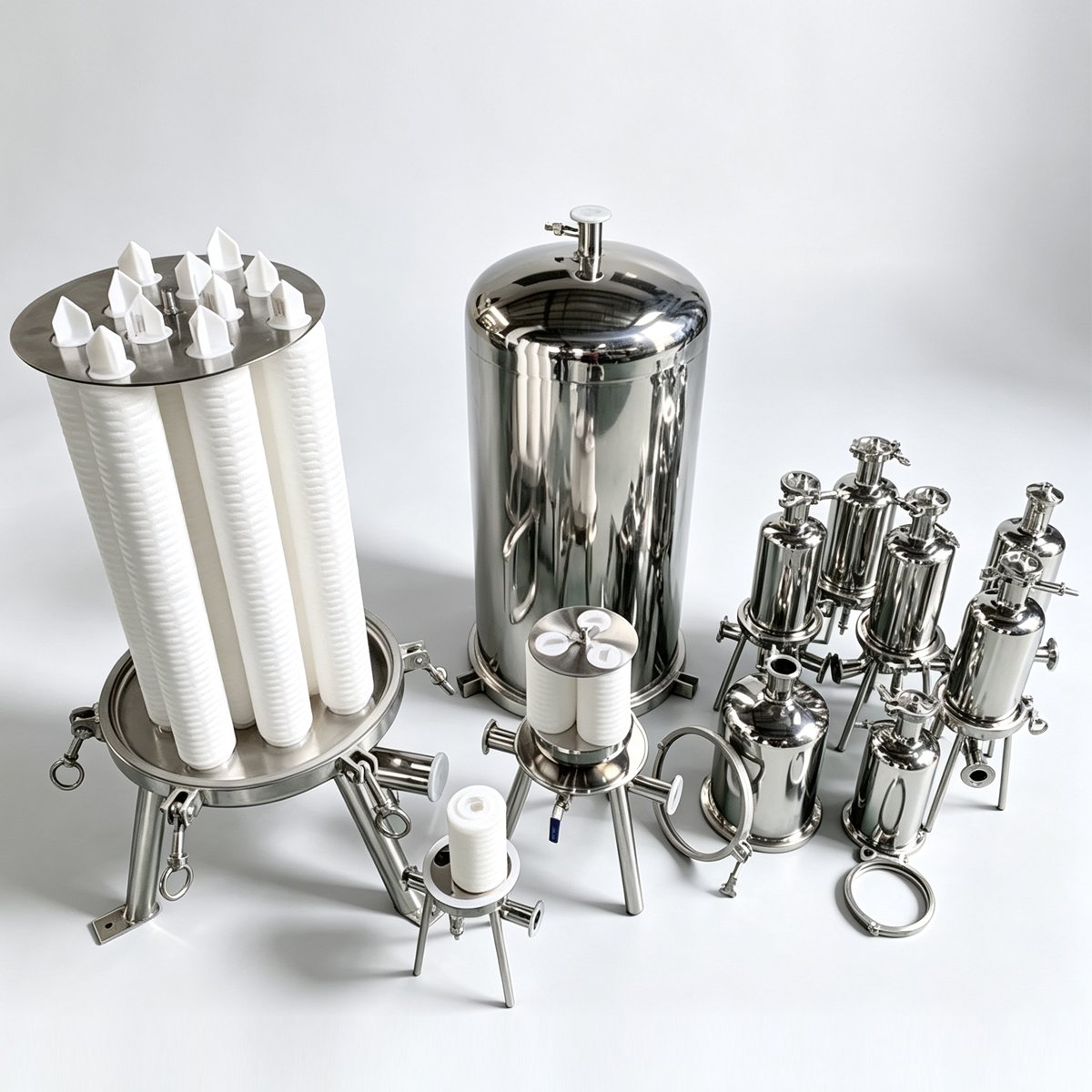
This is one reason multi-cartridge filter housings may be worth evaluating for applications that require greater throughput. Multiple elements can provide more total filtration area within a suitably designed housing.
However, simply adding cartridges does not guarantee the desired performance. The element’s permeability, filtration rating, arrangement, flow distribution, and compatibility with the product all remain relevant.
The appropriate design should be based on the required flow rate and the characteristics of the actual liquid, rather than connection size alone.
Choosing Filter Media for Viscous Liquids
The filter element must provide the required separation while allowing the product to pass through at an acceptable rate.
A finer filtration rating may be necessary when the process must remove smaller particles. However, finer media can also introduce greater flow resistance, depending on its structure and permeability. This trade-off becomes especially important when the liquid is already difficult to move.
Before specifying a filter element, clarify what the process needs to remove. Is the objective to capture visible foreign particles, protect downstream equipment, or achieve a defined level of particle removal?
These are different requirements and may call for different filtration arrangements.
For viscous products, the selection should consider:
- The required particle retention or filtration rating.
- The filter medium’s permeability and compatibility with the liquid.
- The expected amount and type of solids in the product.
- The acceptable pressure drop and required operating flow.
- The cleaning method and the possibility of product buildup on the element.
A finer element should not be selected simply because it appears to provide better filtration. It must also be capable of supporting the process’s practical flow requirements.
What Happens When the Filter Starts to Restrict Flow?
A gradual decline in flow rate does not always mean the original filter was incorrectly sized.
If the liquid contains suspended solids, these may accumulate on the filter medium during operation. As the element loads with retained material, resistance can increase and flow may decline. Viscosity can make the overall operating challenge more pronounced.
A sudden reduction in flow, on the other hand, may warrant checking for a blocked element, an obstructed pipeline, an incorrectly positioned valve, or a change in pump performance.
Before replacing the filter with a larger model, compare the current operating conditions with the original design assumptions.
Check whether the product formulation or temperature has changed, whether differential pressure has increased, whether the filter element is due for cleaning or replacement, and whether the pump can deliver the required operating conditions.
If the filter is clean but the system still cannot achieve its target flow, the original combination of filter area, media, and available pressure may not be suitable for the current product.
A Practical Approach to Selecting a Sanitary Filter for Viscous Liquids
The most reliable selection process begins with the process requirements rather than a catalogue dimension.
Start by identifying the liquid and its operating conditions. Record the product’s viscosity at the actual filtration temperature whenever possible, along with its composition and suspended-solids characteristics.
Next, establish the required flow rate and the available operating pressure. These values help determine whether the proposed filter element and housing can support the intended duty.
Then evaluate the filtration requirement. The necessary filtration rating should be based on the material being removed and the protection required downstream. Once this is clear, compare suitable filter media and available filtration areas.
Finally, consider how the equipment will be cleaned and maintained. In hygienic processing, the housing, seals, element, and product-contact materials must be compatible with the process and its cleaning procedure. The pressure and temperature ratings must also suit the intended operating conditions.
Where the liquid is strongly temperature-dependent, non-Newtonian, or otherwise difficult to characterize, a simple water-based flow estimate may be insufficient. Supplier performance data or testing under representative process conditions may be needed before finalizing the design.
For additional guidance on general flow calculations, see our article on Sanitary Filter Sizing & Flow Rate. If the main decision is whether to use a filter or a strainer, our guide to Sanitary Filter vs Strainer covers that distinction. For applications requiring greater filtration area, Single vs Multi-Cartridge Filter Housing explains the main design differences.
The Right Filter Is the One That Matches the Actual Process
Selecting a sanitary filter for a viscous liquid is not simply a matter of choosing a larger connection or a finer filter element.
The decision depends on how the product behaves at operating temperature, how much filtration area is available, what level of particle removal is required, and how much pressure the system can provide. These factors must work together to achieve a practical balance between filtration performance and production flow.
When evaluating a new application or an existing system with declining flow, begin with the actual process conditions. A filter selected around those conditions is more likely to provide reliable performance than one chosen from nominal pipe size alone.
Haoqintech supplies sanitary filtration components for hygienic process applications. To evaluate a suitable configuration, provide the liquid type, operating temperature, target flow rate, available pressure, required filtration rating, and pipeline connection size. These details help establish which options are worth considering for the application.