Dead legs in hygienic process piping are a common design concern in food processing, dairy production, beverage manufacturing, pharmaceutical processing, and fermentation systems.
A process line may use stainless steel pipes, sanitary fittings, valves, and a cleaning-in-place (CIP) system, yet certain sections can still be difficult to clean. One possible reason is the presence of a dead leg: a branch, extension, or poorly arranged section where product flow or cleaning action may be limited.
If these areas are not properly evaluated, product residues may remain after cleaning, drainage may be incomplete, and the effectiveness of the overall cleaning procedure may be reduced.
This guide explains what dead legs are, where they commonly occur, and how engineers can reduce dead-leg risks when designing or upgrading hygienic process piping.
1. What Is a Dead Leg in Hygienic Piping?
A dead leg is a section of piping or equipment that has limited product flow, insufficient cleaning action, or poor drainage compared with the main process line.
Dead legs may occur in unused branches, instrument connections, valve arrangements, sampling points, and other sections that are not adequately incorporated into the process and cleaning design.
The important issue is not simply whether a pipe section is short or long. Its geometry, connection to the main line, operating conditions, cleaning method, and ability to drain all influence its hygienic performance.
For example, a capped branch extending from a product line may retain liquid or residue if it is not properly designed and cleaned. Similarly, an instrument connection may create a difficult-to-clean area if its internal geometry is unsuitable for the process.
In hygienic system design, the objective is to minimize unnecessary stagnant sections and ensure that required connections can be cleaned and drained appropriately.
2. Why Are Dead Legs a Problem?
2.1 Product Residue May Accumulate
When product flow or cleaning action is limited, residue may remain on internal surfaces.
Depending on the product and process conditions, these residues can become difficult to remove during routine cleaning. In food, beverage, dairy, and fermentation applications, this may create an additional hygiene concern.
2.2 CIP Cleaning May Not Reach Every Surface Effectively
CIP systems circulate cleaning solutions through process equipment and piping without requiring complete disassembly.
However, installing a CIP system does not automatically guarantee that every internal surface receives adequate cleaning.
Dead-end branches, poorly positioned connections, and unsuitable valve arrangements may receive less effective cleaning action than the main process line. Cleaning effectiveness must therefore be considered during piping design and verified under the actual operating conditions.
2.3 Drainage May Be Incomplete
A hygienic piping system should be designed with appropriate drainage for its intended process.
If a branch or low point retains liquid after the process or cleaning cycle, residual moisture and product material may remain in the system. This is particularly important when the process requires controlled hygienic conditions or when the equipment must be prepared for a subsequent production batch.
2.4 Maintenance and Troubleshooting Can Become More Difficult
Dead legs are not always easy to identify during routine operation. If cleaning results are inconsistent, maintenance personnel may need to inspect connection geometry, valve arrangements, drainage, and cleaning coverage.
Addressing these issues during the design stage is generally more practical than trying to correct them after the piping system has been installed.
3. Where Do Dead Legs Commonly Occur?
Several locations deserve attention during hygienic piping design and inspection.
Unused Branch Connections
Unused branches can create stagnant sections when they extend from the main process line without a clear operational purpose.
Several locations deserve attention during hygienic piping design and inspection.
Where possible, remove unnecessary branches from the design. If a connection is required for future expansion, evaluate how it will be isolated, protected, cleaned, and drained.
Instrument and Sensor Connections
Temperature, pressure, and other process instruments may require connections to the product line.
The connection geometry should be appropriate for the instrument and the process. Avoid assuming that a small connection is automatically hygienic simply because its diameter is limited.
Sampling Points
Sampling points should be designed to obtain representative samples while remaining suitable for the required cleaning procedure.
A poorly positioned or unnecessarily extended sampling connection may create a difficult-to-clean section. The sampling method, valve design, connection geometry, and cleaning requirements should be evaluated together.
Valve Arrangements
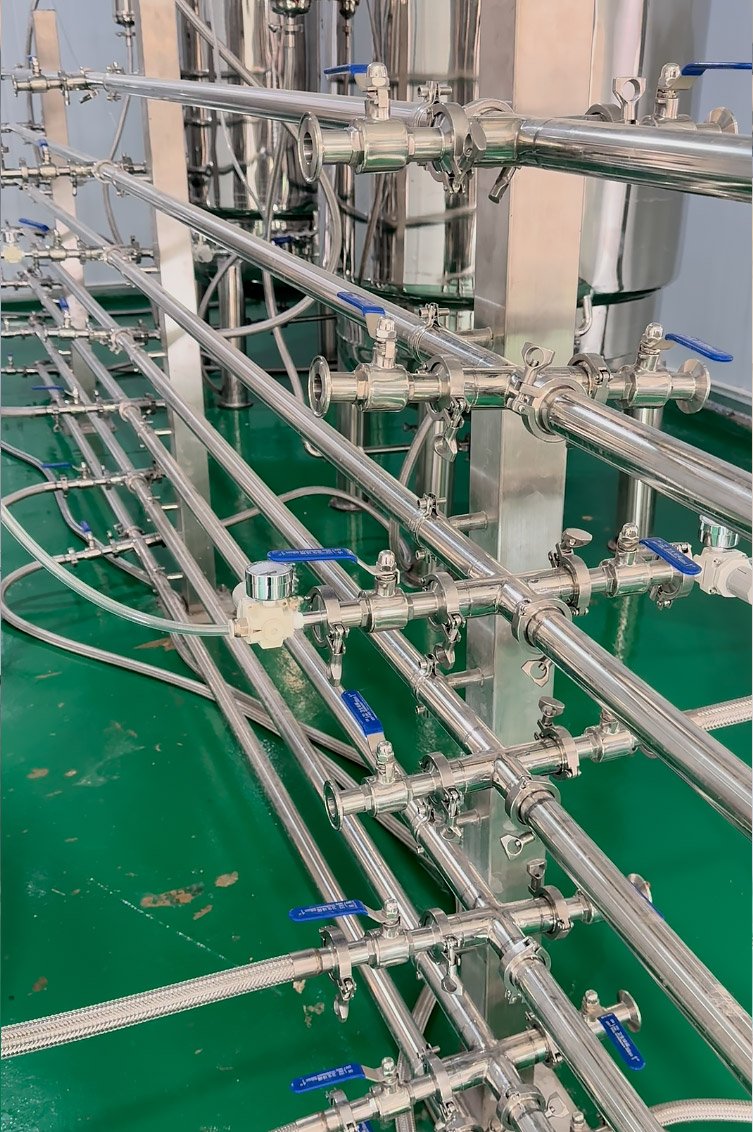
Valves control product flow, isolation, and cleaning routes. However, their installation can create branches or internal spaces that require careful hygienic assessment.
The appropriate valve type and arrangement depend on the process, product characteristics, cleaning procedure, and required level of hygienic control.
Low Points and Poorly Drained Sections
Piping sections that retain liquid after production or cleaning may present a drainage concern.
Pipe slope, support locations, equipment connections, and the overall layout should be considered together. A system that looks straightforward on a drawing may behave differently once installed.
4. How to Prevent Dead Legs in Hygienic Process Piping
4.1 Eliminate Unnecessary Branches
Start by reviewing the process flow diagram and piping layout.
Ask whether each branch is needed for production, measurement, sampling, cleaning, maintenance, or future operation. If a connection has no defined purpose, removing it may simplify the system and reduce unnecessary hygienic risks.
For connections that must remain, document their function and include them in the cleaning and maintenance assessment.
4.2 Design Required Connections for Cleanability
Not every branch can or should be eliminated. Instruments, sampling points, valves, and equipment connections may be essential.
In these cases, evaluate the connection geometry, internal surfaces, orientation, and access for inspection or maintenance. The design should support the cleaning method selected for the actual process.
Do not rely on a single dimensional rule to determine whether every connection is hygienic. Applicable standards, equipment requirements, process conditions, and validated cleaning procedures must be considered.
4.3 Evaluate CIP Coverage and Flow Paths
Review how cleaning solution enters, moves through, and leaves each relevant section of the system.
Consider whether valves are positioned correctly for the cleaning sequence, whether branches are included in the cleaning route, and whether the required flow conditions can be achieved.
Where necessary, use appropriate inspection or validation methods to confirm that the cleaning procedure is effective. Do not assume that successful cleaning of the main line proves that every branch is clean.
4.4 Provide Appropriate Drainage
Review the layout for low points and liquid-retaining sections.
Pipe orientation, slope, supports, valve placement, and equipment connections should be coordinated to support drainage. The correct arrangement depends on the installation and process requirements.
Drainability should be considered alongside cleanability rather than treated as a separate issue after installation.
4.5 Select Suitable Sanitary Components
Pipes, fittings, valves, gaskets, and instruments should be compatible with the process and cleaning conditions.
When selecting components, confirm relevant details such as:
- Material grade and chemical compatibility
- Connection dimensions and standards
- Internal geometry and surface condition
- Operating pressure and temperature requirements
- Compatibility with the intended CIP procedure
- Inspection, disassembly, and maintenance requirements
A sanitary connection alone cannot compensate for an unsuitable piping layout. Component selection and system design need to work together.
4.6 Review the System Before Fabrication
A design review before fabrication can help identify unnecessary branches, inaccessible connections, poor drainage arrangements, and difficult cleaning routes.
For new installations, review the process flow diagram and piping layout before manufacturing begins.
For existing systems, inspect the actual installation rather than relying only on drawings. Unrecorded modifications, added instruments, and temporary connections may introduce risks that were not included in the original design.
5. Dead Legs and CIP: What Should Engineers Check?
A practical review should consider the piping system as a whole.
| Inspection item | Questions to ask |
|---|---|
| Branch connections | Does every branch have a clear purpose? |
| Instrument ports | Is the connection suitable for the instrument and cleaning method? |
| Sampling points | Can the sampling connection be cleaned as required? |
| Valve arrangement | Are all relevant internal areas included in the intended cleaning sequence? |
| Pipe layout | Are there unnecessary stagnant sections or liquid-retaining low points? |
| Drainage | Can the system drain appropriately after processing and cleaning? |
| Cleaning verification | Is there evidence that the cleaning procedure works under actual operating conditions? |
| Documentation | Are drawings and operating procedures consistent with the installed system? |
This checklist can support design reviews, maintenance inspections, and discussions between equipment suppliers and process engineers.
The appropriate acceptance criteria should be defined for the specific industry, product, equipment, and applicable hygienic design requirements.
6. Common Mistakes to Avoid
Assuming Stainless Steel Automatically Means Hygienic
Stainless steel is widely used in hygienic processing, but material selection alone does not guarantee a hygienic installation. Connection geometry, surface condition, fabrication quality, drainage, and cleaning performance also matter.
Assuming CIP Solves Every Cleaning Problem
CIP is a cleaning method, not a guarantee that every part of a system is cleanable. Branches and connections must be included in the cleaning design and verification process.
Applying One Dead-Leg Ratio to Every Application
Dead-leg dimensions are sometimes discussed using simple length-to-diameter ratios. However, a single ratio should not be treated as a universal acceptance criterion for all hygienic systems.
Engineers should consult the standards and guidelines applicable to their industry and evaluate the actual connection geometry, cleaning method, and process risk.
Adding Connections Without Updating the Design
New instruments, sampling ports, bypasses, and temporary branches may change the hygienic characteristics of an existing installation.
Any modification should trigger a review of cleanability, drainage, and the cleaning procedure.
7. How Sanitary Piping Components Fit Into the Overall Design
Sanitary piping depends on multiple components working together.
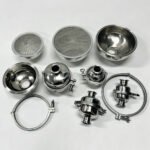
Tri-Clamp connections may be useful where equipment needs to be removed or inspected. Welded connections may be appropriate for permanent piping sections when fabrication and finishing are properly controlled. Valves provide process isolation and flow control, while filters and other inline components need to be installed in locations compatible with the process and cleaning requirements.
The choice of an individual component should therefore be based on more than connection size or purchase price.
Engineers should consider how the component affects the complete process route, cleaning access, drainage, maintenance, and compatibility with the intended operating conditions.
For additional background, see our related guides:
- Tri-Clamp vs Welded Connections in Hygienic Piping Systems
- Sanitary Weld Ferrule vs. Concentric Reducer: When to Use Each
- Rotary vs. Fixed Spray Balls: How to Choose the Right Sanitary Tank Cleaning Nozzle
These topics address different aspects of hygienic connections, piping components, and tank cleaning. They should be considered together when evaluating a complete process system.
8. Final Checklist for Hygienic Piping Design
Before approving a new installation or modifying an existing process line, confirm that:
- Unnecessary branches and stagnant sections have been identified.
- Required instrument, valve, and sampling connections have been reviewed for cleanability.
- CIP flow paths and cleaning sequences account for relevant branches and components.
- The piping layout supports appropriate drainage.
- Materials, connections, and internal surfaces are suitable for the application.
- Applicable standards and project-specific hygienic requirements have been reviewed.
- Cleaning effectiveness is verified using methods appropriate to the process.
- As-built drawings and maintenance procedures reflect the installed system.
These checks help engineers identify potential problems early and reduce the risk of relying on cleaning procedures that cannot adequately address the actual piping arrangement.
Conclusion
Preventing dead legs in hygienic process piping begins with good system design. Unnecessary branches should be eliminated where practical, required connections should be designed for cleanability, and drainage and CIP performance should be evaluated as part of the complete installation.
Stainless steel materials and sanitary fittings are important, but they are only part of the solution. The overall piping geometry, component arrangement, cleaning procedure, and verification process determine whether a system is suitable for its intended hygienic application.
Haoqintech supplies sanitary stainless steel fittings, filters, valves, tank-cleaning components, and related equipment for hygienic fluid-processing applications. If you are reviewing a process piping layout or selecting components for a new project, share your application, connection requirements, or drawings with our team for a preliminary component review.