In commercial liquid mushroom spawn production, transferring liquid culture from a fermentation tank to an inoculation unit is an important part of the production process.
The transfer system must do more than move liquid from one piece of equipment to another. It must support stable delivery, maintain appropriate hygienic conditions, minimize residual liquid and reduce the risk of contamination between production stages.
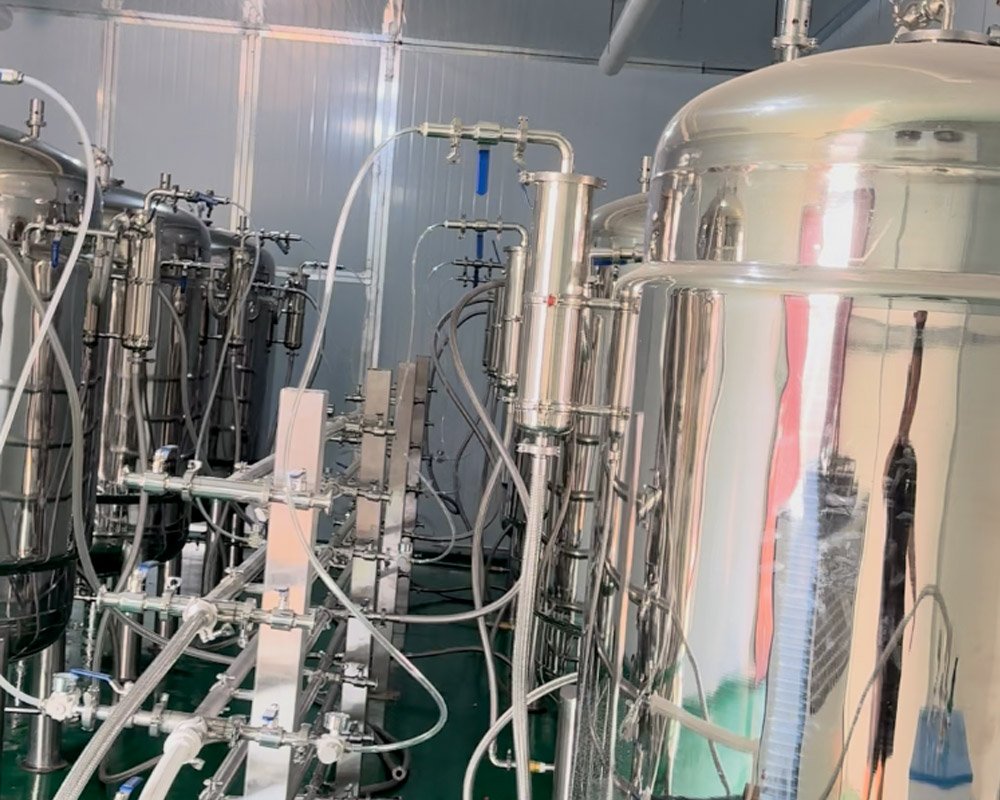
For small and medium-sized liquid spawn production facilities, a pressure-driven transfer arrangement can be a practical solution. In this configuration, pressure inside the fermentation tank pushes the liquid culture through a sanitary flexible hose and toward the downstream dosing or inoculation equipment.
However, the performance of this arrangement depends on several details: hose construction, internal diameter, connection quality, installation layout, residual liquid management and the compatibility of the hose with the intended cleaning and sterilization procedures.
This article explains the engineering considerations involved in designing and managing a pressure-driven liquid spawn transfer system.
1. Understanding the Liquid Spawn Transfer Process
A liquid spawn production line typically includes several stages, from culture preparation and sterilization to fermentation, transfer and inoculation.
Once fermentation is complete and the liquid culture is ready for use, it must be transferred from the fermentation tank to the inoculation equipment.
One possible arrangement uses pressure inside the fermentation tank as the driving force.
The basic process is:
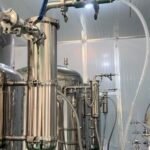
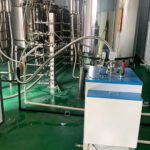
Fermentation Tank → Sanitary Flexible Hose → Dosing or Inoculation Unit
In this arrangement:
- The fermentation tank provides the pressure needed to move the liquid culture.
- The flexible hose connects the tank outlet to the downstream equipment.
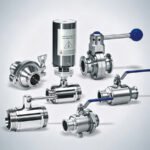
- Tri-Clamp connections provide removable sanitary connections at the equipment interfaces.
- The downstream dosing unit controls the amount delivered during each inoculation cycle.
Unlike a system that relies on a separate transfer pump, this arrangement uses the pressure already available inside the fermentation tank.
The design must therefore consider the relationship between tank pressure, liquid properties, hose dimensions and the resistance of the downstream components.
2. How Pressure-Driven Liquid Spawn Transfer Works
In a pressure-driven transfer system, the pressure inside the fermentation tank creates the force that moves liquid culture through the outlet and connected hose.
The actual flow rate is influenced by several factors:
- Pressure inside the fermentation tank
- Internal diameter of the hose
- Total hose length
- Number and type of bends
- Internal surface condition
- Valves, connectors and other restrictions
- Viscosity and physical characteristics of the liquid culture
- Resistance from the downstream dosing equipment
A larger internal diameter generally reduces flow resistance, but selecting a hose solely on diameter is not sufficient. The hose must also be compatible with the equipment connections, required flow rate, cleaning conditions and installation space.
A hose that is unnecessarily long or has several tight bends may increase resistance and make delivery less consistent.
2.1 Tank Pressure and Dosing Time
In a time-controlled dosing arrangement, the amount of liquid delivered during each cycle depends partly on how long the outlet remains open.
For example, a fermentation system may use a controlled internal tank pressure in the approximate range of 0.05–0.1 MPa. The dosing time can then be adjusted according to the required delivery volume.
However, the relationship between time and delivered volume is not automatically constant under all operating conditions.
Changes in liquid characteristics, tank pressure, hose configuration, valve opening and downstream resistance can affect the actual delivery volume.
For this reason, dosing time should be calibrated under the intended operating conditions rather than determined from a theoretical value alone.
For more information about tank capacity, production planning and time-controlled inoculation, see our related article:
How to Plan a Modular Liquid Mushroom Spawn System with 400L Fermentation Tanks
3. Selecting a Sanitary Flexible Hose for Liquid Spawn Transfer
The flexible hose is an important connection between the fermentation tank and the inoculation equipment.
A rigid stainless steel pipe may be suitable for fixed equipment layouts. However, a flexible connection can make installation and equipment positioning easier, particularly when the tank outlet and downstream equipment are not located at exactly the same height or position.
One hose configuration used in sanitary processing applications is a stainless steel braided sanitary flexible hose with Tri-Clamp ends.
3.1 Why Use a Stainless Steel Braided Flexible Hose?
A braided flexible hose can provide several practical advantages:
Flexible equipment connection
The hose accommodates some movement and positional differences between connected equipment. This can simplify installation and reduce the need for perfectly aligned rigid piping.
Convenient connection and disconnection
When fitted with suitable Tri-Clamp ends, the hose can be disconnected for inspection, maintenance or replacement.
External mechanical protection
The stainless steel braid can provide external reinforcement and protection, depending on the hose construction.
Adaptability to different equipment layouts
Flexible connections can be useful when a production line contains tanks, dosing units and other equipment arranged within a limited space.
However, these advantages do not automatically mean that every braided hose is suitable for sterile liquid culture transfer.
3.2 The Inner Hose Material Is More Important Than the Outer Braid Alone
One important selection detail is the material of the hose’s inner layer.
The stainless steel braid is generally an external reinforcement layer. It does not necessarily come into direct contact with the liquid culture.
The inner hose material is the surface that contacts the liquid and must therefore be evaluated carefully.
Before selecting a hose for liquid spawn production, confirm:
- Inner-layer material
- Suitability for contact with the intended process liquid
- Temperature resistance
- Compatibility with the cleaning agents used
- Compatibility with the actual sterilization method
- Pressure and vacuum ratings, where applicable
- Resistance to repeated operating cycles
- Whether the hose construction is suitable for the required hygienic conditions
Different hose materials have different temperature limits, chemical compatibility and mechanical properties.
For example, a hose suitable for ordinary liquid transfer may not be suitable for repeated steam sterilization.
Therefore, the material should be confirmed from the manufacturer’s technical datasheet. The presence of a 304 stainless steel braid alone is not enough to establish the hose’s complete hygienic or sterilization suitability.
4. Tri-Clamp Connections: Small Components, Important Hygienic Details
Tri-Clamp connections are widely used in sanitary process equipment because they allow components to be connected and disconnected without permanent welding.
In a liquid spawn transfer system, Tri-Clamp ends can connect the flexible hose to the fermentation tank outlet and downstream equipment.
Although the connection is relatively simple, several details deserve attention.
4.1 Gasket Compatibility
The gasket sits between the two clamp ferrules and provides the sealing surface.
The gasket material should be compatible with:
- The liquid culture
- The operating temperature
- The cleaning chemicals
- The intended sterilization process
- The pressure conditions
A gasket that is damaged, incorrectly installed or unsuitable for the process may cause leakage or create a potential contamination concern.
4.2 Connection Surface Condition
The sealing surfaces should be clean and free from visible damage.
Scratches, deformation or accumulated residues around the connection area may affect sealing performance.
Before reconnecting a hose, inspect the ferrules and gasket rather than assuming that tightening the clamp will correct every sealing problem.
4.3 Correct Clamp Installation
The clamp should be suitable for the connection size and installed according to the component manufacturer’s recommendations.
Over-tightening should not be used as a substitute for correct gasket selection or properly aligned ferrules.
The connection should also be depressurized before disassembly. A pressurized hose or tank connection must never be opened while under pressure.
For more information about sanitary connection assembly, see:
How to Install a Tri-Clamp Connection Correctly
5. Hose Length, Bending and Installation Layout
The installation layout can influence transfer performance and hygienic management.
Even when the fermentation tank provides sufficient pressure, an unsuitable hose arrangement may create unnecessary flow resistance or make the system more difficult to inspect and maintain.
5.1 Avoid Unnecessarily Long Hoses
A longer hose creates more internal flow resistance than a shorter hose of otherwise identical construction.
Where practical, keep the connection between the fermentation tank and inoculation unit as direct as the equipment layout allows.
This does not mean that the shortest possible hose is always the best choice. The hose must still have enough length to avoid tension, excessive pulling or mechanical stress at the connections.
5.2 Avoid Tight Bends and Kinking
A flexible hose should not be bent beyond its recommended minimum bend radius.
Tight bends may restrict the internal flow path, damage the hose structure or make residual liquid more difficult to remove.
The hose should be installed without twisting, compression or unnecessary mechanical stress.
5.3 Consider Low Points and Residual Liquid
The position of the hose during and after transfer is particularly important.
If part of the hose forms a low point, liquid may remain inside after the transfer cycle.
Residual liquid can create several operational concerns:
- Uncertainty about how much liquid remains in the transfer line
- Potential changes in the condition of retained liquid over time
- Additional cleaning requirements
- Greater difficulty verifying hygienic conditions before the next production cycle
Where the process requires drainage, the installation should be evaluated to determine whether the hose can drain effectively under the intended operating arrangement.
A flexible hose should not be assumed to be self-draining simply because the tank outlet is positioned above the inoculation unit.
6. Residual Liquid and Contamination Risks
Residual liquid is one of the most important issues to consider in a liquid spawn transfer system.
After the transfer process, a small amount of culture may remain inside the hose, connectors or downstream components.
Whether this creates a significant contamination risk depends on the process conditions, the time before the next production cycle, the condition of the retained liquid and the actual cleaning or sterilization procedure.
It is therefore important to distinguish between two situations:
Liquid transfer without visible problems
A transfer operation may appear normal, with no obvious leakage or contamination symptoms. However, this does not prove that every internal surface remains sterile.
Residual liquid retained between production cycles
If liquid remains inside a hose for an extended period, its condition may change. The retained liquid and internal surfaces should therefore be considered as part of the overall contamination-control strategy.
6.1 Why the Hose Should Not Be Ignored
The fermentation tank may be properly prepared, but the transfer connection is another part of the process boundary.
Potential contamination points include:
- The hose’s internal surface
- The hose ends and ferrules
- Tri-Clamp gaskets
- Tank outlet connections
- Downstream dosing components
- Areas where liquid can accumulate
A contamination-control plan should consider the complete transfer path rather than focusing only on the fermentation tank.
6.2 When Should the Hose Be Inspected?
Inspection is particularly important when:
- Unexpected contamination is detected
- The hose has been damaged or kinked
- Leakage appears around a connection
- The hose shows signs of aging or deterioration
- The process has been interrupted for an extended period
- The hose has been exposed to conditions outside its specified operating limits
If contamination is suspected, the affected transfer components should be evaluated before being returned to production.
Simply rinsing a hose or cleaning its exterior does not establish that its internal surfaces have been adequately cleaned or sterilized.
7. Cleaning and Sterilization: Confirm the Hose’s Actual Capability
Cleaning and sterilization are not interchangeable processes.
Cleaning removes residues and other unwanted material from equipment surfaces. Sterilization is intended to eliminate viable microorganisms through a validated process.
A hose may be suitable for one cleaning method but unsuitable for another sterilization method.
For example, not every flexible hose can withstand repeated exposure to high-temperature steam. The permitted temperature, pressure, exposure time and number of cycles depend on the complete hose construction, including its inner tube, reinforcement layers and end fittings.
Before deciding whether a hose can be cleaned or sterilized in place, confirm:
- The exact inner-layer material.
- The manufacturer’s temperature and pressure ratings.
- Compatibility with the cleaning chemicals.
- Whether steam sterilization is permitted.
- Whether the hose can be adequately drained.
- Whether the end connections and gaskets are compatible with the same process.
If the hose’s specifications are unknown, do not assume that it can safely undergo steam sterilization.
A suitable procedure should be established from the manufacturer’s specifications and the actual production requirements.
8. Designing the Transfer System as Part of the Complete Production Line
A liquid spawn transfer system should not be selected as an isolated component.
Its design should be coordinated with the fermentation tank, dosing unit and downstream inoculation process.
Important considerations include:
| Design area | Questions to evaluate |
|---|---|
| Tank outlet | Is the outlet suitable for the required liquid transfer and pressure conditions? |
| Transfer pressure | Is the operating pressure controlled and within the equipment ratings? |
| Flexible hose | Are the inner material, dimensions and pressure ratings suitable? |
| Connections | Are the Tri-Clamp ferrules and gaskets compatible with the process? |
| Hose layout | Is the hose protected from kinking, tension and unnecessary bends? |
| Dosing unit | Can the required delivery volume be achieved consistently? |
| Residual liquid | Can retained liquid be minimized and managed? |
| Cleaning and sterilization | Is there a confirmed procedure suitable for every wetted component? |
| Maintenance | Can the hose, gaskets and connections be inspected and replaced when necessary? |
The transfer system should also be considered alongside the utilities and supporting equipment required by the complete production line.
For example, compressed air, steam, cooling, water and drainage may all be relevant to the overall project. Their exact roles and specifications depend on the equipment configuration.
A well-planned system should make the transfer process practical to operate, inspect and maintain, rather than simply connecting a fermentation tank to an inoculation machine.
9. Common Mistakes in Liquid Spawn Transfer System Design
Several mistakes can reduce the reliability of a transfer arrangement.
Mistake 1: Selecting a hose based only on its outer material
A stainless steel braided exterior does not identify the material or process capability of the inner tube.
Mistake 2: Assuming all flexible hoses are suitable for sterilization
Temperature and sterilization compatibility must be confirmed from the complete hose specification.
Mistake 3: Ignoring residual liquid
Liquid retained in low points, connectors or downstream components should be considered during system design.
Mistake 4: Using hose length without considering flow resistance
An unnecessarily long or poorly routed hose can affect transfer performance.
Mistake 5: Treating the fermentation tank as the only contamination-control point
The hose, gaskets, valves and dosing equipment are also part of the process pathway.
Mistake 6: Assuming that time-controlled dosing always delivers the same volume
The actual delivery volume should be calibrated under the intended operating conditions.
10. Planning a Liquid Spawn Transfer System for Your Production Project
The appropriate transfer arrangement depends on the production scale, fermentation tank configuration, inoculation requirements and equipment layout.
For a small or medium-sized production facility, the design process should begin with the required daily output and the intended inoculation volume.
The engineering team can then evaluate:
- Fermentation tank capacity and outlet arrangement
- Available tank pressure and pressure-control method
- Required transfer distance
- Hose diameter and length
- Tri-Clamp connection sizes
- Dosing equipment requirements
- Cleaning and sterilization capabilities
- Maintenance and replacement requirements
These details should be confirmed together because changing one component may affect the performance of the entire transfer arrangement.
At Haoqintech, we support liquid mushroom spawn production projects through equipment planning, system configuration, installation, commissioning and technical guidance.
Our project discussions consider the production process as a whole, from culture preparation and fermentation to liquid spawn transfer and inoculation, rather than treating the fermentation tank as a standalone machine.
Once the transfer system is connected to the inoculation equipment, the next consideration is how to deliver a consistent quantity of liquid spawn into each substrate bag. Read our guide to liquid mushroom spawn inoculation into substrate bags for more information about dosing arrangements, equipment coordination and process control.
If you are planning a liquid mushroom spawn production line, the transfer arrangement should be considered during the early equipment-planning stage.
A properly evaluated transfer system can help make the production process easier to operate, maintain and manage.
Liquid spawn transfer is one stage of a larger production process. For a broader understanding of how fermentation, temperature control, aeration, and transfer equipment work together, see our guide to the [integrated liquid mushroom spawn fermentation system].
Frequently Asked Questions
1. Why use a flexible hose instead of rigid stainless steel piping?
A flexible hose can accommodate equipment positioning differences and make certain connections easier to install or disconnect. Rigid stainless steel piping may be more appropriate for fixed layouts. The choice depends on the equipment arrangement, hygienic requirements and maintenance plan.
2. Can a 304 stainless steel braided hose be used for sterile liquid spawn transfer?
It depends on the complete hose construction. The inner tube, end fittings, gaskets, pressure rating and sterilization compatibility must all be confirmed. The 304 stainless steel braid alone does not establish that the hose is suitable for sterile processing.
3. Does tank pressure affect liquid spawn dosing accuracy?
Yes. Tank pressure is one of the factors affecting flow. Hose dimensions, liquid characteristics, valves and downstream resistance can also influence the delivered volume. Time-controlled dosing should be calibrated under the actual operating conditions.
4. Can a flexible hose be steam sterilized?
Not every flexible hose can withstand steam sterilization. The manufacturer’s specifications must confirm the permitted temperature, pressure, exposure time and operating conditions before steam is used.
5. Why is residual liquid inside a transfer hose a concern?
Retained liquid may change condition during storage between production cycles and may create additional contamination-control challenges. The hose layout, drainage capability and cleaning or sterilization procedure should be evaluated together.
6. Should the transfer hose be cleaned after every production batch?
The appropriate procedure depends on the process design, hose construction and validated hygiene requirements. A cleaning frequency should not be determined solely by whether visible contamination has occurred. The complete transfer pathway should be assessed as part of the production hygiene plan.
Planning a Liquid Mushroom Spawn Production Line?
Contact Haoqintech to discuss your production capacity, fermentation equipment, liquid spawn transfer arrangement and inoculation requirements. We can help evaluate the equipment configuration and plan the complete production line around your project needs.