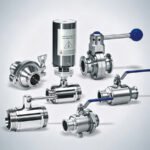
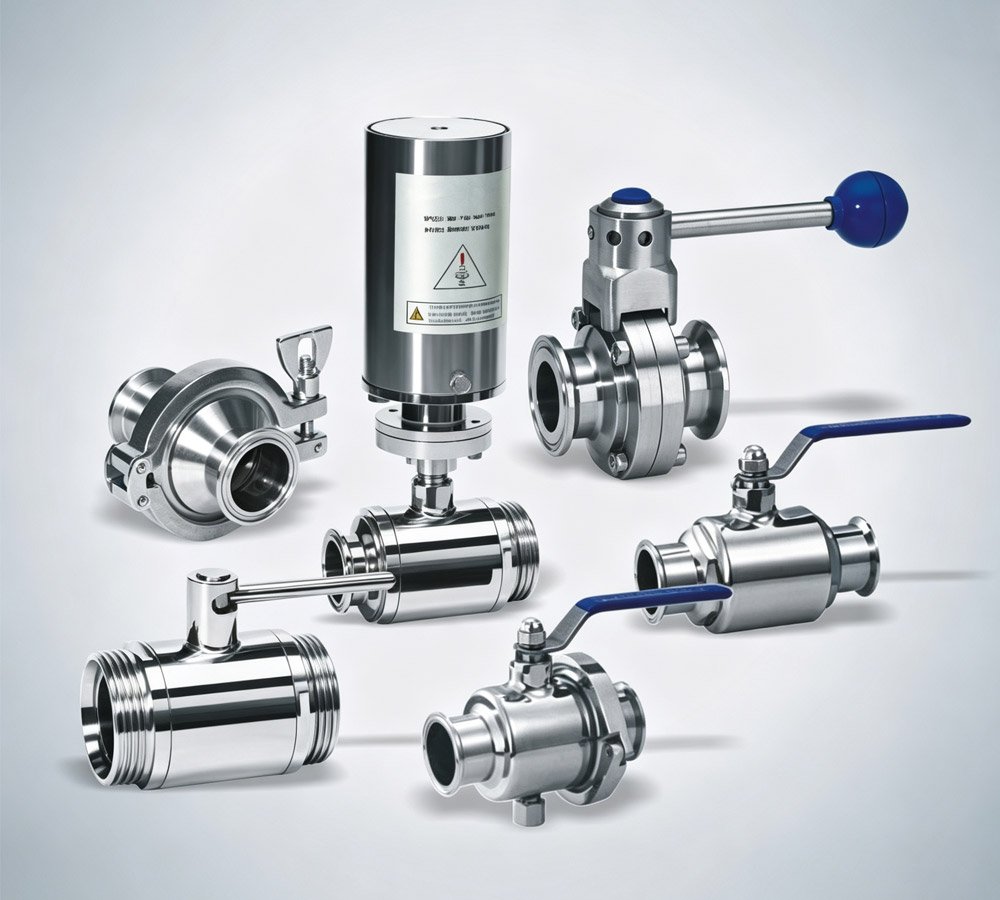
Sanitary butterfly valves are widely used in hygienic process piping for controlling the flow of liquids. Depending on the production process, a valve may be operated manually with a handle or automatically through a pneumatic actuator.
Although both types use a similar butterfly valve structure, their operating methods create different requirements for installation, process control, maintenance and system integration.
For a simple pipeline that requires occasional manual operation, a hand-operated valve may be sufficient. In a production line with frequent switching or centralized process control, a pneumatic valve may be more practical.
This guide explains the differences between manual and pneumatic sanitary butterfly valves, their typical applications, connection options and the key points to check before ordering.
1. How Does a Sanitary Butterfly Valve Work?
A sanitary butterfly valve uses a circular disc positioned inside the valve body. The disc rotates around a stem to open or restrict the flow passage.
When the disc is aligned with the flow direction, the valve is open. When it rotates across the passage, the valve closes.
The basic valve structure can be operated through different mechanisms:
- Manual operation: An operator turns a handle to change the disc position.
- Pneumatic operation: A pneumatic actuator uses compressed air to operate the valve.
The valve body and disc perform the flow-control function, while the operating mechanism determines how the valve is opened and closed.
2. Manual vs. Pneumatic Sanitary Butterfly Valves
The main difference is how the valve receives its operating force.
Manual Butterfly Valve
A manual sanitary butterfly valve uses a lever handle or another manual operating mechanism.
The operator changes the valve position directly. This arrangement is relatively simple and does not require a pneumatic control system.
Manual valves may be suitable for:
- Pipeline isolation points that are operated occasionally.
- Small or relatively simple processing systems.
- Equipment connections where local manual operation is sufficient.
- Production lines without centralized automatic valve control.
One important consideration is accessibility. The handle must have enough clearance for the operator to reach and move it safely.For an example of a manually operated design, see our SS304 sanitary butterfly valve with lever handle.
Pneumatic Butterfly Valve
A pneumatic sanitary butterfly valve uses a pneumatic actuator mounted on the valve.
Compressed air operates the actuator, allowing the valve to be controlled through a suitable pneumatic control arrangement.
Pneumatic valves may be considered for:
- Production lines with frequent valve operation.
- Automated process sequences.
- Centralized equipment control.
- Systems where operators need to control valves from a remote control point.
- Installations where multiple valves operate as part of a coordinated process.
A pneumatic actuator requires a suitable compressed-air supply and compatible control components. These requirements should be considered when planning the complete process system.
The actuator configuration, control method and operating behavior should be confirmed for the selected valve model.
3. Key Differences Between Manual and Pneumatic Valves
The following table summarizes the main selection differences.
| Comparison factor | Manual butterfly valve | Pneumatic butterfly valve |
|---|---|---|
| Operating method | Hand-operated handle | Pneumatic actuator |
| Operating force | Applied by the operator | Supplied by compressed air |
| Control location | Normally at the valve | Can be integrated into a suitable control system |
| Automation | Requires additional arrangements if automated operation is needed | Suitable for pneumatic automation |
| Utility requirements | No pneumatic supply required for operation | Requires compressed air |
| Installation | Generally simpler | Requires actuator space and pneumatic connections |
| Operation frequency | Suitable for occasional manual operation | Useful for frequent or coordinated operation |
| Initial system complexity | Generally lower | Higher due to actuator and control requirements |
Neither operating method is automatically better.
The correct choice depends on how frequently the valve operates, whether the process requires automation, the available utilities and the overall equipment layout.
4. When Should You Choose a Manual Butterfly Valve?
A manual butterfly valve is often a practical option when the valve is mainly used for local isolation or occasional adjustment.
For example, a processing line may contain several branch connections that are normally kept in a fixed position. If operators only need to change these positions during maintenance or production changeovers, manual operation may be sufficient.
Manual valves can also simplify equipment arrangements where there is no need to connect every valve to a centralized control system.
Before selecting a manual valve, consider:
- Whether operators can access the valve easily.
- Whether the handle has enough operating clearance.
- How frequently the valve needs to be opened or closed.
- Whether the operating position can be identified clearly.
- Whether manual operation is appropriate for the production procedure.
If the valve is installed behind equipment or in an area that is difficult to access, manual operation may become inconvenient.
5. When Should You Choose a Pneumatic Butterfly Valve?
A pneumatic butterfly valve may be more suitable when valve operation forms part of an automated production sequence.
For example, a production system may require several pipeline connections to open or close in a defined sequence. Pneumatic actuators can be integrated into a suitable control arrangement to coordinate these operations.
This can reduce the need for operators to move between individual valves during routine production.
Pneumatic operation may be particularly useful when:
- Valves need to operate frequently.
- The process requires coordinated opening and closing.
- The equipment is controlled from a central control panel.
- Valves are installed in locations that are difficult to access.
- The production line requires automatic process switching.
However, pneumatic operation also introduces additional requirements.
Before choosing this configuration, check:
Compressed-air availability
Confirm that the plant has a suitable compressed-air supply for the intended actuator configuration.
Control arrangement
Determine whether the actuator will be operated through a solenoid valve, control panel or another compatible control arrangement.
Actuator installation space
Allow sufficient space for the actuator, pneumatic connections and maintenance access.
Operating behavior
Confirm whether the selected actuator is double-acting or spring-return, if applicable, and establish the required valve position under loss of air or power.
The actuator should be selected together with the valve rather than treated as an independent accessory.
6. Connection Types: Clamp, Welded and Threaded Designs
The operating method is only one part of valve selection. The connection type must also match the existing process piping.
The factory catalogue includes several sanitary butterfly valve configurations.
| Valve configuration | Operating method | Connection type |
|---|---|---|
| Sanitary clamp butterfly valve | Manual | Clamp |
| Sanitary pneumatic clamp butterfly valve | Pneumatic | Clamp |
| Sanitary welding butterfly valve | Manual | Welded |
| Sanitary pneumatic welding butterfly valve | Pneumatic | Welded |
| Sanitary threaded butterfly valve | Manual | Threaded |
| Sanitary pneumatic threaded butterfly valve | Pneumatic | Threaded |
| Three-piece butterfly valve | Manual or pneumatic, depending on configuration | Confirm the selected model |
The catalogue also presents different dimensional series, including DIN, SMS, 3A and ISO in relevant product tables.
These standards and dimensions should not be assumed to be interchangeable.
When selecting a valve, confirm the actual connection dimensions and the corresponding piping standard. A valve that appears to have the correct nominal size may not necessarily fit the existing pipeline.
For more information about sanitary connection selection, see our guide to Tri-Clamp fittings and their components.
7. Installation and Maintenance Considerations
Both manual and pneumatic butterfly valves need to be installed with consideration for the surrounding equipment and pipeline arrangement.
However, their operating mechanisms introduce different installation requirements.
For Manual Valves
Check the following:
- Handle clearance and accessibility.
- Whether nearby pipes or equipment interfere with operation.
- Whether the valve position can be identified by operators.
- Access for inspection and seal replacement.
For Pneumatic Valves
In addition to the valve body and connection dimensions, check:
- Actuator installation height and overall dimensions.
- Compressed-air supply and pneumatic tubing arrangement.
- Compatibility with the planned control system.
- Access to actuator components for inspection and maintenance.
- The required operating behavior if the air supply is interrupted.
For both types, confirm the valve’s material, sealing components, pressure and temperature limits, and compatibility with the process fluid and cleaning procedure.
A sanitary appearance or stainless-steel construction alone does not establish suitability for every hygienic application.
8. What Should You Confirm Before Ordering?
Before requesting a quotation, prepare the following information:
- Valve operating method: Manual or pneumatic.
- Connection type: Clamp, welded or threaded.
- Dimensional standard: DIN, SMS, 3A, ISO or another specified system, as applicable.
- Required size: Confirm the actual pipeline and connection dimensions.
- Material requirements: Specify the required stainless-steel grade.
- Process medium: Describe the liquid or other medium passing through the valve.
- Operating conditions: Confirm working pressure and temperature requirements.
- Cleaning requirements: Identify the cleaning method and chemical compatibility requirements.
- Automation requirements: For pneumatic valves, provide the intended control arrangement and available air-supply information.
For pneumatic configurations, it is also useful to confirm the actuator type, control accessories and required operating behavior.
Providing these details helps the supplier identify a suitable configuration instead of selecting a valve based only on its nominal size.
9. Frequently Asked Questions
Is a pneumatic butterfly valve better than a manual butterfly valve?
Not in every situation. A pneumatic valve is useful when automatic or coordinated operation is required. A manual valve may be more practical for simple pipeline isolation and occasional operation.
Does a pneumatic butterfly valve require compressed air?
Yes. Pneumatic operation depends on a suitable compressed-air supply. The required air conditions and actuator specifications should be confirmed for the selected model.
Can a manual butterfly valve be converted into a pneumatic valve?
Some valve designs can be fitted with a suitable actuator, but compatibility depends on the valve construction, mounting arrangement and actuator requirements. Confirm this with the manufacturer before planning a conversion.
Are pneumatic butterfly valves suitable for automated production lines?
They can be suitable when the actuator and control arrangement are correctly selected and integrated into the process system. The complete control requirements should be reviewed before installation.
Which connection type should I choose?
The connection should match the existing process piping and the required installation method. Clamp, welded and threaded configurations have different installation and maintenance considerations. Always verify the actual dimensions and applicable standard.
Conclusion
Manual and pneumatic sanitary butterfly valves use a similar basic valve structure, but their operating methods serve different process requirements.
Manual valves are suitable for straightforward local operation, while pneumatic valves provide an option for automated and coordinated process control.
When selecting a valve, consider not only the operating mechanism but also the connection type, dimensional standard, material, sealing components and actual process conditions.
Haoqintech works with factory manufacturing resources to support different sanitary butterfly valve configurations, including manual and pneumatic designs, with clamp, welded and threaded connections.
For assistance with valve selection, provide your required size, connection type, operating method and process conditions so that the appropriate configuration can be confirmed.
Explore our sanitary valve product range for more valve configurations and connection options.