Liquid mushroom spawn quality plays an important role in commercial mushroom production. Before transferring a liquid culture into substrate bags or another production stage, growers need to determine whether the culture is suitable for inoculation.
A culture that appears healthy does not automatically guarantee good performance. Its condition should be assessed through several factors, including mycelial development, culture uniformity, possible contamination, fermentation records, and verification procedures.
This article explains how to evaluate liquid mushroom spawn before inoculation and what production teams should consider when deciding whether a batch is ready for use.
1. Why Liquid Spawn Quality Matters
Liquid mushroom spawn is used to introduce actively growing mycelium into a larger production system. Its quality can influence inoculation consistency, colonization performance, and the reliability of subsequent cultivation stages.
If a batch is used without proper assessment, potential problems may include:
- Uneven mycelial distribution during inoculation
- Slower or inconsistent substrate colonization
- Reduced production consistency between batches
- Introduction of unwanted microorganisms into the substrate
- Difficulties identifying the source of production problems later
For commercial operations, quality assessment should therefore be part of the normal production workflow rather than an occasional inspection.
The purpose is not simply to confirm that mycelium is visible. It is to establish whether the culture meets the requirements defined for the particular mushroom strain and production process.
2. Check the General Appearance of the Culture
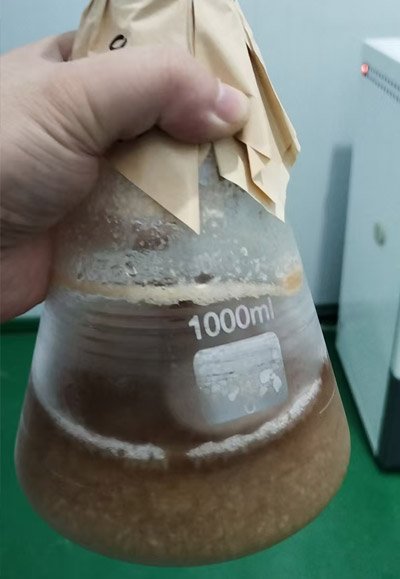
Visual inspection is usually one of the first checks performed before inoculation.
Operators can observe the culture through the fermentation tank sight glass, a sampling container, or another suitable inspection point.
Depending on the mushroom species, strain, culture medium, and fermentation conditions, liquid spawn may show different growth patterns.
During inspection, pay attention to:
- The general appearance of the liquid culture
- The presence and distribution of visible mycelial growth
- Unusual color changes compared with the established batch standard
- Unexpected floating material or sediment
- Any visible signs that differ from previous healthy batches
However, appearance alone cannot confirm that a liquid culture is free from contamination.
Some microorganisms may not produce obvious visual changes, while normal differences in mycelial appearance can occur between strains and culture conditions.
For this reason, visual inspection should be treated as an initial screening step, not a complete quality-control method.
3. Evaluate Mycelial Growth and Uniformity
The growth condition of the mycelium is another important consideration.
A suitable liquid culture should show a growth pattern consistent with the expected characteristics of the selected strain and the established production process.
Operators should consider several aspects.
Mycelial Development
Observe whether mycelial growth has developed as expected during the fermentation period.
The appearance of the mycelium may vary. Depending on the strain and cultivation conditions, it may form small fragments, suspended particles, or larger clusters.
There is no single visual pattern that applies to every mushroom species.
Distribution Within the Liquid
Check whether the mycelium appears reasonably distributed throughout the culture.
Uneven distribution may affect the consistency of liquid transfer and inoculation, particularly when the production system relies on controlled dosing.
If the culture contains large clusters or noticeable differences in distribution, the production team should evaluate whether the mixing or air-agitation process is operating as intended.
Consistency Between Batches
Comparing a current batch with previous batches of the same strain can provide useful information.
Records of normal growth appearance, fermentation conditions, and production performance help operators identify unusual changes.
The goal is to establish a strain-specific reference rather than apply one universal visual standard to all liquid spawn.
4. Identify Possible Signs of Contamination
Contamination control is essential before liquid spawn enters the substrate production stage.
During inspection, operators should look for unusual changes such as:
- Unexpected color changes
- Unusual surface films or growth patterns
- Abnormal odors identified during an appropriate sampling procedure
- Unexpected turbidity or material that differs from the normal culture condition
- Changes in growth behavior compared with established batch records
These observations may indicate a problem, but none should be treated as definitive evidence on its own.
A culture can look normal while still containing unwanted microorganisms. Conversely, some visual differences may be related to normal strain characteristics or changes in fermentation conditions.
When contamination is suspected, the batch should be isolated from the production inoculation process until it has been evaluated.
For more information about responding to suspected contamination, see our guide on How to Respond to Contamination in Liquid Mushroom Spawn Production.
5. Review Fermentation Batch Records
A quality assessment should include more than visual observation.
Production records help determine whether the batch was prepared under the expected operating conditions.
Before inoculation, review the available records for the following information:
| Record item | What to review |
|---|---|
| Mushroom strain | Confirm the strain and its intended application |
| Culture medium | Check that the planned medium and preparation procedure were followed |
| Sterilization | Review the sterilization process and relevant operating records |
| Inoculation history | Confirm the source and preparation details of the inoculum |
| Fermentation conditions | Review recorded temperature, aeration, and process conditions |
| Batch duration | Compare the actual process duration with the established production procedure |
| Equipment status | Check for recorded abnormalities, maintenance issues, or process interruptions |
The importance of each parameter depends on the strain, equipment configuration, and production method.
A batch that has completed its planned fermentation period should not automatically be considered ready for inoculation. The recorded process conditions and actual culture condition should be evaluated together.
Consistent batch documentation also makes it easier to investigate problems if the subsequent substrate colonization process does not perform as expected.
6. Use Sampling and Quality Verification When Necessary
For commercial production, sampling provides an additional way to assess liquid spawn quality.
A representative sample can be collected through a suitable sampling point using an appropriate aseptic procedure.
Depending on the production requirements, verification may include:
- Microscopic observation of mycelial characteristics
- Examination of a sample under suitable culture conditions
- Checks for possible bacterial or fungal contamination
- Comparison with established quality-control references
The exact testing procedure should be selected according to the mushroom strain, production environment, and the level of quality assurance required.
Sampling procedures must also be carefully controlled. An improperly handled sample can introduce contamination or produce misleading results.
For larger production facilities, it is useful to establish a consistent sampling procedure and keep the results with the corresponding fermentation batch record.
7. When Is a Liquid Spawn Batch Ready for Inoculation?
A batch should be released for inoculation only after the relevant quality checks have been completed.
In practical production, the decision should consider several factors together:
- The culture shows growth characteristics consistent with the selected strain.
- No unexplained visual changes or suspicious abnormalities have been identified.
- The fermentation records are consistent with the established process.
- Any required sampling or verification checks have been completed satisfactorily.
- The transfer and inoculation equipment is prepared for the next production stage.
These checks should be based on documented procedures developed for the specific strain and production system.
There is no universal color, fermentation duration, or visual appearance that can independently confirm liquid spawn quality for every mushroom species.
If a batch does not meet the established requirements, it should not be released simply to maintain the production schedule. The cause of the abnormality should be investigated first.
8. Connect Quality Control with Liquid Spawn Transfer and Inoculation
Liquid spawn quality assessment is closely connected with the design of the downstream production system.
Even when a batch has passed the required checks, the transfer and inoculation process must be properly prepared.
Several factors should be considered:
- Whether the fermentation tank and transfer pipeline have been cleaned and sterilized according to the operating procedure
- Whether the transfer connections are suitable for hygienic operation
- Whether the liquid culture can be transferred without unnecessary exposure to the surrounding environment
- Whether the dosing system can deliver the required inoculation volume consistently
- Whether the receiving substrate bags or containers are ready for inoculation
For example, a production line using controlled liquid dosing requires coordination between the fermentation tank, transfer pipeline, pressure or pumping arrangement, and inoculation unit.
The equipment should be planned as one connected process rather than as separate machines. This includes designing a suitable liquid spawn transfer arrangement that maintains hygienic conditions and supports consistent delivery. For more details, see our guide to designing a liquid spawn transfer system, which covers pressure transfer, flexible hoses, and contamination control.
You can learn more about the downstream process in our article on Liquid Mushroom Spawn Inoculation into Substrate Bags: Dosing Systems, Equipment and Process Control.
For projects that require a more integrated setup, the Integrated Liquid Mushroom Spawn Fermentation System also provides an overview of how fermentation equipment can be connected with the wider production process.
Conclusion
Assessing liquid mushroom spawn before inoculation is an important part of maintaining consistent commercial production.
Visual inspection, mycelial growth evaluation, contamination screening, fermentation records, and appropriate sampling all contribute to a more reliable quality-control process.
Most importantly, no single observation should determine whether a batch is ready for use. Quality decisions should be based on the combined results of multiple checks and on standards established for the specific mushroom strain and production process.
For commercial growers developing or expanding liquid mushroom spawn production, integrating quality-control procedures into the fermentation, transfer, and inoculation workflow can help improve production consistency and reduce avoidable risks.