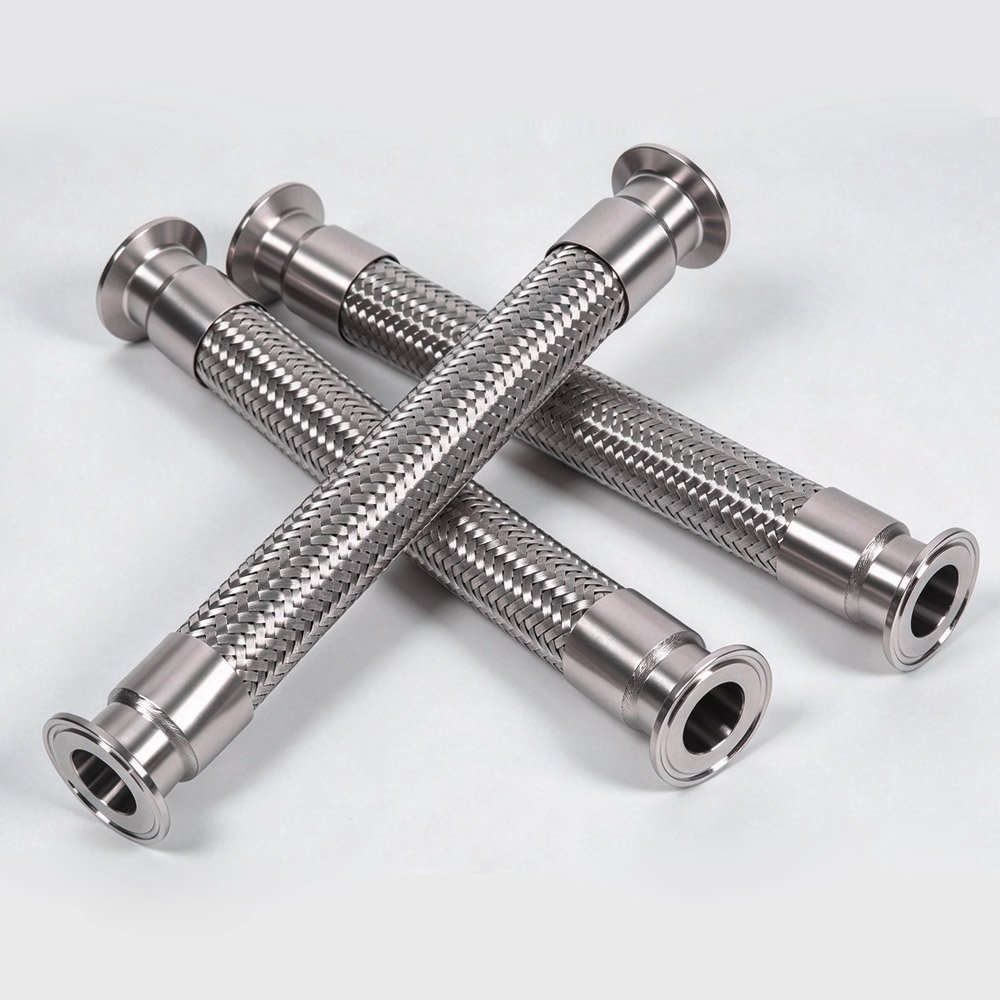
A flexible hose can solve an important problem in a hygienic piping system: connecting equipment where a completely rigid pipe arrangement may be impractical. However, selecting the right sanitary hose involves more than checking its nominal size or connection type.
Material compatibility, operating pressure, temperature, installation length, bending requirements and end connection dimensions all affect whether a hose assembly is suitable for a particular process.
For food and beverage processing, dairy production, pharmaceutical manufacturing, fermentation and other hygienic fluid-handling applications, these factors should be reviewed before ordering.
This guide explains what to consider when selecting a stainless steel braided sanitary hose for process piping and how to avoid common specification mistakes.
What Is a Stainless Steel Braided Sanitary Hose?
A stainless steel braided sanitary hose is a flexible hose assembly designed to connect compatible components in a process piping system. Its construction, reinforcement and end connections depend on the specific product design.
In a braided assembly, the stainless steel outer braid provides reinforcement and mechanical protection. The inner tube or liner is the part that directly contacts the process fluid, so its material and construction are particularly important when evaluating compatibility.
The end connections determine how the hose integrates with the surrounding equipment. In hygienic piping systems, Tri-Clamp connections are often selected where components need to be disconnected for inspection, maintenance or replacement.
However, not every braided hose has the same inner tube material or construction. A hose with a stainless steel braid may have a metal inner tube, a PTFE liner or another type of liner. Buyers should verify the complete assembly specification rather than judging suitability from the braid material alone.
When Is a Flexible Hose Connection Useful?
Rigid stainless steel piping is widely used in hygienic process installations, but some connection points benefit from a flexible section.
Depending on the hose design and approved operating conditions, a flexible assembly may be considered for:
- Connecting equipment where a rigid pipe arrangement is difficult to install.
- Accommodating limited movement between connected components.
- Simplifying the connection between equipment with different installation positions.
- Supporting maintenance access where a removable hose assembly is appropriate.
- Connecting process equipment through compatible sanitary end fittings.
A flexible hose should not automatically be treated as a solution for every alignment or vibration problem. Its suitability depends on the actual construction, length, routing, movement and operating conditions.
It should also not be used to compensate for poor piping alignment or to carry unsupported equipment loads unless the assembly is specifically designed for that purpose.
5 Factors to Check Before Selecting a Sanitary Hose
1. Confirm the Process Medium and Material Compatibility
Start by identifying the liquid or gas that will pass through the hose.
The material exposed to the process medium must be compatible with the fluid, its concentration and the expected operating conditions. The same consideration applies to cleaning agents and sanitation procedures used in the system.
For example, a hose intended for one type of water-based liquid should not automatically be assumed suitable for every chemical solution or cleaning cycle.
Check the following information before ordering:
- Process fluid or gas.
- Fluid concentration, where applicable.
- Normal and cleaning temperatures.
- Cleaning chemicals and sanitation procedure.
- Inner tube or liner material.
- Wetted end-fitting and gasket materials.
- Any required food-contact, pharmaceutical or other regulatory documentation.
A stainless steel outer braid does not by itself establish the chemical compatibility or hygienic suitability of the complete hose assembly.
2. Verify Operating Pressure and Temperature
Pressure and temperature are essential selection criteria.
The allowable operating conditions depend on the hose construction, liner or tube, reinforcement, end fittings, connections and installation arrangement. The permitted pressure may also vary with temperature.
Do not select a hose based only on the pressure rating of its stainless steel braid or Tri-Clamp ends.
Before installation, confirm the manufacturer’s specifications for:
- Maximum allowable working pressure at the required temperature.
- Minimum and maximum operating temperatures.
- Any vacuum or negative-pressure limitations.
- Pressure fluctuations or other operating stresses.
- Cleaning or sterilization conditions, if applicable.
If the hose will be used in a CIP or SIP process, confirm that the complete assembly is suitable for the actual cleaning or sterilization cycle. Do not assume that a stainless steel construction automatically makes a hose suitable for steam service.
3. Select the Correct Hose Length
Hose length affects installation space, routing and the way the assembly sits between two connection points.
A hose that is too short may be difficult to install correctly or may place unwanted loads on the end connections. A hose that is excessively long may create unnecessary loops, occupy valuable space or make cleaning and inspection more difficult.
When determining the required length, consider:
- The distance between the two connection points.
- The actual length measurement method used by the supplier.
- The space available around the connected equipment.
- The required bend radius and hose routing.
- Whether movement is expected during normal operation.
- Access for inspection and maintenance.
Always confirm whether the stated length refers to the hose body, the distance between ferrule faces or the overall assembled length. These measurements are not necessarily identical.
4. Confirm the Tri-Clamp Connection Dimensions
Tri-Clamp connections are useful in hygienic systems because they can be disconnected without cutting or permanently welding the connected equipment.
However, nominal size alone may not be sufficient to establish compatibility. Different connection standards or configurations can have different physical dimensions.
Before ordering a hose assembly, verify:
- Nominal size at both ends.
- Actual ferrule dimensions.
- Compatibility with the mating fittings.
- Clamp and gasket requirements.
- Whether both ends use the same connection size.
- Any required connection standard or dimensional drawing.
Do not assume that two components will fit simply because their product listings use the same DN designation.
For additional background, read our guide to Tri-Clamp vs welded connections in hygienic piping systems.
5. Check Bending and Installation Requirements
A flexible hose still has installation limits.
Bending it too tightly, twisting it during installation or placing repeated stress near the end fittings can damage the assembly or shorten its service life. The allowable bend radius and movement limits vary by hose design.
During installation:
- Follow the manufacturer’s minimum bend-radius requirements.
- Avoid twisting the hose to align the end connections.
- Avoid sharp bends immediately next to the ferrules.
- Prevent abrasion against nearby equipment or sharp edges.
- Support connected equipment independently where necessary.
- Confirm whether the hose is suitable for the expected frequency of movement.
If the hose will be exposed to repeated movement, vibration or pressure fluctuations, explain those conditions to the supplier before selecting the assembly.
Why Verify the Complete Hose Assembly Before Ordering?
A hose assembly is more than a length of flexible material with two connections attached.
The inner tube, reinforcement, end fittings, seals and assembly method work together. A mismatch in any of these elements can make a product unsuitable for the intended process.
For this reason, procurement teams and engineers should evaluate the complete assembly rather than selecting a product based on one specification alone.
A useful enquiry should include:
- Required nominal size and actual connection dimensions.
- Required hose length and measurement reference.
- Process medium.
- Normal and maximum operating pressure.
- Normal and maximum operating temperature.
- Cleaning and sterilization requirements.
- Expected movement or vibration.
- Required material documentation or certifications.
- Quantity and any special installation requirements.
Providing this information helps the supplier assess the requested configuration and identify any specifications that still need confirmation.
Haoqintech 304 Stainless Steel Braided Sanitary Hose
Haoqintech offers a 304 stainless steel braided sanitary flexible hose with Tri-Clamp connections at both ends for compatible process piping applications.
The confirmed product configuration includes:
- Inner tube: 304 stainless steel.
- Outer braided layer: 304 stainless steel.
- End ferrules: 304 stainless steel.
- Connection type: Tri-Clamp at both ends.
- Standard length: 300 mm.
- Available nominal sizes: DN10, DN15, DN20, DN25, DN32, DN40, DN50, DN70, DN80, DN100, DN125, DN150, DN200, DN250, DN300, DN350, DN400 and DN450.
The actual ferrule dimensions and compatibility with the mating connections should be confirmed before ordering.
Working pressure, temperature limits, minimum bend radius, process-fluid compatibility and any required compliance documentation must also be confirmed for the intended application. They should not be inferred from the stainless steel material specification alone.
For product details and quotation enquiries, visit the 304 Stainless Steel Braided Sanitary Hose with Tri-Clamp Ends product page.
If your installation requires a transition between a sanitary clamp connection and a flexible hose, you may also review our 304 Stainless Steel Sanitary Tri-Clamp Hose Barb Adapter. The appropriate fitting depends on the actual hose and connection specifications.
Frequently Asked Questions
Is a stainless steel braided hose automatically suitable for sanitary processing?
No. The braid material alone does not establish suitability. The inner tube, wetted components, seals, assembly design, cleanability and required documentation must all be considered for the intended application.
Can I choose a sanitary hose by DN size alone?
No. DN is a useful starting point, but you should also verify actual ferrule dimensions, the connection standard, gasket and clamp compatibility, and the required assembled length.
How do I choose the correct hose length?
Measure the installation between the intended connection points and confirm how the supplier defines overall length. Allow for the specified bend radius, routing and available installation space.
Can every stainless steel braided hose be used for CIP or SIP?
No. Suitability depends on the complete assembly’s pressure, temperature, liner, connection and cleaning-cycle limitations. Confirm the manufacturer’s approved operating conditions before use.
What information should I provide when requesting a quotation?
Provide the nominal size, connection dimensions, required length, process medium, operating pressure and temperature, cleaning conditions, quantity and any required certifications or documentation.
Conclusion
Selecting a stainless steel braided sanitary hose requires more than matching the nominal pipe size. Material compatibility, operating conditions, hose length, connection dimensions and installation requirements all need to be checked.
For hygienic process piping, the safest approach is to verify the complete assembly against the actual application before ordering.
Haoqintech supplies 304 stainless steel braided sanitary hoses with Tri-Clamp ends in multiple nominal sizes. Contact us with your connection dimensions and operating requirements to discuss a suitable configuration for your process.