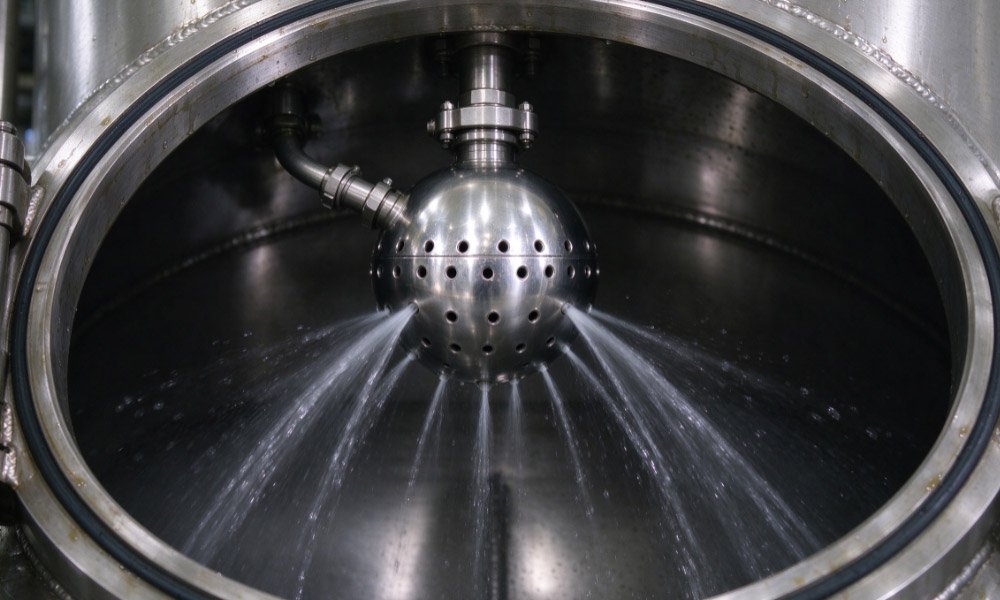
A CIP (Clean-in-Place) system can circulate cleaning solution through a process tank without dismantling the equipment. However, installing a spray ball does not automatically guarantee that every internal surface receives adequate cleaning.
Tank geometry, spray device selection, operating conditions, installation position, and internal obstructions can all affect cleaning coverage.
For food, beverage, pharmaceutical, fermentation, and other hygienic processing applications, understanding how to evaluate CIP spray ball coverage is an important step toward designing a reliable cleaning process.
This guide explains what spray ball coverage means, which areas deserve attention, and how to assess whether a tank cleaning arrangement is suitable for its intended application.
1. What Does CIP Spray Ball Coverage Mean?
CIP spray ball coverage refers to how effectively a tank cleaning device distributes cleaning liquid over the intended internal surfaces of a vessel.
These surfaces may include:
- The tank roof and upper shell
- Sidewalls and lower shell
- The tank bottom and drainage area
- Internal pipes, baffles, and support structures
- Areas around agitator shafts and other internal components
- Connections and geometrically complex regions
Coverage is not the same as cleaning effectiveness.
A spray device may distribute liquid across much of a tank’s internal surface, but the cleaning result still depends on factors such as cleaning chemistry, temperature, contact time, flow conditions, and the nature of the soil being removed.
Therefore, spray coverage should be assessed as one part of the overall CIP process rather than as proof that a tank is clean.
2. Why Can a Spray Ball Leave Cleaning Blind Spots?
Several engineering factors can affect how cleaning liquid reaches internal tank surfaces.
Tank geometry
A tall, narrow tank and a wide, shallow vessel do not necessarily require the same spray arrangement. Tank diameter, height, roof shape, bottom design, and the position of the cleaning device all influence liquid distribution.
Internal obstructions
Agitators, baffles, dip pipes, probes, and other internal components may obstruct spray paths or create areas that receive less direct liquid impact.
A cleaning arrangement that works well in an unobstructed vessel may not perform equally well after additional equipment is installed.
Installation position
A spray device installed too close to an obstruction, too far from a critical surface, or in an unsuitable orientation may fail to provide the intended coverage.
The mounting arrangement should be evaluated against the actual tank geometry rather than selected from the nominal tank volume alone.
Flow and pressure conditions
The cleaning device must operate within its specified conditions. Inadequate supply flow, unsuitable operating pressure, restrictions in the supply line, or excessive pressure loss can affect its cleaning performance.
The relevant operating values should be checked against the manufacturer’s specifications and the requirements of the CIP system.
Spray device selection
Fixed spray balls and rotary tank-cleaning devices operate differently. Their suitability depends on the vessel, the type of residue, the required cleaning performance, and the available CIP supply conditions.
For a comparison of these device types, see our guide to rotary vs. fixed spray balls.
3. How to Evaluate CIP Spray Ball Coverage
A practical evaluation should begin with the equipment design and progress to testing under representative operating conditions.
Step 1: Review the tank and cleaning-system design
Before testing, document the tank’s internal dimensions, roof and bottom configuration, internal components, spray-device location, and cleaning-liquid supply arrangement.
Identify surfaces that are difficult to reach, particularly those behind baffles, beneath agitators, around internal pipes, and near vessel transitions.
This review helps determine where coverage needs to be demonstrated rather than assuming that a single spray device will clean every surface equally well.
Step 2: Confirm the operating conditions
Check the actual cleaning-system conditions against the spray device’s specified operating range.
Depending on the system, relevant parameters may include:
- Cleaning-liquid flow rate
- Operating pressure at the appropriate measurement point
- Supply-line restrictions
- Spray-device condition and orientation
- Evidence of blockage, wear, or mechanical malfunction
Pressure readings should be interpreted carefully. A pressure reading at the pump does not necessarily represent the pressure available at the cleaning device.
If performance is unsatisfactory, investigate the complete supply path rather than replacing the spray ball immediately.
Step 3: Conduct a visual inspection
Where the vessel design and safety procedures permit, inspect the tank interior and the spray device’s installation.
Look for damaged components, blocked openings, incorrect mounting, residue accumulation, and obstructions that may affect spray distribution.
Visual inspection is useful for identifying obvious problems, but it cannot independently establish that all critical surfaces receive adequate cleaning during the complete CIP cycle.
Step 4: Consider a riboflavin coverage test
A riboflavin test is one method used to visualize liquid coverage on accessible surfaces of a vessel.
In a typical qualitative test, a suitable riboflavin solution is applied to selected internal surfaces. The cleaning system is then operated under the defined test conditions, and the remaining fluorescence is examined under appropriate lighting.
Areas with visible residual fluorescence may indicate that liquid distribution or the selected test conditions need further investigation.
A meaningful test should define:
- The surfaces to be evaluated
- The spray device and its operating conditions
- The test solution and application method
- The duration and conditions of the cleaning cycle
- The inspection method and acceptance criteria
Riboflavin testing has limitations. Results depend on how the test is prepared and evaluated, and a coverage test does not by itself prove that a process removes all relevant product residues, allergens, microorganisms, or other contaminants.
For critical applications, the test method and acceptance criteria should be established as part of an appropriate cleaning-validation strategy.
Step 5: Verify cleaning performance for the actual process
After evaluating spray coverage, assess whether the complete cleaning process meets its intended requirements.
Depending on the application, this may involve residue testing, visual inspection, conductivity or other process measurements, microbiological testing, or other suitable analytical methods.
The method should be selected according to the product, the contamination risks, the equipment, and the applicable quality requirements.
A successful spray coverage test is useful evidence about liquid distribution. It should not be treated as a substitute for verifying cleaning effectiveness.
4. Fixed Spray Balls vs. Rotary Cleaning Devices: What Should Be Tested?
Both fixed spray balls and rotary cleaning devices can be appropriate for hygienic tank cleaning, but their performance should be assessed in the context of the application.
Fixed spray balls
Fixed devices distribute liquid through stationary openings. Their suitability depends on the spray pattern, flow conditions, installation arrangement, and the cleaning requirements of the vessel.
During evaluation, pay particular attention to surfaces that may receive limited direct liquid contact and to whether the actual operating conditions match the design assumptions.
Rotary cleaning devices
Rotary devices use moving spray elements to distribute cleaning liquid as the device operates. Their performance depends on the specific design and operating conditions.
Evaluation should consider the required supply conditions, the device’s mechanical condition, the tank’s internal geometry, and whether the intended cleaning pattern is achieved.
Neither device type should be selected solely because it is described as providing 360-degree coverage. The actual coverage and cleaning performance must be appropriate for the application.
5. Common Mistakes When Evaluating CIP Coverage
Several assumptions can lead to an incomplete assessment.
Assuming 360-degree coverage means complete cleaning. A nominal spray angle or coverage description does not guarantee that every surface receives adequate cleaning action.
Testing under conditions that do not represent normal operation. The test should reflect the intended installation and relevant operating conditions. Changes in supply flow, pressure, internal equipment, or cleaning procedure may affect the outcome.
Ignoring internal obstructions. Baffles, agitators, probes, and dip pipes should be included in the assessment.
Using coverage results as the only acceptance criterion. Liquid distribution and actual soil removal are related but different questions.
Replacing the spray device before checking the supply system. Restrictions, incorrect installation, or unsuitable operating conditions may be responsible for poor performance.
For additional troubleshooting guidance, see Why Is CIP Cleaning Ineffective? Common Causes & Solutions.
6. What Information Is Needed Before Selecting a Tank Cleaning Device?
Before choosing a spray ball or rotary cleaning device, gather the following information:
- Tank diameter, height, and internal configuration
- Tank roof and bottom geometry
- Internal components that may obstruct the spray pattern
- Required cleaning objectives and the type of residue
- Available CIP flow rate and operating pressure
- Cleaning-liquid temperature and chemical compatibility requirements
- Installation connection, mounting position, and maintenance access
- Any applicable testing, documentation, or validation requirements
This information helps establish whether a proposed cleaning device is suitable for the intended vessel and operating conditions.
For complex vessels or critical cleaning applications, the selection should be supported by appropriate engineering review and performance testing.
7. Building a More Reliable CIP Cleaning Arrangement
Reliable CIP cleaning depends on the interaction between the vessel design, cleaning device, supply system, operating procedure, and verification method.
A well-selected spray ball cannot compensate for every supply-system problem. Likewise, sufficient flow and pressure do not guarantee that all critical surfaces receive adequate cleaning action.
The practical approach is to define the cleaning requirements first, select a suitable device, confirm the installation and operating conditions, and verify performance using an appropriate test method.
For sanitary process equipment used in food, beverage, pharmaceutical, and fermentation applications, these steps help create a more defensible basis for equipment selection and CIP system design.
Conclusion
CIP spray ball coverage should be evaluated rather than assumed.
Reviewing tank geometry, checking operating conditions, inspecting installation details, and using suitable coverage tests can help identify potential cleaning blind spots. However, coverage testing and cleaning validation serve different purposes, and both should be considered when the application requires demonstrated cleaning performance.
Selecting the right sanitary tank cleaning device begins with understanding the actual vessel and process requirements—not simply choosing a spray ball based on its nominal coverage description.