A CIP system can complete the programmed cleaning cycle and still leave product residue inside the tank.
This is one of the most frustrating problems in sanitary processing: the pump is running, cleaning solution is circulating, the temperature looks normal, and the cycle finishes without an alarm — but after opening the tank, deposits are still visible.
When this happens, the problem is not necessarily the cleaning chemical or the spray device alone.
Effective Cleaning-in-Place (CIP) depends on several conditions working together, including flow rate, pressure, spray coverage, temperature, chemical concentration, cleaning time, tank geometry, and drainage.
If one of these conditions is insufficient, the cleaning result can become inconsistent.
This article explains the most common engineering causes of ineffective CIP cleaning and how to troubleshoot them step by step.
What Does “Ineffective CIP Cleaning” Actually Mean?
Poor CIP performance does not always mean that the entire tank is dirty.
Typical symptoms include:
- Product residue remains on the tank wall
- Deposits remain around the tank bottom or outlet
- Some areas are clean while other areas remain dirty
- Cleaning performance changes from one cycle to another
- The operator needs to manually clean the tank after CIP
- The cleaning cycle needs to be extended repeatedly
- More chemical or water is being consumed without improving the result
- Cleaning works with one product but not another
These symptoms indicate that the cleaning process is not achieving the required combination of mechanical action, chemical action, temperature, and exposure time.
In practical engineering, the first question should therefore not be:
“Which spray ball should we buy?”
The better question is:
“Is the complete CIP system delivering the conditions required by the tank and the type of residue?”
8 Common Causes of Poor CIP Cleaning
1. Insufficient Cleaning Flow Rate
One of the first things an engineer should check is the actual cleaning flow rate.
A spray device can only perform according to the flow available to it. If the CIP pump cannot provide sufficient flow through the piping and cleaning device, the spray pattern may not provide enough mechanical action or coverage.
This can happen when:
- The CIP pump is undersized
- The piping diameter is too small
- There are excessive bends or restrictions
- Valves are not fully open
- Filters or strainers are partially blocked
- The spray device requires more flow than the system can provide
- Multiple cleaning branches are operating at the same time
The important point is that pump capacity is not the same as actual flow at the tank cleaning device.
Pressure losses in the piping system can significantly change the conditions at the spray device.
For this reason, the actual operating flow should be checked rather than relying only on the pump nameplate or theoretical capacity.
2. Insufficient Pressure at the Cleaning Device
Flow and pressure are closely related, but they are not exactly the same thing.
A CIP system may have acceptable flow at the pump while the pressure available at the tank cleaning device is insufficient.
This can reduce the mechanical force reaching the tank surface.
For tank cleaning, what matters is not simply the pressure shown at the pump outlet. The pressure and flow conditions at the cleaning device determine how the cleaning media reaches the internal surfaces.
If pressure drops because of:
- Long piping runs
- Undersized piping
- Excessive elbows
- Partially closed valves
- Incorrect pump selection
- High system resistance
- Incorrect spray device selection
the cleaning result can deteriorate.
Therefore, when troubleshooting poor CIP performance, check the system from the pump to the tank rather than looking at one pressure gauge alone.
Actual impact on the tank surface is particularly important when evaluating mechanical cleaning performance.
3. The Spray Device Is Not Suitable for the Tank
A spray ball or rotary spray device is not automatically suitable simply because it can be physically installed on the tank.
The cleaning device must match the:
- Tank diameter
- Tank height
- Internal geometry
- Cleaning difficulty
- Required flow
- Available pressure
- Type of product residue
- Internal components
A simple tank containing an easily removable liquid residue may require a very different cleaning solution from a tank containing sticky, viscous, or dried deposits.
The cleaning device also needs to provide adequate coverage and mechanical action.
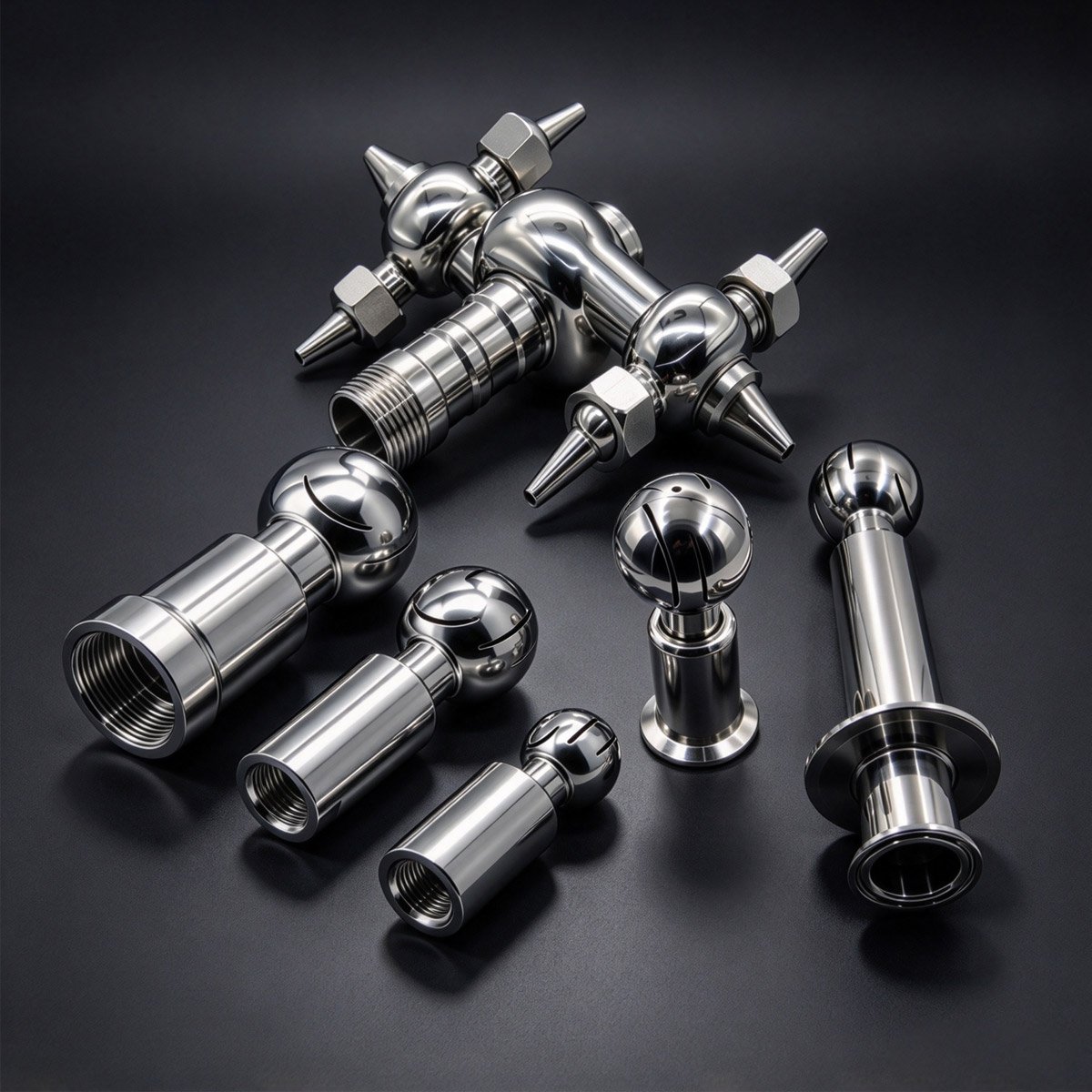
For example, static spray balls are commonly used for relatively straightforward cleaning applications, while rotary cleaning devices can provide a different combination of coverage and mechanical impact. The appropriate choice depends on the actual application and available CIP conditions.
4. Poor Spray Coverage Inside the Tank
Even when the spray device itself is working correctly, some parts of the tank may not receive sufficient cleaning action.
This can happen because of:
- Agitators
- Baffles
- Internal coils
- Temperature sensors
- Pipes
- Manways
- Tank geometry
- Dead zones
- Incorrect installation position of the cleaning device
A spray device should therefore not be evaluated only by looking at whether it rotates.
The more important question is:
Does the cleaning media actually reach the surfaces that need to be cleaned?
Complex tank internals can create shadow areas where the cleaning fluid does not have sufficient impact or coverage. Tank cleaning design therefore needs to consider both the cleaning device and the internal geometry of the vessel.
5. CIP Temperature Is Too Low
Temperature is another important part of the cleaning process.
If the cleaning solution temperature is lower than the process requires, chemical cleaning action may become less effective and the overall cleaning cycle may take longer.
However, higher temperature does not automatically mean better cleaning.
The correct temperature depends on:
- Product residue
- Cleaning chemical
- Tank material
- Gasket material
- Process requirements
- CIP system design
A well-designed CIP system should therefore control and monitor temperature rather than simply increasing it whenever cleaning becomes difficult.
Temperature is one of the key process variables commonly controlled in automated CIP systems, together with flow, chemical concentration and cleaning time.
6. Chemical Concentration Is Incorrect
Increasing the amount of detergent is not always the solution to poor cleaning.
If the chemical concentration is too low, the cleaning action may be insufficient.
If it is too high, the additional chemical may increase cost and rinsing requirements without providing a proportional improvement in cleaning performance.
The correct concentration depends on:
- Type of residue
- Cleaning chemical
- Process temperature
- Contact time
- Equipment material
- Cleaning procedure
For automated CIP systems, chemical concentration can be monitored through dosing systems and conductivity measurement.
This allows the cleaning process to be controlled rather than relying entirely on manual chemical preparation.
7. Cleaning Time Is Too Short
A CIP cycle can have the correct temperature, flow and chemical concentration and still fail if the exposure time is insufficient.
This is especially important when removing:
- Protein deposits
- Organic residues
- Sticky materials
- Dried product
- Heavy contamination
A common mistake is to shorten the cleaning cycle simply because the equipment appears visually clean after a short rinse.
The required cleaning time depends on the combination of:
Mechanical action + Chemical action + Temperature + Time
If one factor is reduced, another factor may need to compensate.
For example, a lower mechanical cleaning force may require longer exposure time or a different cleaning method.
Therefore, cleaning time should be determined from actual cleaning performance rather than simply choosing the shortest possible cycle.
8. The CIP System Does Not Match the Actual Tank
This is one of the most important causes of poor CIP performance.
A CIP system may work perfectly on one tank and poorly on another because the two tanks have different:
- Volumes
- Diameters
- Heights
- Internal structures
- Pipe arrangements
- Spray devices
- Drainage conditions
- Product residues
A CIP system should therefore be designed around the actual equipment being cleaned.
Important design questions include:
- What is the tank diameter?
- What is the tank height?
- What internal components are present?
- What flow rate is available?
- What pressure is available at the cleaning device?
- What type of residue needs to be removed?
- How quickly can the tank drain?
- Where is the cleaning device installed?
- Are there dead zones or shadow areas?
- Is the return line large enough for the cleaning flow?
A tank cleaning system is not simply a pump plus a spray ball.
It is a complete hydraulic and cleaning system.
Fixed Spray Ball vs. Rotary Spray Ball: Which Is Better?
There is no universal answer.
The correct choice depends on the tank and the cleaning requirements.
A fixed spray ball has a relatively simple construction and can be suitable for straightforward tank cleaning applications.
A rotary spray device introduces movement into the cleaning pattern and can provide more dynamic coverage of the tank’s internal surfaces.
However, choosing between them based only on the tank diameter is not sufficient.
The engineer should consider:
- Required cleaning intensity
- Available flow
- Available pressure
- Tank geometry
- Internal obstacles
- Type of residue
- Cleaning cycle requirements
For more detailed guidance on this comparison, see our article:
Rotary vs. Fixed Spray Balls: How to Choose the Right Sanitary Tank Cleaning Nozzle
The key point is simple:
The cleaning device must match the complete CIP system, not just the tank size.
How to Troubleshoot Poor CIP Cleaning Step by Step
When a sanitary tank is not being cleaned properly, avoid changing several parameters at the same time.
A structured troubleshooting process makes it much easier to identify the actual cause.
Step 1: Check the Actual Flow Rate
Do not rely only on the pump specification.
Check the actual flow during the CIP cycle.
Ask:
- Is the flow stable?
- Does the flow decrease during the cycle?
- Is another CIP branch operating simultaneously?
- Is there a restriction in the piping?
Step 2: Check Pressure at the Relevant Point
Check the pressure available to the cleaning device.
If pressure is adequate at the pump but significantly lower at the tank, investigate the piping and valve arrangement.
Possible causes include:
- Pipe diameter
- Pipe length
- Elbows
- Valves
- Filters
- Fittings
- Spray device resistance
Step 3: Inspect the Cleaning Device
Check whether the spray device is:
- Correctly installed
- Blocked
- Damaged
- Worn
- Rotating correctly
- Receiving the required flow
A blocked or damaged cleaning device can significantly change the cleaning pattern.
Step 4: Check Spray Coverage
Identify where the residue remains.
If residue repeatedly appears in the same location, this is an important clue.
For example:
- Top area → possible coverage problem
- Behind internal components → possible shadow area
- Bottom area → possible drainage or flow problem
- Around outlet → possible geometry or product accumulation problem
The location of the remaining residue can help identify the underlying engineering issue.
Step 5: Check Temperature
Verify the actual cleaning temperature rather than relying only on the programmed setpoint.
Temperature can change during the cycle, especially when:
- The tank is large
- The cleaning solution is initially cold
- Heat losses are significant
- Flow rate is high
Step 6: Check Chemical Concentration
Confirm that the cleaning chemical is actually reaching the intended concentration.
If concentration changes during the cycle, the cleaning result may also change.
Automated CIP systems can use dosing and conductivity monitoring to improve control of this parameter.
Step 7: Check Cleaning Time
If the other parameters are correct but residue remains, evaluate whether the exposure time is sufficient for the specific contamination.
Do not simply increase the cycle time indefinitely.
First determine whether the real problem is:
- Mechanical action
- Chemical action
- Temperature
- Coverage
- Drainage
Increasing time can sometimes compensate for another weakness, but it may also increase water, chemical and energy consumption.
Step 8: Check the Tank Geometry and Drainage
Finally, inspect the tank itself.
Look for:
- Internal obstacles
- Poorly positioned spray devices
- Areas where liquid can accumulate
- Insufficient drain capacity
- Poor outlet geometry
- Dead legs
- Shadow zones
The tank and CIP system must work together as one system.
How to Improve CIP Cleaning Efficiency
If the troubleshooting process identifies a problem, improvements should focus on the complete system.
1. Match the cleaning device to the application
Select the spray ball or rotary cleaning device according to tank geometry, residue type, flow and pressure requirements.
2. Provide sufficient flow
Make sure the CIP pump and piping can deliver the required flow to the cleaning device.
3. Maintain sufficient pressure
Verify the pressure available at the relevant cleaning point, not only at the pump outlet.
4. Ensure adequate spray coverage
Pay particular attention to internal obstacles and difficult-to-reach surfaces.
5. Control temperature
Use a temperature suitable for the cleaning chemical and contamination being removed.
6. Control chemical concentration
Use the correct chemical concentration rather than simply increasing detergent dosage.
7. Provide sufficient exposure time
Allow enough time for the combined mechanical and chemical cleaning action.
8. Design proper drainage
Cleaning liquid must be able to leave the tank and return to the CIP system efficiently.
9. Keep the CIP piping hygienically designed
The piping system should avoid unnecessary restrictions, dead legs and difficult-to-clean areas.
10. Monitor the actual process
For automated CIP systems, monitoring flow, pressure, temperature and chemical concentration can make cleaning performance more repeatable and easier to troubleshoot.
Why Spray Ball Selection Should Be Based on the Complete CIP System
One of the most common mistakes in tank cleaning design is treating the spray device as an independent component.
In reality, the cleaning result depends on the relationship between:
Tank
↓
CIP Pump
↓
Piping
↓
Valves and Fittings
↓
Flow and Pressure
↓
Cleaning Device
↓
Tank Surface
↓
Return and Drainage
If one part of this chain is incorrectly sized, the final cleaning performance can suffer.
For example, installing a larger cleaning device does not automatically improve cleaning if the CIP pump cannot provide the required flow.
Likewise, increasing pump pressure may not solve a problem caused by poor spray coverage or an unsuitable cleaning device.
This is why CIP troubleshooting should always begin with the complete system rather than one individual component.
Conclusion
When CIP cleaning is ineffective, the problem is rarely solved simply by increasing the cleaning chemical or extending the cleaning cycle.
A better approach is to systematically check:
Flow → Pressure → Spray Coverage → Cleaning Device → Temperature → Chemical Concentration → Time → Tank Geometry → Drainage
The objective is not to make one parameter as high as possible.
The objective is to create a balanced CIP system in which the tank, pump, piping, cleaning device and cleaning parameters work together.
Effective CIP cleaning is therefore not the result of one component alone.
It is the result of a correctly matched tank cleaning system.
At Haoqintech, we focus on sanitary stainless-steel components and fluid-processing equipment for hygienic processing applications. When selecting tank cleaning components, we recommend evaluating the actual tank geometry, cleaning requirements, flow and pressure conditions rather than selecting a component based on size alone.