

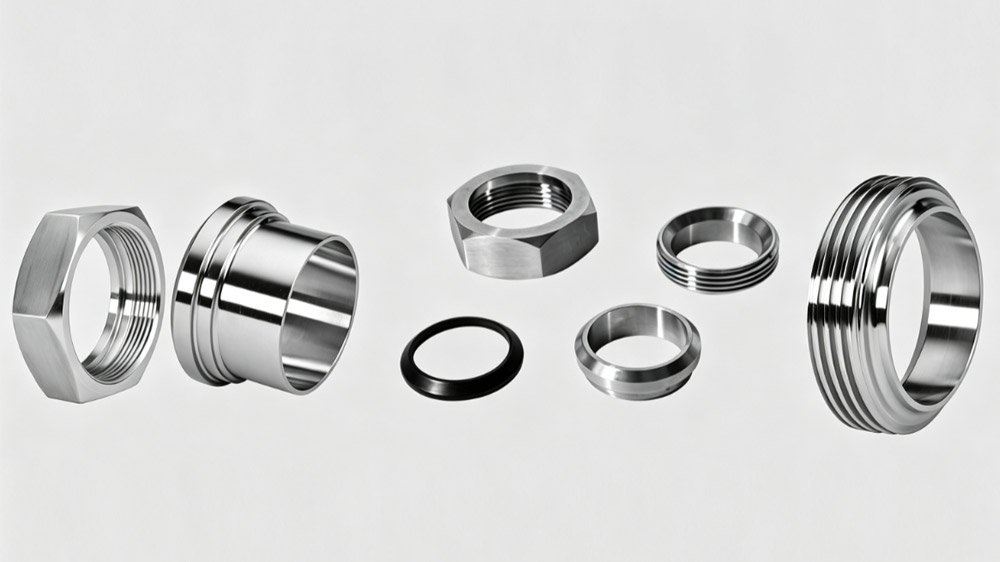
In food, beverage, dairy and other hygienic processing systems, sanitary fittings play an important role in connecting equipment, tanks, hoses and process pipelines. While Tri-Clamp connections are widely recognized, another connection type is still used in many traditional sanitary processing installations: bevel seat sanitary fittings.
A bevel seat fitting uses a threaded ferrule, a plain ferrule and a union nut to create a detachable mechanical connection. A compatible gasket can also be used to provide a more controlled sealing interface.
For engineers, maintenance teams and purchasing personnel, understanding how these components work is important when replacing existing fittings, extending process lines or specifying new equipment.
This guide explains the main components, connection principles, common configurations and selection considerations for bevel seat sanitary fittings.
1. What Are Bevel Seat Sanitary Fittings?
Bevel seat sanitary fittings are detachable stainless steel pipe connections commonly used in food, dairy, beverage and hygienic process systems.
Unlike Tri-Clamp fittings, which use a clamp to hold two ferrules together, a bevel seat connection uses a threaded union arrangement.
A typical connection consists of:
- One threaded bevel seat ferrule
- One plain bevel seat ferrule
- One hexagonal union nut
- A compatible bevel seat gasket, where specified by the connection design
The two ferrules are normally welded to their respective pipe sections or equipment connections. The union nut then holds the two mating ends together.
This design provides a relatively rigid and reusable connection that can be disassembled when equipment needs to be cleaned, inspected, maintained or reconfigured.
Bevel seat fittings are particularly relevant when maintaining or expanding existing process systems that already use this connection style.
2. Main Components of a Bevel Seat Fitting
Understanding the individual components helps prevent incorrect purchasing and assembly.
2.1 Threaded Bevel Seat Ferrule
The threaded bevel seat ferrule is one side of the connection. It has an external threaded section designed to engage with the union nut.
Its mating face is shaped to work with the corresponding plain ferrule and sealing arrangement.
Common configurations include short and long threaded ferrules, depending on the installation and product design.
2.2 Plain Bevel Seat Ferrule
The plain bevel seat ferrule is the corresponding mating component.
It typically has a smooth connection profile without the external threads found on the threaded ferrule. The union nut fits over this component and engages with the threaded ferrule.
Plain ferrules are commonly available in different lengths and welding configurations.
2.3 Hex Union Nut
The hex union nut connects the two ferrules mechanically.
Its external hexagonal shape allows a suitable wrench to be used during installation and removal.
The nut must match the relevant bevel seat connection size and thread design. A similar-looking nut from another connection system should not automatically be assumed compatible.
2.4 Bevel Seat Gasket
The gasket is an important part of the sealing arrangement.
A compatible gasket helps reduce direct metal-to-metal contact at the sealing interface and provides a defined sealing surface.
When selecting a gasket, confirm:
- Compatibility with the ferrule design
- Material compatibility with the process liquid
- Operating temperature
- Cleaning chemicals and CIP conditions
- Correct dimensions and seating profile
Common gasket materials used in sanitary processing include elastomers such as EPDM and silicone, although the appropriate material depends on the actual process conditions and supplier specifications.
3. How Does a Bevel Seat Union Work?
A bevel seat union creates a detachable connection through mechanical engagement between the ferrules and union nut.
The general assembly process is as follows:
- Position the compatible gasket at the designated sealing interface, if required by the connection design.
- Align the threaded and plain ferrules.
- Position the union nut around the plain ferrule.
- Engage the nut with the threaded ferrule.
- Tighten the connection according to the fitting manufacturer’s instructions.
Once assembled, the union holds the two ferrules together and maintains the intended sealing arrangement.
Before installation, inspect the mating faces, threads and gasket. Damaged threads, incorrect gasket profiles or misaligned ferrules can lead to leakage.
Do not use excessive tightening force as a substitute for correct component matching and gasket selection.
4. Bevel Seat vs. Tri-Clamp Fittings
Bevel seat and Tri-Clamp fittings both provide detachable connections for hygienic process piping, but their mechanical designs are different.
| Feature | Bevel Seat | Tri-Clamp |
|---|---|---|
| Connection method | Threaded union nut | External clamp |
| Main components | Threaded ferrule, plain ferrule and union nut | Two clamp ferrules, gasket and clamp |
| Sealing arrangement | Matching bevel seat interface and compatible gasket where specified | Gasket compressed between ferrule faces |
| Assembly tools | Suitable wrench may be required | Clamp tightening method depends on clamp design |
| Typical application | Existing bevel seat process lines and equipment connections | Hygienic pipelines, tanks and removable process connections |
| Maintenance | Disassembled by releasing the union nut | Disassembled by releasing the clamp |
Neither connection type is universally better.
The correct choice depends on the existing equipment, pipeline configuration, maintenance requirements and connection specifications.
If a process system already uses bevel seat fittings, replacing them with Tri-Clamp components may require suitable transition pieces or modifications to the existing pipework.
Bevel seat and Tri-Clamp connections are not the only options used in hygienic process piping. Threaded connections may also be found in certain equipment interfaces and pipeline configurations. Understanding the differences between these connection methods can help when selecting compatible fittings or planning pipeline modifications. Read our guide to Tri-Clamp vs. Threaded Connections for a closer comparison.
For more information about another common sanitary connection method, see our guide to Tri-Clamp fittings and their components.
5. Common Bevel Seat Fitting Configurations
Bevel seat fittings are available in several configurations for different installation requirements.
Short and Long Ferrules
Short and long ferrules provide different connection lengths and installation arrangements.
The correct configuration depends on the available space, welding position and mating components.
Solid End Caps
A bevel seat solid end cap can be used to close an unused connection.
It is useful when a pipeline branch or equipment connection needs to remain sealed while not in operation.
Tank Spuds
Bevel seat tank spuds provide a connection point on a tank wall or equipment surface.
They can be used when a tank requires a compatible bevel seat outlet or inlet connection.
Bevel Seat to Tri-Clamp Adapters
Transition fittings can connect equipment or pipeline sections using different connection systems.
For example, a bevel seat connection may need to interface with a Tri-Clamp process line.
The exact adapter configuration should be confirmed according to the connection dimensions and required installation orientation.
6. Materials, Sizes and Surface Finish
Stainless steel is commonly used for bevel seat sanitary fittings because of its corrosion resistance and suitability for hygienic processing environments.
Common material options offered in supplier catalogs include:
- Stainless Steel 304
- Stainless Steel 316L
The choice depends on the process medium, cleaning chemicals, operating environment and corrosion requirements.
Common Size Range
Some commercial bevel seat fitting catalogs offer sizes from 1 inch to 4 inches.
However, available sizes, tube outside diameters, ferrule dimensions and thread specifications can vary between product designs and manufacturers.
Do not assume that a nominal pipe size alone is sufficient to identify a compatible fitting.
Surface Finish
Surface finish is another important consideration for hygienic applications.
Some suppliers specify internal and external finishes such as 32 Ra, but this should not be treated as a universal specification for every bevel seat fitting.
When a particular hygienic surface finish is required, confirm the actual roughness specification and inspection requirements before ordering.
7. How to Select the Right Bevel Seat Sanitary Fittings
Before purchasing bevel seat fittings, confirm the following information.
1. Connection Type
Identify whether the existing connection uses bevel seat ferrules, threaded unions or another sanitary connection design.
A photograph of the installed connection can help with initial identification.
2. Nominal Size and Tube Outside Diameter
Confirm the nominal size and actual tube outside diameter.
Do not rely only on labels such as 1 inch, 1½ inches or 2 inches. The relevant ferrule dimensions must also match.
3. Ferrule Configuration
Determine whether you need:
- Short plain ferrules
- Long plain ferrules
- Short threaded ferrules
- Long threaded ferrules
- Tank spuds
- Solid end caps
- Transition adapters
4. Material
Specify the required stainless steel grade, such as 304 or 316L.
Consider the process liquid, cleaning chemicals and operating environment before selecting the material.
5. Gasket Requirements
Confirm the gasket profile, dimensions and material.
A gasket should be selected for the specific bevel seat connection rather than assumed interchangeable with a Tri-Clamp gasket.
6. Surface Finish and Special Requirements
If the fitting is intended for a hygienic or pharmaceutical process, confirm the required surface finish, documentation and any applicable industry requirements.
Providing a drawing or photograph is often the most reliable way to clarify a non-standard connection.
8. Common Purchasing and Installation Mistakes
Several problems can occur when bevel seat fittings are ordered without confirming the connection details.
Assuming all sanitary unions are interchangeable
Bevel seat fittings, Tri-Clamp fittings and other sanitary union designs have different connection geometries. Similar appearance does not guarantee compatibility.
Ordering only by nominal size
Two fittings carrying the same nominal size may still differ in ferrule dimensions, thread details or sealing profiles.
Using an incorrect gasket
An incompatible gasket may not seat correctly and can lead to leakage or an unreliable seal.
Mixing different fitting designs
Do not assume that components from different connection families can be combined simply because their dimensions appear similar.
Ignoring the installation environment
Limited installation space, cleaning requirements and maintenance access should all be considered when selecting the fitting configuration.
Confirming these details before purchasing helps reduce incorrect orders, installation delays and unnecessary replacement costs.
9. What Information Should You Provide When Requesting a Quote?
When requesting bevel seat sanitary fittings, providing clear technical information helps suppliers identify the correct components.
We recommend preparing the following details:
- Product name or component type
- Nominal size and tube outside diameter
- Material: 304 or 316L
- Ferrule configuration and length
- Gasket material, if required
- Required quantity
- Surface finish requirements
- Drawing or reference photograph, if available
If you are replacing an existing fitting, a photograph showing the complete connection and a close-up of the ferrule profile can be particularly helpful.
For special connections or mixed pipeline configurations, custom sanitary fittings and transition components may also need to be considered.
Explore our custom sanitary fittings for more information about non-standard connection requirements.
Conclusion
Bevel seat sanitary fittings remain a relevant connection option in food, beverage, dairy and other hygienic process installations.
Their threaded ferrule and union nut design provides a detachable connection for equipment and pipelines, while compatible gaskets help establish the required sealing interface.
The most important selection factors are the connection design, ferrule dimensions, thread compatibility, material and gasket specification.
Whether you are maintaining an existing bevel seat pipeline or planning a connection between different sanitary systems, confirming these details before ordering is essential for a reliable installation.
Need help identifying a bevel seat fitting?
Send us a product photograph, drawing or required dimensions. We can help review the connection type and identify the relevant components for your application.