A tank vent may look like a small accessory, but its design affects how a storage tank or process vessel exchanges air with the surrounding environment. In sanitary processing equipment, the choice of vent should reflect the vessel’s operating conditions, cleanliness requirements, and intended application.
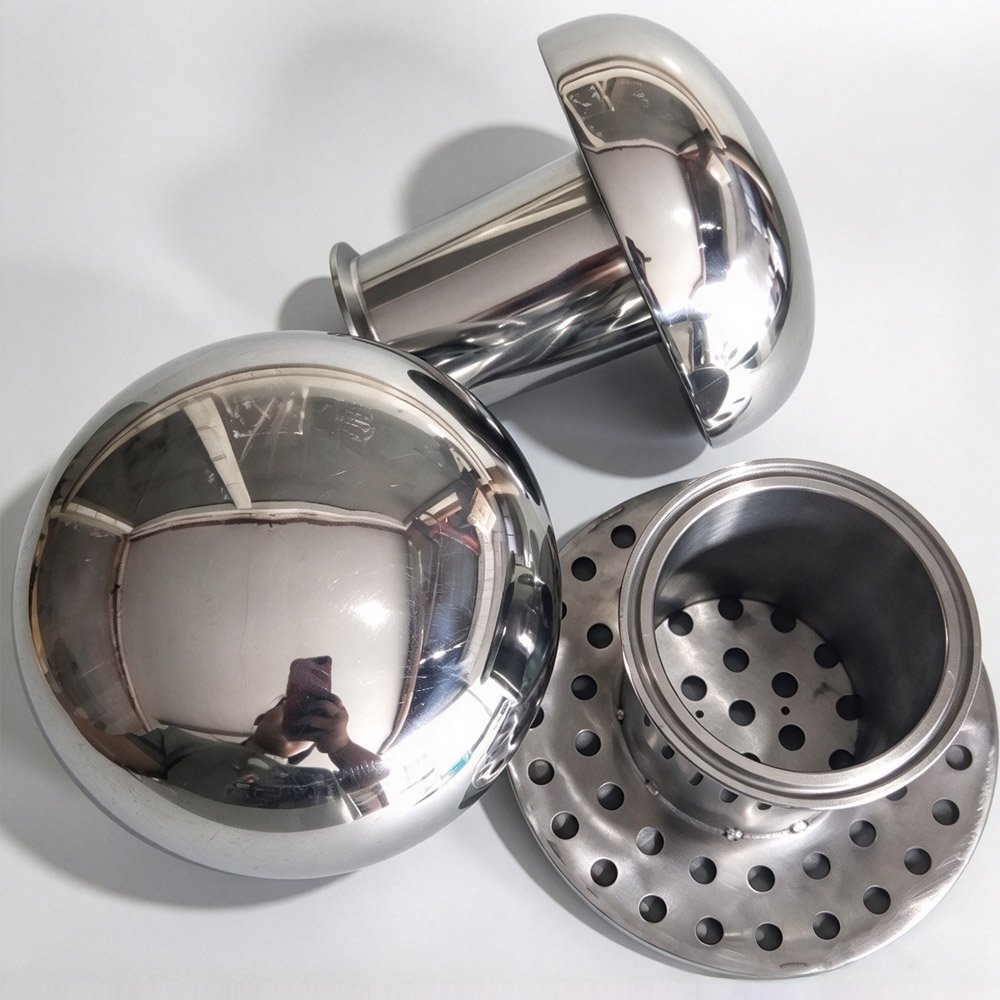
A mushroom tank vent cap is a simple venting component with a dome-shaped cover and openings beneath it. The cover helps shield the vent openings from direct exposure to rain and larger airborne debris while allowing air to move through the vent.
However, a mushroom vent cap is not the same as a filtered tank breather. Understanding the difference helps equipment buyers choose a suitable component rather than relying on appearance or connection size alone.
How Does a Mushroom Tank Vent Cap Work?
A mushroom-style tank vent typically consists of three visible features: a dome-shaped cover, a perforated base or vent section, and a connection that mounts to the tank.
The dome helps protect the openings from direct exposure to the external environment. Air passes through the openings beneath the cover, allowing communication between the tank interior and the surrounding atmosphere.
This arrangement can be useful where a vessel requires simple atmospheric venting. For example, air may need to enter or leave a non-pressurized storage tank as liquid levels change.
The actual airflow capacity depends on the vent’s open area, geometry, and the pressure difference across it. A vent cap should not be assumed to provide sufficient airflow for every tank simply because it has multiple openings.
Where Are Mushroom Tank Vent Caps Used?
Mushroom vent caps may be considered for suitable atmospheric storage and process vessels in food, beverage, dairy, and other sanitary processing environments.
Typical applications may include:
- Atmospheric storage tanks that require air exchange.
- Mixing or ingredient tanks operating under suitable atmospheric conditions.
- Non-pressurized process vessels where simple venting is appropriate.
- Equipment where a removable sanitary connection is useful for inspection and maintenance.
The suitability of the vent depends on the actual process. A vessel containing sensitive products may require a higher level of protection against airborne contamination than an open vent cap can provide.
For fermentation, pharmaceutical, or other contamination-sensitive applications, the venting arrangement should be assessed as part of the overall process design.
Mushroom Vent Cap vs. Filtered Tank Breather
Although both components are installed on tanks, a mushroom vent cap and a filtered tank breather serve different purposes.
| Selection Factor | Mushroom Vent Cap | Filtered Tank Breather |
|---|---|---|
| Main function | Allows atmospheric air exchange | Allows air exchange through a filter element |
| Protection against direct exposure | Dome helps shield openings from rain and larger debris | Depends on housing design and filter arrangement |
| Particle filtration | No defined filtration rating unless a separate filter is incorporated | Depends on the installed filter element and its specifications |
| Sterile air capability | Not provided by the cap alone | Requires a suitable filter and validated operating conditions |
| Maintenance | Inspection and cleaning of openings and surfaces | Inspection, cleaning, and filter-element replacement as applicable |
| Typical selection priority | Simple atmospheric venting | Air exchange with a specified filtration requirement |
A filtered breather is generally the more appropriate starting point when incoming air must pass through a specified filtration medium. The required filtration efficiency, airflow, operating conditions, and sterilization compatibility must still be confirmed.
For more information, see our guide to How to Choose a Sanitary Tank Breather Filter.
What to Check Before Selecting a Mushroom Vent Cap
1. Tank Operating Conditions
First, determine whether the vessel is designed for atmospheric operation or whether it may experience positive or negative pressure.
A simple mushroom vent cap should not be treated as a certified pressure-and-vacuum relief device. If the vessel requires protection against excessive pressure or vacuum, an appropriately sized and specified protective device may be necessary.
2. Airflow Requirements
Consider the maximum rate at which liquid enters or leaves the tank, along with any temperature-related changes that affect the required air exchange.
The vent must have sufficient capacity for the intended operating conditions. Connection diameter alone does not establish airflow capacity.
3. Cleanliness and Contamination Control
The dome cover helps reduce direct exposure to rain and larger debris, but the openings do not provide a defined barrier against fine particles or microorganisms.
Where product protection depends on filtered air, select a suitable filtered venting arrangement instead of assuming that a protective cover provides sterile ventilation.
4. Connection Size and Installation
A sanitary Tri-Clamp connection allows the vent to be removed for inspection and cleaning. When selecting a size, confirm the actual ferrule dimensions and compatibility with the tank connection.
Do not select the connection based only on the nominal diameter shown in a product listing. Confirm the required interface with the equipment supplier.
5. Material and Cleaning Requirements
Stainless steel is commonly used for sanitary process components. The appropriate grade depends on the product, cleaning chemicals, temperature, and corrosion requirements.
Confirm the actual material grade and surface finish before specifying the component for a particular application. A removable connection can simplify access, but it does not by itself establish that a component is suitable for every cleaning or sterilization procedure.
Why Use a Tri-Clamp Mushroom Tank Vent?
A Tri-Clamp connection offers practical advantages when a vent needs to be removed for inspection, cleaning, or replacement.
Compared with a permanently fixed connection, a removable connection can make routine maintenance more convenient and help equipment integrators standardize sanitary interfaces across compatible components.
The connection should nevertheless match the vessel’s design, and the complete installation must meet the process’s airflow, cleanliness, and pressure-protection requirements.
Frequently Asked Questions
Does a mushroom tank vent cap filter the air?
Not by itself. A standard mushroom vent cap allows air to pass through its openings but does not provide a defined particle-removal rating. Filtration requires a suitable filter element or a separate filtration arrangement.
Can a mushroom vent cap be used on a fermentation tank?
It may be suitable for certain atmospheric vessels, depending on the process. Fermentation tanks that require controlled or sterile air exchange generally need a specifically designed vent filtration system. Confirm the tank’s operating conditions and contamination-control requirements before selecting the component.
Does a mushroom vent cap prevent overpressure?
It should not be relied upon as a pressure-relief device. Its airflow capacity may be insufficient under certain conditions, and it is not automatically designed or certified for pressure or vacuum protection.
What is the advantage of a Tri-Clamp connection?
A Tri-Clamp connection allows convenient removal and reinstallation for inspection and cleaning, provided the connection dimensions are compatible with the vessel.
Choosing the Right Tank Vent
A mushroom tank vent cap can be a practical choice when a vessel requires simple atmospheric venting and the process does not require a defined air-filtration barrier. Where contamination control, sterile air, or pressure and vacuum protection are critical, the complete venting system needs a more specific engineering assessment.
Before purchasing, confirm the tank’s operating conditions, required airflow, connection dimensions, material, and cleanliness requirements.
Looking for a sanitary Tri-Clamp mushroom tank vent cap? Contact Haoqintech to confirm connection compatibility and product specifications for your application.