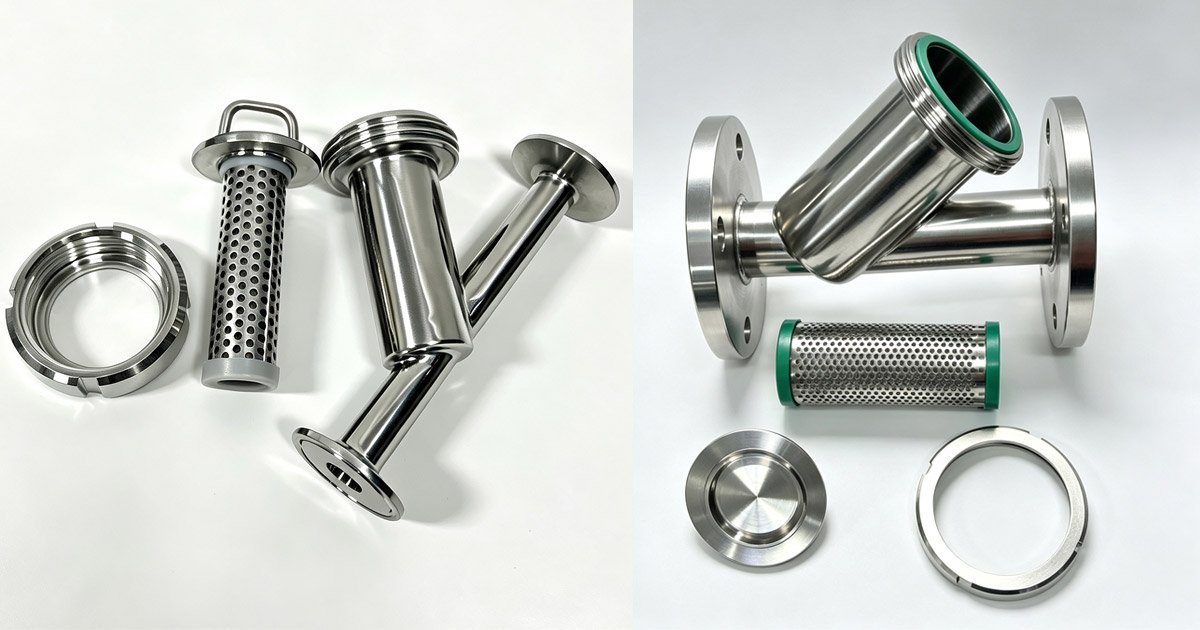
When selecting a stainless steel Y-strainer, the connection type is one of the first details to confirm. A flanged Y-strainer and a Tri-Clamp Y-strainer serve a similar basic purpose: retaining unwanted particles in a pipeline. However, their connection designs, installation requirements, and size specifications are different.
Choosing the wrong connection can lead to installation delays, additional adapters, or compatibility problems with existing pipework.
For purchasing teams, equipment integrators, and process engineers, the decision should start with the existing piping system—not simply the nominal size shown on a product listing.
1. What Is the Difference Between Flanged and Tri-Clamp Connections?
The main difference is how the strainer connects to the pipeline.
A flanged Y-strainer connects through mating flanges. Installation requires compatible flange dimensions, bolt-hole arrangements, sealing surfaces, and the appropriate gasket and fastening components.
A Tri-Clamp Y-strainer uses clamp-style sanitary connections. The mating ferrules, gasket, and clamp must match the intended connection size and design.
These connection types are not directly interchangeable. If a pipeline uses flanges, a Tri-Clamp strainer will not normally fit without a suitable transition assembly. The same applies when installing a flanged strainer in a Tri-Clamp line.
The right option depends on the piping already installed, the equipment connection, and the requirements of the process.
2. When Should You Choose a Flanged Y-Strainer?
A flanged Y-strainer is worth considering when the existing pipeline and connected equipment use compatible flanged connections.
Before ordering, confirm:
- The required nominal pipe size (DN).
- The applicable flange standard and dimensions.
- The bolt-hole arrangement and flange facing.
- The required sealing components.
- The material and operating conditions specified for the application.
A DN designation alone is not enough to confirm that two flanges will fit together. Flange standards and dimensional details must also be checked.
Available Flanged Y-Strainer Sizes
Haoqintech’s 304 SS Sanitary Flanged Y-Strainer is listed in the following nominal sizes:
| Listed size | Connection |
|---|---|
| DN20 | Flanged |
| DN25 | Flanged |
| DN32 | Flanged |
| DN40 | Flanged |
| DN50 | Flanged |
| DN65 | Flanged |
| DN80 | Flanged |
The product is listed in SS304 stainless steel.
The applicable flange standard and detailed flange dimensions should be confirmed before ordering. Do not assume a particular standard based on the DN size alone.
View the product: 304 SS Sanitary Flanged Y-Strainer.
3. When Should You Choose a Tri-Clamp Y-Strainer?
A Tri-Clamp Y-strainer may be suitable when the existing process line uses compatible sanitary clamp connections and requires components that can be disconnected for inspection or maintenance.
Before ordering, check:
- The connection size and corresponding ferrule dimensions.
- Compatibility with the existing clamp and gasket.
- The required strainer body material.
- The screen specification needed for the process.
- The operating conditions and applicable cleaning requirements.
A Tri-Clamp connection can simplify disassembly compared with a permanently welded connection, but the connection alone does not establish that the entire assembly meets a particular hygienic or cleanability standard. The complete design and operating requirements still matter.
Available Tri-Clamp Y-Strainer Sizes
Haoqintech’s 304 Stainless Steel Sanitary Y-Strainer Tri-Clamp Quick Connect is listed in the following sizes:
| Listed size | Tube outside diameter |
|---|---|
| 3/4 in | φ19 mm |
| 1 in | φ25 mm |
| 1-1/4 in | φ32 mm |
| 1-1/2 in | φ38 mm |
| 1-3/4 in | φ45 mm |
| 2 in | φ51 mm |
| 2-1/4 in | φ57 mm |
| 2-1/2 in | φ63 mm |
| 3 in | φ76 mm |
| 3-1/2 in | φ89 mm |
| 4 in | φ102 mm |
These are the sizes listed for this product. Confirm the required connection dimensions against the actual mating components before placing an order.
View the product: 304 Stainless Steel Sanitary Y-Strainer Tri-Clamp Quick Connect.
4. DN and Tube Outside Diameter Are Not the Same Specification
One common purchasing mistake is to compare a DN size directly with a tube outside diameter and assume that the two are equivalent.
DN is a nominal size designation. The tube outside diameter is a physical dimension. Tri-Clamp connection sizing also depends on the corresponding ferrule and clamp design.
For example, the listed Tri-Clamp sizes include φ25 mm and φ51 mm tube outside diameters. These figures should not be treated as direct equivalents to DN25 and DN50 flanged connections without checking the relevant dimensional standards.
When comparing products from different suppliers, use the connection drawings and dimensional specifications—not the size label alone.
5. What Should You Confirm Before Ordering?
To reduce the risk of ordering an incompatible Y-strainer, prepare the following information:
Connection type: Confirm whether the pipeline uses flanges or Tri-Clamp connections.
Required size: Provide the nominal size and, where relevant, the actual tube outside diameter or mating connection dimensions.
Connection standard: For flanged products, confirm the applicable flange standard and bolt-hole dimensions. For Tri-Clamp products, confirm ferrule and clamp compatibility.
Material: The two products described here are listed as SS304. If another material grade is required, confirm its availability before ordering.
Screen specification: Confirm the required mesh or opening size for the particles being retained. Do not assume that the screen specification is the same across different product models.
Operating conditions: Provide the process fluid, operating temperature, pressure requirements, and other relevant conditions so the product can be checked for suitability.
Installation and maintenance: Consider available installation space and whether the strainer needs to be disconnected for inspection or cleaning.
6. Which Y-Strainer Connection Is Right for Your System?
There is no universal winner between flanged and Tri-Clamp Y-strainers. The appropriate choice is the one that matches the existing pipework and the requirements of the application.
Choose a flanged model when the pipeline requires a compatible flanged connection and the flange dimensions have been verified.
Choose a Tri-Clamp model when the pipeline uses compatible sanitary clamp connections and the required ferrule dimensions have been confirmed.
If the connection type or dimensions are uncertain, verify them before selecting a product. This is generally more reliable than choosing by nominal size alone.
Haoqintech offers both a 304 SS Sanitary Flanged Y-Strainer and a 304 Stainless Steel Sanitary Tri-Clamp Y-Strainer. Share your required connection type, size, and application details when requesting a quotation so the specifications can be checked before order confirmation.