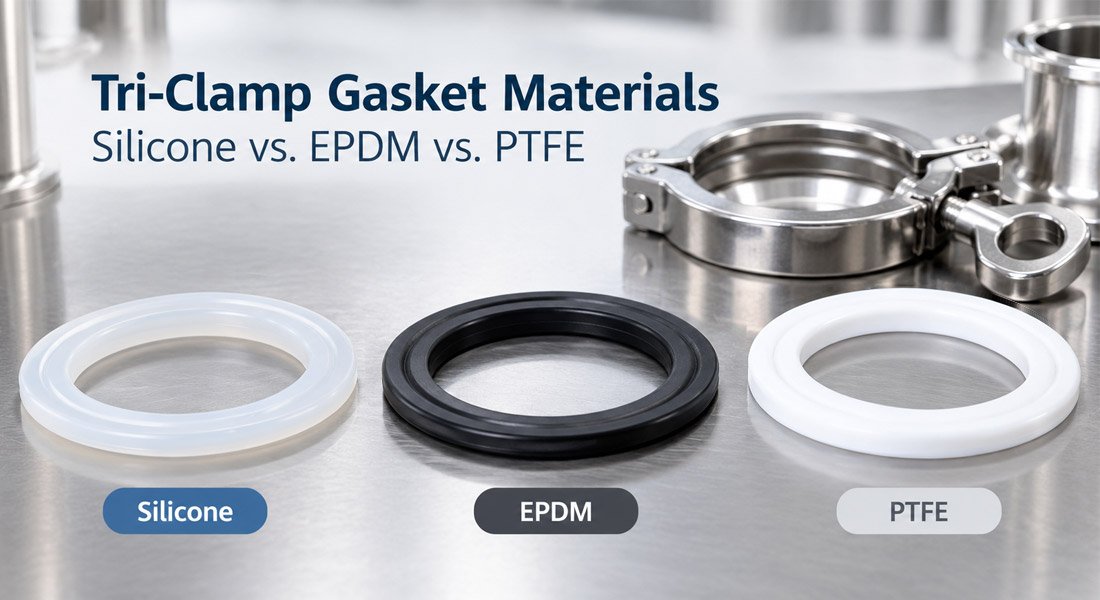
Tri-Clamp gaskets play a critical role in sanitary process piping. Although they are small components, the wrong gasket material can lead to leakage, premature wear, chemical incompatibility, or unnecessary maintenance.
Silicone, EPDM, and PTFE are three common gasket material options for hygienic processing systems. However, they are not interchangeable in every application. The right choice depends on the process fluid, operating temperature, cleaning chemicals, pressure conditions, and applicable hygiene requirements.For an overview of ferrules, clamps, and connection components, see our guide to Tri-Clamp fittings.
This guide compares silicone, EPDM, and PTFE Tri-Clamp gaskets to help equipment engineers, maintenance teams, and purchasing professionals make a more informed selection.
1. Silicone vs. EPDM vs. PTFE: Key Differences
The three materials have different physical and chemical properties. Understanding these differences is the first step toward selecting a suitable gasket.
| Property | Silicone | EPDM | PTFE |
|---|---|---|---|
| Material type | Silicone elastomer | Synthetic rubber | Fluoropolymer |
| Flexibility | Generally very flexible | Flexible and resilient | Relatively rigid compared with elastomers |
| Temperature resistance | Good, depending on grade | Good, depending on grade | Broad temperature capability, depending on design |
| Water and steam resistance | Often suitable for specified conditions | Often suitable for specified conditions | Generally excellent chemical and thermal resistance |
| Chemical resistance | Depends on the fluid and grade | Good for many water-based and alkaline applications; limited with oils and some solvents | Broad resistance to many chemicals |
| Compression and recovery | Good, depending on formulation | Good elastic recovery | Conventional PTFE can creep under sustained compression |
| Typical consideration | Hygiene requirements and mechanical durability | Cleaning chemicals and process-fluid compatibility | Sealing design, creep, and installation conditions |
These are general comparisons, not universal material ratings. Actual performance depends on the compound, gasket design, operating conditions, and manufacturer’s specifications.
2. Silicone Tri-Clamp Gaskets
Silicone gaskets are commonly used in hygienic applications where flexibility, temperature capability, and cleanability are important.
Advantages
- Good flexibility helps the gasket conform to the sealing surfaces.
- Suitable grades can tolerate repeated exposure to hot water and specified steam-cleaning conditions.
- Silicone is available in formulations designed for food-contact applications.
- Its flexibility can simplify installation and routine replacement.
Limitations
Silicone is not automatically compatible with every process fluid or cleaning chemical. Certain oils, solvents, and aggressive chemicals may cause swelling, degradation, or loss of sealing performance.
Mechanical damage and compression set can also affect long-term sealing reliability. Repeated thermal cycling and installation practices should be considered when establishing a maintenance schedule.
Typical applications
Silicone may be considered for food and beverage processing, liquid culture systems, and other hygienic processes where its specific grade meets the required temperature, chemical compatibility, and regulatory criteria.
For steam sterilization or repeated CIP cycles, verify the manufacturer’s documented limits rather than relying on the material name alone.
3. EPDM Tri-Clamp Gaskets
EPDM, or ethylene propylene diene monomer rubber, is widely used in industrial sealing applications. It can be a practical option for systems exposed to water, hot water, and many common aqueous cleaning solutions.
Advantages
- Good resistance to water and many water-based cleaning environments.
- Good elasticity and sealing recovery when properly selected.
- Suitable grades are available for repeated hot-water or steam exposure.
- Often a cost-effective option for compatible process conditions.
Limitations
EPDM is generally not a good choice for many petroleum-based oils, greases, and certain hydrocarbon solvents. Compatibility with acids, alkalis, oxidizing agents, and other cleaning chemicals depends on their concentration, temperature, and exposure duration.
An EPDM gasket that performs well in a water-based CIP system may not be appropriate for a different formulation or a process involving incompatible oils or solvents.
Typical applications
EPDM may be suitable for water-based food processing, beverage systems, utility lines, and CIP circuits when the specific compound is approved for the intended service.
Before specifying EPDM, check the full cleaning cycle, including chemical concentration, temperature, contact time, rinsing conditions, and any steam exposure.
4. PTFE Tri-Clamp Gaskets
PTFE, or polytetrafluoroethylene, is a fluoropolymer known for its broad chemical resistance and low-friction surface.
It is often considered when elastomer compatibility is a concern or when the process involves chemicals that may attack silicone or EPDM.
Advantages
- Excellent resistance to a broad range of chemicals.
- Suitable for many aggressive process-fluid applications.
- Low surface friction and low material reactivity.
- Can be used in applications requiring a chemically resistant sealing material.
Limitations
Conventional PTFE is less elastic than rubber materials. It does not recover in the same way as silicone or EPDM and can creep under sustained compressive loading.
This means that gasket geometry, flange alignment, clamp loading, surface condition, and installation procedure become especially important. A PTFE gasket should not be assumed to provide better sealing simply because its chemical resistance is higher.
PTFE formulations and gasket designs also differ. Modified PTFE and envelope-style gaskets may behave differently from conventional solid PTFE gaskets.
Typical applications
PTFE may be considered for chemical processing, pharmaceutical production, and other hygienic systems where chemical compatibility is a priority.
For pharmaceutical or food-contact service, chemical resistance alone is not enough. Confirm the relevant extractables or material qualification requirements, applicable regulatory documentation, and suitability for the actual cleaning and sterilization cycle.
5. Which Gasket Material Is Best for CIP and SIP?
Clean-in-place (CIP) and steam-in-place (SIP) impose different demands on gasket materials.
CIP may expose a gasket to alkaline detergents, acids, surfactants, hot water, and repeated thermal changes. SIP introduces additional considerations involving steam temperature, exposure duration, pressure, and repeated sterilization cycles.
| Operating condition | Material to evaluate | What to verify |
|---|---|---|
| Water-based CIP | EPDM or silicone | Cleaner compatibility, concentration, temperature, and exposure time |
| Repeated hot-water cleaning | Silicone or EPDM | Maximum service temperature and long-term aging |
| Specified steam sterilization | Qualified silicone or EPDM; suitable PTFE designs where applicable | Steam rating, pressure, cycle duration, and repeated-cycle performance |
| Chemically aggressive media | PTFE or a specifically compatible elastomer | Compatibility with the actual fluid and cleaning agents |
| Frequent disassembly | Silicone or EPDM may offer practical advantages | Compression recovery, wear, and correct gasket seating |
This table is a starting point, not a substitute for a compatibility review. Neither silicone nor EPDM is universally suitable for SIP, and PTFE’s chemical resistance does not eliminate its mechanical sealing limitations.
For a new system, document the complete cleaning and sterilization cycle before finalizing the gasket specification.For more information on hygienic tank cleaning, see our guide to CIP cleaning systems.
6. How to Choose the Right Tri-Clamp Gasket
Material selection should be based on the actual operating conditions rather than price or a general preference for one material.
Identify the process fluid
List every fluid that may contact the gasket, including the main product, flushing water, cleaning solutions, and sterilization media.
A gasket compatible with the product itself may still be damaged by the cleaning chemicals used between production batches.
Confirm the operating temperature
Consider both normal operating temperature and the highest temperature reached during cleaning or sterilization. Repeated heating and cooling can affect material life even when each individual cycle falls within a nominal temperature rating.
Check pressure and sealing design
Confirm the system’s operating pressure, any pressure fluctuations, the connection geometry, and the gasket’s specified pressure limitations.
PTFE deserves particular attention because conventional PTFE can deform under sustained compression. Correct installation and the manufacturer’s recommended clamp assembly procedure are essential.
Verify hygienic and regulatory requirements
For food, dairy, pharmaceutical, and liquid culture applications, confirm whether the gasket needs food-contact documentation, specific regulatory compliance, or additional qualification for high-purity service.
Do not assume that all products made from the same base material have identical approvals.
Match the gasket to the Tri-Clamp connection
The gasket must match the connection’s nominal size and the sealing geometry. Check the applicable flange standard, ferrule dimensions, gasket profile, and required material specification.
A gasket with the correct nominal pipe size may still be unsuitable if its sealing profile does not match the connection.
7. Common Tri-Clamp Gasket Selection Mistakes
Several avoidable mistakes can shorten gasket life or cause leakage.
- Choosing by material name alone. Different silicone, EPDM, and PTFE grades can have different performance limits.
- Ignoring cleaning chemicals. Compatibility with the product does not guarantee compatibility with CIP detergents or sanitizers.
- Using temperature ratings without checking the cycle. Peak temperature, exposure duration, and repeated cycling all matter.
- Overlooking the sealing design. A less resilient material may require more careful attention to gasket geometry and installation.
- Reusing damaged gaskets. Cuts, deformation, swelling, cracking, or permanent compression can compromise the seal.
- Mixing incompatible specifications. The gasket profile, ferrule dimensions, clamp assembly, and material requirements must all match the intended service.
If a connection repeatedly leaks, replacing the gasket with a different material is not always the correct first step. Inspect ferrule alignment, surface damage, assembly technique, clamp condition, and the possibility of excessive or uneven loading.
8. Questions to Confirm Before Purchasing
Before ordering replacement or new Tri-Clamp gaskets, prepare the following information:
- Tri-Clamp nominal size and gasket profile.
- Process fluid and any cleaning or sterilization chemicals.
- Normal and maximum operating temperatures.
- Operating pressure and relevant pressure variations.
- CIP/SIP frequency and cycle duration.
- Food-contact, pharmaceutical, or other documentation requirements.
- Preferred gasket material and any existing equipment specifications.
Providing these details to the gasket supplier helps reduce the risk of selecting an incompatible material or connection size.
Conclusion
Silicone, EPDM, and PTFE each have advantages in sanitary process systems. Silicone offers flexibility and is available in grades for hygienic applications. EPDM can be suitable for many water-based cleaning environments. PTFE provides broad chemical resistance but requires careful consideration of its mechanical sealing behavior.
The best Tri-Clamp gasket is the one that matches the process fluid, cleaning cycle, temperature, pressure, connection geometry, and applicable hygiene requirements.
For reliable performance, confirm the exact gasket grade and design with the manufacturer’s technical documentation before installation.