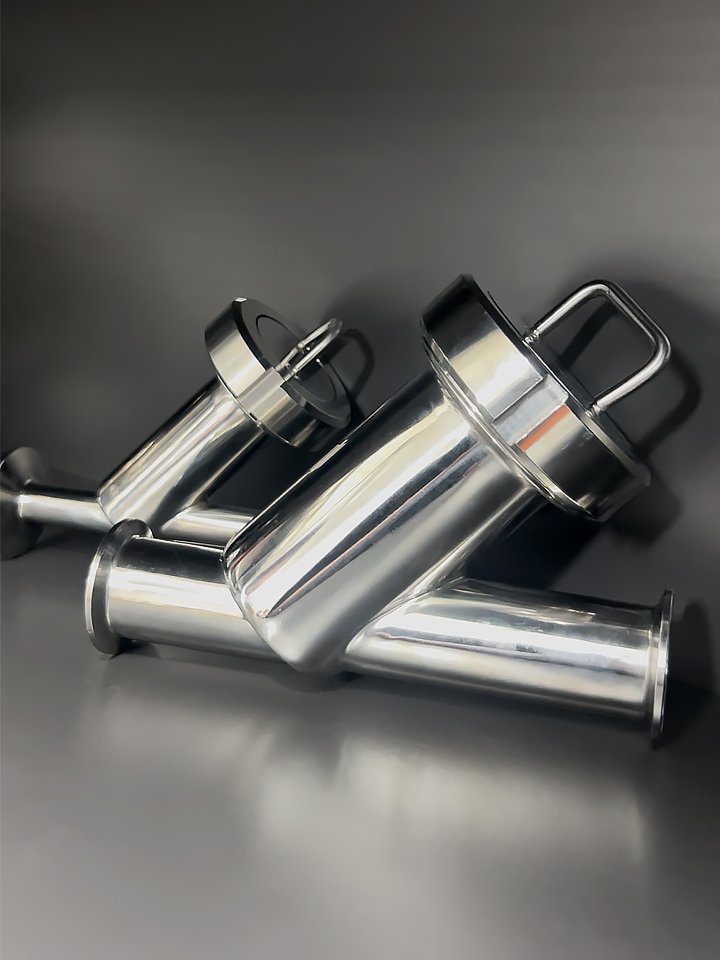
A sanitary Y-strainer is commonly installed in hygienic piping systems to remove unwanted particles before they reach pumps, valves, heat exchangers, filling equipment, or other downstream components.
However, a Y-strainer can also become a source of pressure drop.
A small pressure difference across a clean strainer can be normal. The problem occurs when the pressure drop becomes excessive or increases significantly during operation.
This can reduce flow, increase pump load, affect downstream equipment, and indicate that the strainer requires inspection or cleaning.
In this article, we look at the most common reasons why a sanitary Y-strainer causes pressure drop and how engineers can identify and solve the problem.
What Is Pressure Drop Across a Y-Strainer?
Pressure drop is the difference between the fluid pressure upstream and downstream of the strainer.
In simple terms:
Pressure Drop = Upstream Pressure − Downstream Pressure
When liquid flows through a sanitary Y-strainer, it passes through the internal filter screen.
The screen creates resistance to the flow. A clean screen normally creates some pressure loss, while a partially blocked or undersized screen can create a much larger pressure drop.
The actual pressure drop depends on several factors, including:
- Flow rate
- Screen opening size
- Available filtration area
- Fluid viscosity
- Particle loading
- Strainer size
- Internal geometry
- Screen condition
- Installation configuration
Therefore, pressure drop should always be considered together with the actual process conditions.
1. The Strainer Screen Is Becoming Blocked
One of the most common causes of increasing pressure drop is screen blockage.
During operation, particles captured by the Y-strainer accumulate on the screen surface.
As more of the screen becomes covered, the effective open area available for liquid flow decreases.
The result is increased flow resistance.
This can create a typical pattern:
Clean Screen → Normal Pressure Drop
Partially Blocked Screen → Higher Pressure Drop
Heavily Blocked Screen → Excessive Pressure Drop and Reduced Flow
This is particularly important in processes containing suspended solids, fibers, particles, crystallized material, or other contaminants.
If the pressure difference gradually increases during production, the first practical step is often to inspect the strainer screen.
2. The Mesh Is Too Fine for the Application
A finer mesh can capture smaller particles, but it also provides smaller openings for the liquid to pass through.
This means that selecting a very fine screen simply because it provides better filtration can create unnecessary flow resistance.
For example, a process that only needs to remove relatively large particles may not benefit from an extremely fine mesh.
Instead, the finer screen may:
- Increase pressure drop
- Block more quickly
- Require more frequent cleaning
- Reduce effective flow
- Increase maintenance requirements
This does not mean that coarse mesh is always better.
The screen opening should be selected according to the particles that need to be removed and the flow requirements of the system.
The objective is to achieve the required filtration without creating unnecessary resistance.
3. The Strainer Is Undersized
Another common cause of pressure drop is an undersized strainer.
A small strainer may technically connect to the pipeline, but the available filtration area may not be sufficient for the required flow rate.
When a large amount of liquid is forced through a relatively small screen area, the velocity through the screen can increase.
This can result in higher pressure loss.
For this reason, the connection size alone should not be used to determine whether a Y-strainer is correctly sized.
Engineers should also consider:
- Required flow rate
- Fluid viscosity
- Screen area
- Particle loading
- Available installation space
- Acceptable pressure drop
A larger strainer is not automatically required in every application, but the filtration area should be appropriate for the process.
4. The Fluid Has High Viscosity
Pressure drop is also affected by the properties of the liquid being filtered.
Water-like liquids can pass through a strainer relatively easily.
Higher-viscosity liquids create greater resistance to flow.
This becomes particularly important in food processing, dairy, syrup, fermentation, cosmetic, and other hygienic applications where the process fluid may be considerably more viscous than water.
If the same strainer is used for two liquids with very different viscosities, the pressure drop may also be very different.
Therefore, strainer selection should consider the actual process fluid rather than using water-flow performance as the only reference.
5. The Process Flow Rate Is Too High
Increasing flow rate generally increases the velocity through the strainer and can increase pressure loss.
A strainer that performs well at one flow rate may produce a higher pressure drop when the process flow is significantly increased.
This is important when a production line is upgraded.
For example, a system originally designed for a lower production capacity may later be operated at a higher flow rate.
The existing Y-strainer may then become a restriction in the system.
If the process has recently increased its flow rate, the strainer should be reevaluated rather than assuming that the original specification is still suitable.
6. Too Much Solid Material Is Being Captured
Even when the screen mesh is appropriate, a high concentration of particles can cause rapid screen loading.
This can happen when the upstream process generates or carries a significant amount of solid material.
Examples may include:
- Product particles
- Crystals
- Fibers
- Sediment
- Process debris
- Upstream equipment contamination
In this situation, the pressure drop may increase much faster than expected.
The solution may not simply be to install a larger or coarser screen.
The process may also need:
- More frequent cleaning
- An upstream pre-filtration stage
- A larger filtration area
- A different filtration arrangement
- Improved upstream process control
The correct solution depends on the type and quantity of material being captured.
7. The Strainer Is Installed Incorrectly
Installation can also affect performance.
A sanitary Y-strainer should be installed according to its intended flow direction and process configuration.
If the strainer is installed incorrectly, the screen may not operate as intended and cleaning or particle collection can also become more difficult.
Before troubleshooting the screen itself, check:
- Flow direction
- Installation orientation
- Connection alignment
- Valve positions
- Upstream and downstream piping
- Whether the screen is correctly seated
A basic installation problem can sometimes create symptoms that appear to be a filtration problem.
8. The Screen Is Damaged or Not Properly Seated
A strainer screen should be correctly positioned inside the housing.
If the screen is damaged, deformed, incorrectly installed, or not properly seated, the flow path may be affected.
A damaged screen can also create a filtration problem rather than simply a pressure-drop problem.
During maintenance, inspect the screen for:
- Deformation
- Damage
- Corrosion
- Blockage
- Broken mesh
- Incorrect installation
The gasket and sealing surfaces should also be checked when the strainer is opened.
How Can You Tell What Is Causing the Pressure Drop?
A practical way to troubleshoot a sanitary Y-strainer is to compare the pressure upstream and downstream of the strainer.
If pressure gauges or pressure sensors are available on both sides, the pressure difference can be monitored during operation.
For example:
Low pressure drop + stable flow
→ The strainer is likely operating normally.
Pressure drop gradually increasing
→ Screen loading or blockage should be investigated.
High pressure drop from the beginning
→ Check strainer sizing, mesh, flow rate, fluid viscosity, and installation.
Sudden pressure increase
→ Check for rapid blockage, abnormal particle loading, valve problems, or changes in the process.
Monitoring pressure difference over time can therefore provide useful information about the condition of the strainer.
How to Reduce Pressure Drop Across a Sanitary Y-Strainer
If the pressure drop is too high, several approaches can be considered.
Clean the Screen
If the screen is loaded with particles, cleaning may immediately restore flow capacity.
Review the Mesh Size
If the screen is unnecessarily fine for the application, a more suitable mesh may reduce flow resistance.
The filtration requirement should still be maintained.
Increase the Filtration Area
For higher-flow applications, a larger strainer or a design with greater effective screen area may help reduce pressure loss.
Review the Flow Rate
If the process flow has increased, check whether the existing strainer is still appropriately sized.
Consider Fluid Properties
For viscous liquids, strainer selection should account for the actual viscosity rather than relying only on water-based specifications.
Improve Upstream Filtration
If the Y-strainer is becoming blocked too quickly, an upstream filtration stage may reduce the particle load reaching the strainer.
Should You Always Choose a Larger Mesh?
No.
The objective of strainer selection is not simply to minimize pressure drop.
The screen must still remove the particles that could damage or interfere with downstream equipment.
A screen that is too coarse may reduce pressure drop but allow unwanted particles to pass through.
A screen that is too fine may provide better particle retention but create excessive pressure loss and require frequent cleaning.
The correct choice is therefore a balance between:
Particle Removal + Flow Requirement + Pressure Drop + Maintenance Frequency
This is particularly important in sanitary processing systems where both product quality and equipment protection matter.
When Should a Sanitary Y-Strainer Be Cleaned?
There is no universal cleaning interval that applies to every process.
Cleaning frequency depends on:
- Particle concentration
- Process fluid
- Flow rate
- Screen mesh
- Strainer size
- Production schedule
- Acceptable pressure drop
Instead of relying only on a fixed calendar interval, some systems can use pressure difference as an indicator.
If the pressure drop across the strainer increases beyond the acceptable operating range, the screen can be inspected and cleaned.
This approach can help maintenance teams respond to actual process conditions.
Y-Strainer Pressure Drop in Hygienic Processing Systems
In food, beverage, dairy, pharmaceutical, fermentation, and other hygienic systems, maintaining stable flow is important for consistent process performance.
A Y-strainer is often installed upstream of sensitive equipment such as:
- Pumps
- Valves
- Filling systems
- Heat exchangers
- Flow control components
- Other process equipment
If the strainer becomes heavily blocked, the resulting pressure loss may affect the entire downstream process.
For this reason, the strainer should be considered as part of the complete piping system rather than as an isolated component.
The correct combination of strainer size, screen mesh, flow rate, and maintenance practice can help maintain stable operation.
Practical Checklist
When a sanitary Y-strainer causes excessive pressure drop, check the following:
- Is the screen blocked?
- Is the mesh too fine?
- Is the strainer correctly sized?
- Has the process flow rate increased?
- Is the fluid more viscous than expected?
- Is there excessive particle loading?
- Is the flow direction correct?
- Is the screen properly installed?
- Is the screen damaged?
- Does the system require more filtration area?
- Would upstream pre-filtration reduce the particle load?
Working through these points systematically can help identify the cause without immediately replacing the entire strainer.
Conclusion
A sanitary Y-strainer naturally creates some resistance to liquid flow because the process fluid must pass through a filtration screen.
However, excessive or increasing pressure drop usually indicates that the strainer or process conditions need to be reviewed.
The most common causes include screen blockage, overly fine mesh, insufficient filtration area, high flow rate, high fluid viscosity, excessive particle loading, and installation problems.
The solution is not always to use a larger mesh or a larger strainer.
Instead, the strainer should be evaluated according to the actual process conditions, filtration requirements, and acceptable pressure drop.
For hygienic piping systems, the best-performing strainer is not necessarily the one with the finest screen or largest connection. It is the one that provides the required particle removal while maintaining appropriate flow and manageable maintenance requirements.