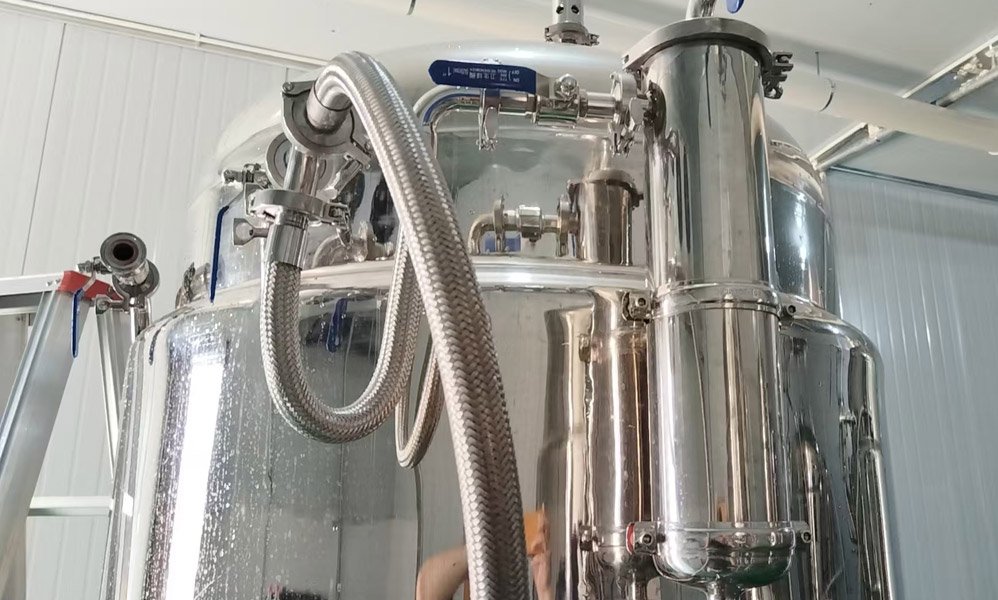
Rigid stainless steel pipe is often the preferred choice for permanent process lines. However, some connections need a little more flexibility.
A sanitary flexible hose can help connect equipment that is difficult to align with fixed pipework, accommodate limited movement where the hose is designed for that duty, or simplify the connection between two components. The challenge is choosing a hose that suits the actual process rather than selecting one based only on its diameter and end connections.
In hygienic applications, hose selection should consider the product being transferred, operating conditions, connection compatibility, installation geometry, and cleaning requirements.
When Does a Process Line Need a Flexible Hose?
Not every connection benefits from a flexible hose. For long, permanent runs, properly designed rigid stainless steel piping may provide a more suitable and easier-to-support arrangement.
A flexible hose is worth considering when equipment connections require a removable section, when a fixed connection would be difficult to assemble, or when limited movement must be accommodated within the hose’s rated capabilities.
For example, a short hose may connect a pump outlet to downstream process equipment where a rigid spool would make installation or removal inconvenient. In other applications, a removable connection may help with equipment servicing or routine maintenance.
The important distinction is that a flexible hose should solve a defined installation or operating problem. It should not be used to compensate for poor pipe alignment, inadequate support, or uncontrolled equipment movement.
Start With the Product and Operating Conditions
The first selection question is not the connection size. It is what the hose will carry and under what conditions.
A hose used for water may face different requirements from one carrying food ingredients, dairy products, cleaning solutions, or other process liquids. The suitability of the hose assembly depends on the wetted materials, the fluid’s properties, and the manufacturer’s documented compatibility information.
Temperature and pressure also matter. Check the expected operating range, including any cleaning or sanitization conditions that apply to the process. The allowable pressure may vary with temperature, hose construction, connection design, and other operating factors.
Do not assume that a stainless steel exterior makes the complete hose assembly suitable for every process. The inner tube, end connections, seals, and other product-contact components all need to be considered.
Match the Connections to the Process Line
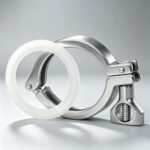
Tri-Clamp connections are commonly used in hygienic process systems because they allow components to be assembled and removed without a permanent threaded or welded connection at every joint.
When selecting a hose with Tri-Clamp ends, verify both the nominal pipe size and the actual clamp or ferrule dimensions. Similar-looking connections should not be assumed to be interchangeable.
Also check the available installation space. A hose that fits the connections on paper may still be unsuitable if it must bend too tightly, twist during installation, or carry an unintended mechanical load.
Connection compatibility should be confirmed against the actual mating components rather than inferred from a nominal diameter alone.
Hose Length and Routing Affect Reliability
Hose length should be chosen for the installed arrangement, not simply because a particular length is available.
A hose that is too short may be placed under tension or pull on the equipment connections. An excessively long hose can create unnecessary loops, make cleaning more difficult, or leave sections poorly supported.
Follow the manufacturer’s minimum bend radius and routing instructions. Avoid twisting the hose to align the end connections, and do not use the hose as a substitute for proper pipe supports.
Where equipment vibration or movement is involved, verify that the hose assembly is specifically rated for the expected duty. Flexibility alone does not establish suitability for vibration, repeated movement, or cyclic loading.
Consider Cleaning and Hygienic Design
In food, beverage, dairy, and other hygienic processing environments, a hose must be compatible with the cleaning procedure used by the facility.
Consider the cleaning agents, temperature, exposure time, and whether cleaning is performed in place or requires removal of the hose. The inner surface, end connections, seals, and installed routing can all affect how effectively the assembly can be cleaned and inspected.
Avoid installation arrangements that create avoidable low points, trapped product, or inaccessible surfaces where these conflict with the process’s hygienic design requirements.
For applications involving frequent cleaning or demanding sanitation conditions, request the manufacturer’s documentation for the complete hose assembly rather than relying on the material description alone.
Stainless Steel Braiding: What Should You Verify?
Some sanitary hose assemblies use stainless steel braiding around an inner tube. The braid may contribute to the assembly’s mechanical construction, but its presence alone does not establish the hose’s pressure rating, flexibility limits, or suitability for a particular fluid.
Confirm the construction details and the manufacturer’s rated operating conditions. In particular, establish which materials contact the product and whether the complete assembly is suitable for the intended temperature, pressure, and cleaning cycle.
Do not assume that every braided hose is designed for suction, high-pressure service, repeated flexing, or steam cleaning. These capabilities must be verified for the specific model.
A Practical Selection Checklist
Before ordering a sanitary flexible hose, confirm the following details with the supplier:
- Process fluid: Identify the liquid or product and any relevant chemical compatibility requirements.
- Operating conditions: Specify normal and maximum temperature, operating pressure, and applicable cleaning conditions.
- Connection details: Confirm the nominal size, Tri-Clamp dimensions, and end configuration at both ends.
- Installed length and routing: Check the required length, bend radius, available space, and support arrangement.
- Construction and documentation: Verify the inner tube, braid, seals, product-contact materials, and rated operating limits.
- Maintenance requirements: Establish how the hose will be inspected, cleaned, removed, and replaced.
Providing these details at the start makes it easier to identify a suitable configuration and reduces the risk of selecting a hose that fits physically but does not meet the process requirements.
Select for the Installed Duty, Not Just the Specification Sheet
A sanitary flexible hose is one part of a larger process system. Its performance depends on the complete assembly and how it is installed, operated, cleaned, and maintained.
The most suitable option is not necessarily the shortest, largest, or most heavily reinforced hose. It is the assembly that matches the product, operating conditions, connections, routing, and hygienic requirements of the actual application.
Haoqintech supplies sanitary process components, including stainless steel braided hose assemblies with Tri-Clamp connections. To discuss a hose configuration, provide the required connection size, installed length, process fluid, operating temperature, pressure, and cleaning conditions. The final selection should be checked against the confirmed specifications of the hose assembly.