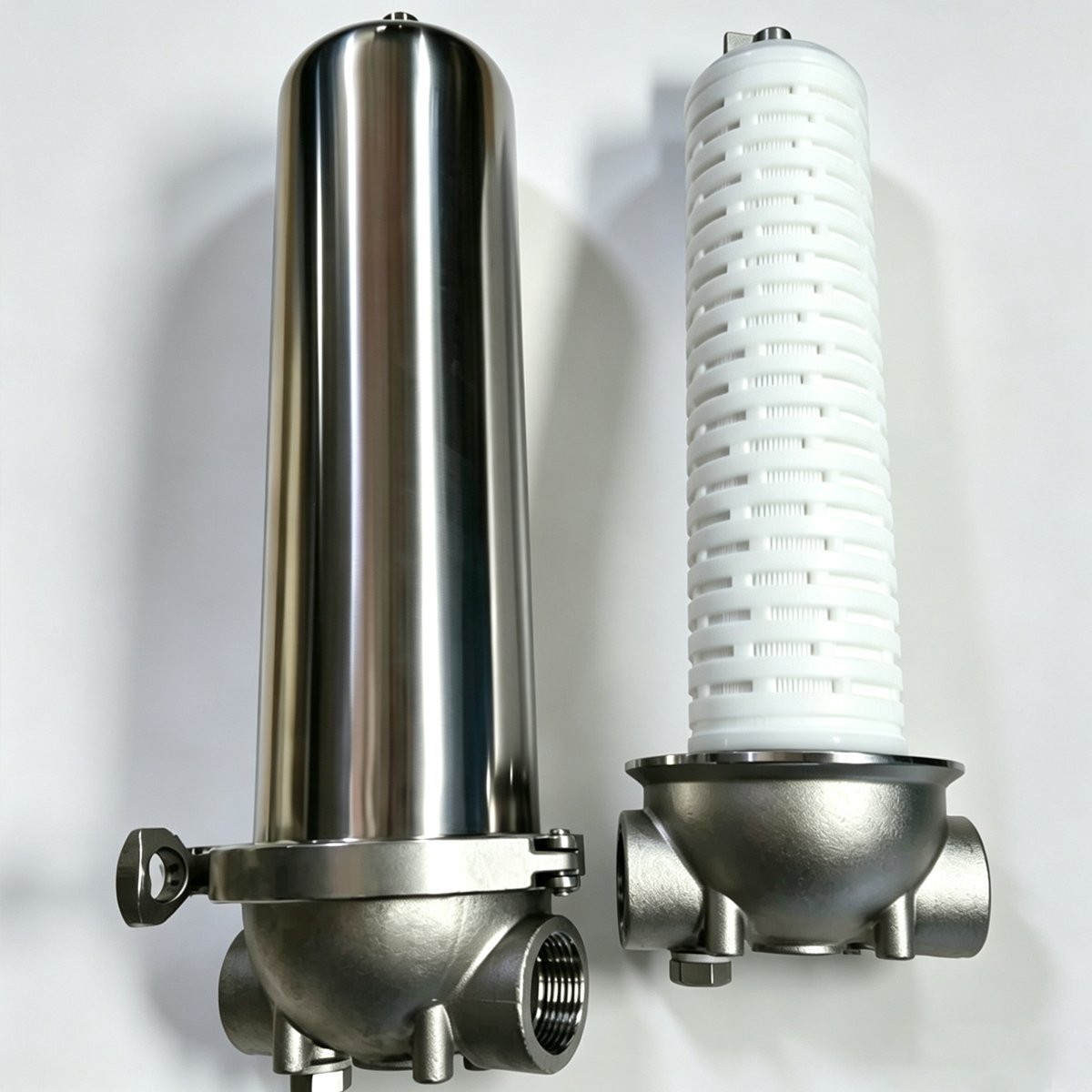
A sanitary filter housing is a stainless steel housing designed to hold a replaceable filter cartridge for hygienic filtration applications. It provides a controlled enclosure for the filter element and directs process liquid, air, or gas through the cartridge during filtration.
The filter housing itself does not perform the primary filtration. Instead, it provides the structure, flow path, sealing, and connections needed for the filter cartridge to operate as part of a filtration system.
Sanitary filter housings are commonly used in food and beverage processing, dairy production, pharmaceutical manufacturing, biotechnology, fermentation, and other hygienic fluid-processing applications. Depending on the housing design and cartridge installed, they can also be used for air or process-gas filtration.
What Makes a Filter Housing “Sanitary”?
The word sanitary refers to more than the material used to manufacture the housing.
304 or 316L stainless steel is commonly used for sanitary filter housings, but hygienic design also considers how the housing is connected, sealed, cleaned, drained, and maintained.
- Hygienic process connections
- Suitable gaskets and seals
- Smooth and cleanable product-contact surfaces
- Minimized areas where product or contaminants can accumulate
- Practical draining and venting
- Easy access for cartridge replacement
- Compatibility with the cleaning or sanitization procedures required by the process
Different manufacturers and applications may use different surface finishes, materials, connection standards, and cleaning methods. Therefore, “sanitary” should be understood as a design approach for hygienic processing rather than simply a specification for stainless steel.
How Does a Sanitary Filter Housing Work?
The basic filtration path is:
Process Fluid or Gas → Inlet → Filter Cartridge → Outlet → Filtered Fluid or Gas
The process can be understood in several steps.
1. The Process Medium Enters the Housing
The process medium enters through the housing inlet connection.
Depending on the application, this may be a liquid, air, or process gas. The inlet and outlet configuration should match the process piping and the intended installation.
2. The Medium Passes Through the Filter Cartridge
Inside the housing, the process medium is directed through the installed filter cartridge.
The cartridge contains the actual filter media. Its construction and filtration characteristics determine which particles or contaminants are retained.
The exact flow direction depends on the cartridge and housing design. Some cartridge configurations operate from outside to inside, while others use an inside-to-outside flow path.
This is why the filter cartridge should always be matched to the housing and the intended process configuration.
3. The Filtered Medium Leaves Through the Outlet
After passing through the filter cartridge, the filtered medium moves toward the housing outlet and continues into the downstream process.
The housing helps maintain a controlled flow path and keeps the cartridge correctly positioned and sealed during operation.
4. The Cartridge Can Be Replaced
When the cartridge reaches its service limit, it can normally be removed and replaced while the housing remains part of the process system.
This makes cartridge filtration different from a system in which the entire filtration vessel must be replaced when the filter element reaches the end of its service life.
Filter Housing and Filter Cartridge: Different Roles
One of the most important concepts to understand is that the filter housing and filter cartridge perform different functions.
The housing provides:
- Mechanical containment
- The process flow path
- Cartridge support and positioning
- Sealing between components
- Inlet and outlet connections
- Access for cartridge replacement
The cartridge provides:
- The actual filtration media
- Particle or contaminant retention
- The filtration characteristics required by the process
In simple terms:
The housing contains and directs the process flow; the cartridge performs the filtration.
Together with the required seals and process connections, they form a cartridge filtration assembly.
For example, Haoqintech’s 304 Stainless Steel Quick-Connect Filter Housing represents the housing side of this assembly, while the installed cartridge determines the actual filtration function.
What Are the Main Components of a Sanitary Filter Housing?
Although housing designs vary, a sanitary cartridge filter housing generally contains several basic components.
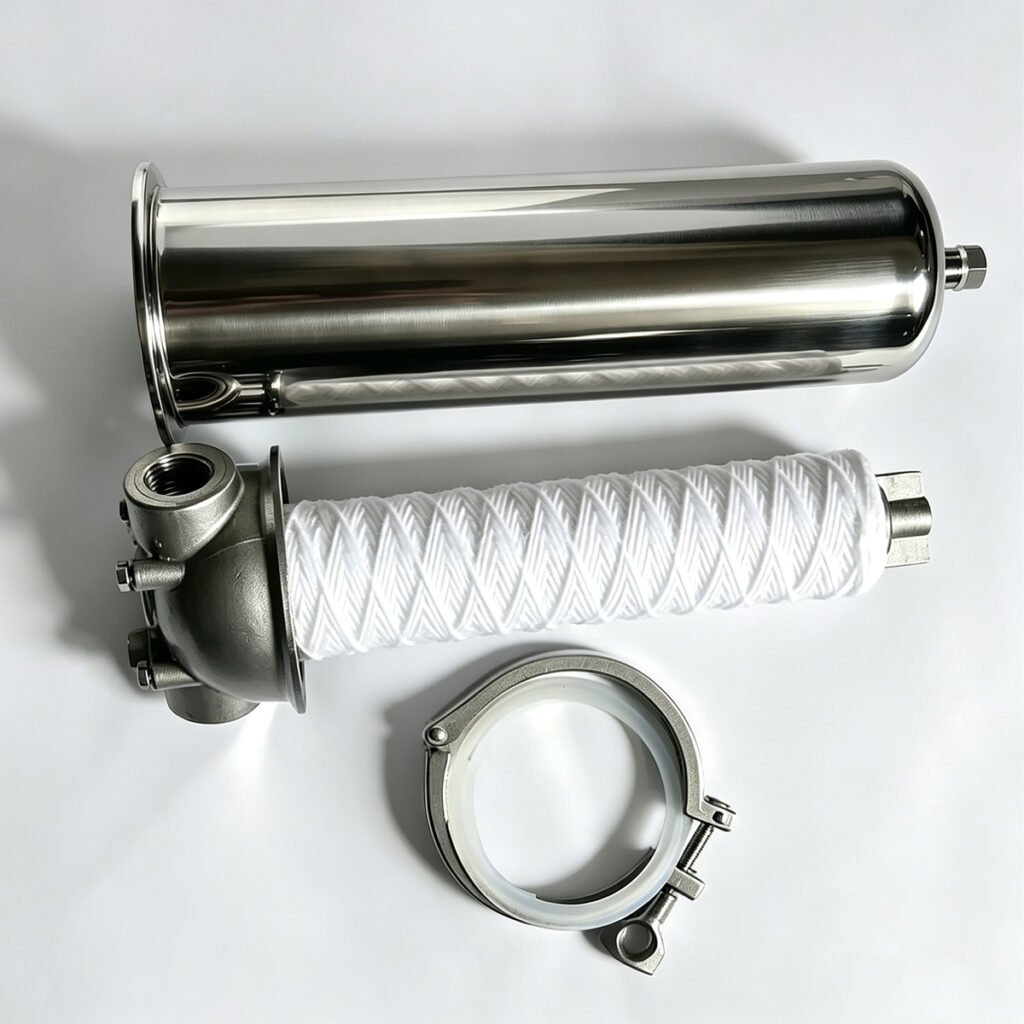
Housing Body
The housing body forms the main enclosure around the filter cartridge.
Stainless steel such as 304 or 316L is commonly used, depending on the process requirements, corrosion conditions, and hygienic requirements.
Filter Cartridge
The cartridge is the replaceable filtration element installed inside the housing.
Different housing designs support different cartridge configurations. The cartridge must be compatible with the housing’s dimensions, sealing arrangement, connection/interface, and intended service.
Haoqintech also supplies a Titanium Rod Filter Cartridge as an example of a reusable filtration element rather than a housing.
Inlet and Outlet Connections
The inlet and outlet connect the housing to the process piping.
Sanitary applications may use clamp-style connections or other connection configurations depending on the system.
Gaskets and Seals
Gaskets and seals help prevent leakage and maintain separation between the process stream and the surrounding environment.
Their material should be compatible with the process medium and operating conditions.
Closure or Clamp
The housing requires a closure mechanism that allows the operator to open the vessel for cartridge replacement while maintaining a secure seal during operation.
Depending on the design, this may be a sanitary clamp, swing-bolt closure, or another type of closure.
What Are Vent, Drain, and Gauge Ports Used For?
Some sanitary filter housings include additional ports for venting, draining, or process monitoring.
Vent
A vent can help remove trapped air or gas from the housing during filling or operation.
Drain
A drain provides a controlled way to remove residual process fluid from the housing during maintenance or cleaning.
Gauge or Monitoring Port
A gauge port can be used for pressure monitoring. Pressure information can help operators understand operating conditions and identify changes in pressure drop across the filtration system.
For applications requiring pressure monitoring, Haoqintech’s 304 SS Sanitary Cartridge Filter Housing with Gauge is an example of a housing configured with a gauge.
The exact ports and valve arrangements depend on the housing design and application.
Single-Cartridge and Multi-Cartridge Housings
Sanitary filter housings can be designed for one cartridge or multiple cartridges.
A single-cartridge housing contains one filter cartridge and is commonly used for compact or lower-capacity filtration arrangements.
A multi-cartridge housing contains several cartridges and can provide a larger total filtration area for applications requiring greater flow capacity.
The choice between these configurations depends on the process requirements, available installation space, flow requirements, and overall filtration system design.
For example, a sanitary multi-cartridge filter housing can be used when a liquid filtration system requires greater filtration area or flow capacity than a single-cartridge configuration can provide.
For liquid filtration applications, cartridge quantity should be selected according to flow rate, filtration area and process requirements.
What Can a Sanitary Filter Housing Be Used For?
The application depends on the housing configuration, the installed cartridge, and the process conditions.
Liquid Filtration
Sanitary cartridge filter housings are widely used for liquid filtration in hygienic processing systems.
- Food and beverage processing
- Dairy processing
- Pharmaceutical liquids
- Biotechnology
- Fermentation systems
- Process water
- Other hygienic liquid-processing applications
Different cartridge types can be used for different filtration duties, so the housing should be considered as part of the complete filtration system rather than as the filtration medium itself.
Air and Process Gas Filtration
Some sanitary cartridge housings are also designed for air or process-gas filtration.
For example, Haoqintech’s Sanitary Stainless Steel Air Filter Housing is positioned for sanitary air and process-gas filtration rather than specifically as a tank breather.
However, a general sanitary air filter housing should not automatically be considered a tank breather.
A tank breather filter is specifically associated with air exchange and venting of a tank or vessel. A sanitary air or gas filter housing may instead be installed directly in an air or process-gas line.
The installation object and process function therefore matter when defining the product.
What Should You Consider Before Choosing a Sanitary Filter Housing?
The correct housing should be selected according to the requirements of the complete filtration system.
- Process medium
- Required flow rate
- Filter cartridge configuration
- Housing material
- Process connections
- Operating pressure and temperature
- Gasket and seal compatibility
- Cleaning and maintenance requirements
- Available installation space
The housing and cartridge must work together as a complete assembly. A suitable housing with an unsuitable cartridge, or a suitable cartridge installed in an incompatible housing, will not provide the intended filtration system.
For detailed cartridge-selection guidance, see 304 Stainless Steel Filter Housing: Which Filter Cartridge Should You Choose?
Maintenance and Cartridge Replacement
One practical advantage of a cartridge filter housing is that the filter element can normally be replaced without replacing the entire housing.
A typical maintenance sequence may include:
- Isolate the filtration system from the process.
- Relieve pressure according to the system procedure.
- Drain or vent the housing as required.
- Open the housing closure.
- Remove the used cartridge.
- Inspect the cartridge seating and sealing surfaces.
- Install the replacement cartridge.
- Close the housing and return the system to service according to the applicable process procedure.
The exact maintenance procedure depends on the housing design, process medium, operating conditions, and site safety requirements.
Sanitary Filter Housing as Part of a Complete Filtration System
A filter housing should not be considered as an isolated component.
A typical cartridge filtration assembly includes:
Filter Housing + Filter Cartridge + Seals + Process Connections
The housing provides the physical enclosure and controlled flow path.
The cartridge provides the filtration function.
The seals maintain process integrity.
The connections integrate the assembly into the process piping.
This is why selecting a sanitary filter housing should begin with understanding the process and filtration requirements rather than choosing a housing based only on its size or material.
Conclusion
A sanitary filter housing is a reusable stainless steel housing designed to hold and support a replaceable filter cartridge within a hygienic process system.
Its role is to provide containment, controlled flow, sealing, connections, and practical access for cartridge replacement. The cartridge, rather than the housing itself, performs the actual filtration.
The term sanitary also involves the overall design of the equipment, including hygienic connections, sealing, cleanability, drainage, and the way the housing integrates with the surrounding process system.
Sanitary filter housings can be configured for different cartridge arrangements and used for liquid, air, or process-gas filtration depending on the application.
Understanding the relationship between the housing and the cartridge is therefore the starting point for understanding sanitary cartridge filtration systems.