When selecting a valve for a hygienic process system, a sanitary ball valve and a sanitary butterfly valve may both appear suitable. Both are commonly used for quarter-turn operation, but their internal designs affect flow passage, installation space, cleaning considerations, and suitability for different process requirements.
Choosing between them is not simply a matter of price or material. The right option depends on the fluid, required flow characteristics, available space, cleaning procedure, connection type, and operating conditions.
This guide explains the key differences between sanitary ball valves and sanitary butterfly valves to help engineers, equipment manufacturers, and process-system buyers make a more informed selection.
1. What Is a Sanitary Ball Valve?
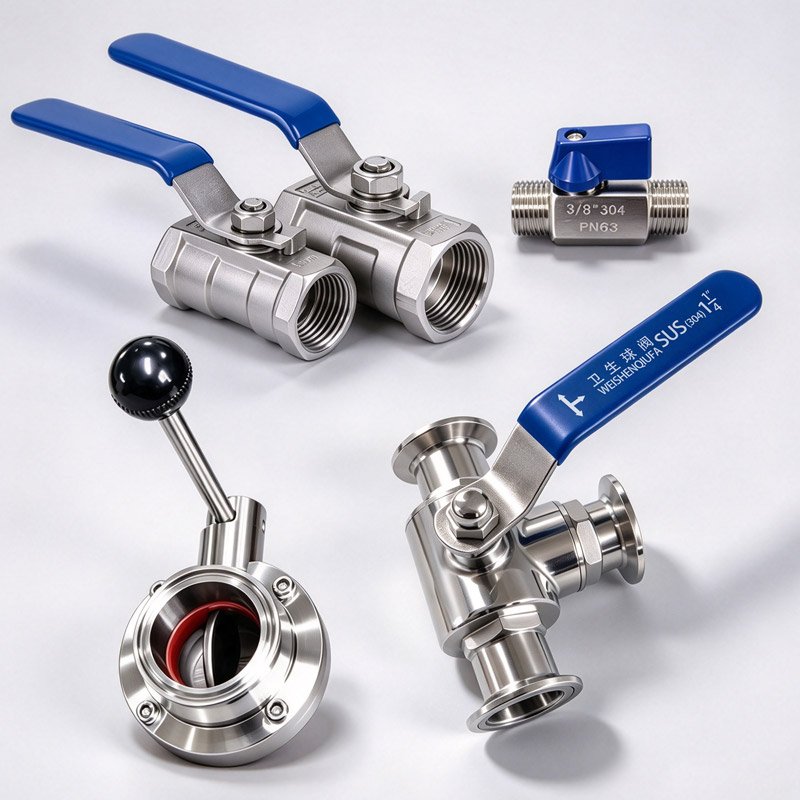
A sanitary ball valve uses a rotating ball with a bore through its center. When the bore aligns with the pipeline, fluid can pass through. When the ball rotates approximately 90 degrees, the bore turns away from the flow path and closes the valve.
Sanitary ball valves are commonly considered when a process requires a clear open-or-closed operating function and a relatively unobstructed flow passage.
Depending on the design, ball valves may be available with different body configurations, connection types, sealing materials, and operating mechanisms. Not every ball valve has the same flow characteristics or hygienic design features.
Typical characteristics
- Quarter-turn operation for opening and closing.
- A ball with a central flow passage.
- Potentially low flow resistance when fully open, depending on bore and body design.
- A design that may include internal cavities and sealing interfaces requiring consideration during hygienic cleaning.
- Availability in different configurations for manual or automated operation, depending on the product.
For hygienic applications, buyers should confirm the internal geometry, sealing arrangement, surface finish, and cleaning suitability rather than relying on the term “sanitary” alone.
2. What Is a Sanitary Butterfly Valve?
A sanitary butterfly valve uses a circular disc mounted inside the pipeline. Turning the stem rotates the disc to open, partially open, or close the flow path.
Butterfly valves are widely used in hygienic piping systems where a compact valve body and convenient operation are important.
Typical characteristics
- Quarter-turn operation.
- A compact body that can be advantageous where installation space is limited.
- A disc that remains inside the flow passage, including when the valve is fully open.
- A relatively straightforward operating arrangement.
- Compatibility with different connection and actuation options, depending on the design.
Because the disc remains in the pipeline, it influences the flow path even when the valve is open. Its suitability for a particular process therefore depends on the required flow rate, pressure drop, fluid properties, and operating conditions.
3. Sanitary Ball Valve vs. Butterfly Valve: Key Differences
The following table summarizes common design differences. Actual performance depends on the specific valve model, bore, disc or ball geometry, seals, and operating conditions.
| Comparison factor | Sanitary ball valve | Sanitary butterfly valve |
|---|---|---|
| Operating principle | Rotating ball with a central bore | Rotating disc inside the pipeline |
| Typical operation | Open or closed | Open, closed, or partially open |
| Flow passage when fully open | May provide a relatively unobstructed passage, depending on bore design | Disc remains within the flow path |
| Installation space | Depends on body and handle design | Often compact in face-to-face length |
| Flow adjustment | Not generally the preferred choice for continuous throttling unless specifically designed for it | Can provide basic flow adjustment, but is not automatically a precision control valve |
| Cleaning considerations | Internal cavities and seat areas need evaluation | Disc, stem, seals, and surrounding geometry need evaluation |
| Common selection priority | Flow passage and positive shutoff requirements | Compact installation and simple operation |
| Connection options | Depend on the model | Depend on the model |
Neither valve type is universally better. The comparison should be based on the actual process duty and the construction of the selected product.
4. Which Valve Is Better for Different Applications?
Applications where a sanitary ball valve may be suitable
A sanitary ball valve may be worth considering when the primary requirement is to open or isolate a line, particularly where the selected design provides the required flow passage.
Potential applications include:
- Isolation points in hygienic process piping.
- Transfer lines where the valve is normally fully open or fully closed.
- Process systems that prioritize the selected valve’s bore and shutoff characteristics.
- Installations where the available connection and sealing configuration meets the system requirements.
The buyer should verify whether the ball valve’s internal geometry and sealing arrangement are appropriate for the fluid and cleaning procedure. A ball valve should not be assumed to be suitable for every hygienic duty simply because it is made of stainless steel.
Applications where a sanitary butterfly valve may be suitable
A sanitary butterfly valve may be a practical choice when compact installation and straightforward operation are important.
Potential applications include:
- Hygienic transfer and distribution piping.
- Process lines with limited installation space.
- Isolation points in food, beverage, dairy, and other hygienic processing systems.
- Equipment layouts where a compact valve configuration is beneficial.
The disc’s effect on the flow path should be considered when sizing the valve. If the process requires precise regulation, a dedicated control valve may be more appropriate.
These examples are general selection guidance, not confirmation that every valve model is suitable for every listed industry. The specific product design and process requirements must be checked.Explore our available sanitary ball valve options for different process piping
requirements.
5. Cleaning and Hygienic Design: What Should Buyers Check?
For food processing, dairy production, pharmaceutical manufacturing, and other hygienic applications, valve selection must consider more than the external material.
A valve’s suitability for clean-in-place (CIP) or other cleaning procedures depends on its detailed construction and how it is installed and operated within the system.
Before purchasing either type, review the following points.
Internal geometry and product-contact surfaces
Check the areas that contact the process fluid, including the ball or disc, seats, seals, stem area, and body interfaces. Determine whether the design is appropriate for the product and the required cleaning method.
Potential product-retention areas
Consider whether the valve contains cavities, gaps, or other areas where product could remain. The actual risk depends on the valve design, process fluid, installation orientation, and cleaning procedure.
Seal and gasket compatibility
Confirm that the sealing materials are compatible with the product, cleaning chemicals, temperature, and operating conditions. Do not assume that two valves with the same stainless-steel grade use equivalent sealing materials.
Cleaning validation and system design
A valve cannot be judged in isolation from the complete piping system. Installation, drainage, flow conditions, cleaning sequence, and the surrounding equipment can all affect cleaning performance.
If a process requires documented hygienic compliance or a specific industry standard, request the relevant evidence for the exact product model.For additional information about butterfly valve design considerations, see our article on SS304 sanitary butterfly valves with lever handles
6. Flow Control: Can Either Valve Regulate Flow?
This is an important distinction when selecting a valve.
Both ball valves and butterfly valves can physically occupy intermediate positions, but this does not mean they are automatically suitable for accurate flow regulation.
A conventional ball valve is generally selected for on/off service unless its design specifically supports the intended control duty. Using an unsuitable valve for prolonged throttling may result in poor controllability or undesirable wear, depending on the application.
A butterfly valve can provide basic flow adjustment by changing the disc position. However, the relationship between disc angle and flow is not necessarily linear, and performance depends on the valve design and system conditions.
If the process requires accurate, repeatable flow control, evaluate a purpose-designed control valve and the associated actuator or control system.
For simple isolation, compare the valves in their intended open-or-closed operating condition. For flow adjustment, compare their actual performance data rather than relying on valve type alone.
7. Installation Space, Connections, and Maintenance
Installation constraints can be just as important as flow characteristics.
A butterfly valve often has a compact body, but the handle or actuator still needs sufficient operating clearance. A ball valve’s overall dimensions depend on the body construction, handle, and actuation arrangement.
Before finalizing the selection, check:
- Connection type: Confirm whether the system requires Tri-Clamp, threaded, welded, or another connection.
- Pipeline dimensions: Verify the actual connection dimensions and compatibility with the existing piping.
- Operating clearance: Allow sufficient space for the handle, actuator, and maintenance access.
- Seal replacement: Review the maintenance procedure and availability of compatible replacement seals.
- Operating frequency: Consider how frequently the valve will be operated and whether manual or automated operation is appropriate.
- Process conditions: Confirm the required pressure, temperature, fluid compatibility, and other limits against the manufacturer’s specifications.
Do not select a valve solely by nominal size. Connection dimensions and the internal flow passage can differ between models with similar nominal sizes.
8. A Practical Checklist Before Ordering
Use this checklist to compare candidate valves before requesting a quotation.
- Define the function. Is the valve primarily for isolation, or does the process require flow adjustment?
- Identify the fluid. Consider viscosity, suspended solids, product sensitivity, and chemical compatibility.
- Confirm the connection. Specify the required connection standard and dimensions.
- Check operating conditions. Confirm the actual working pressure and temperature with the supplier.
- Review hygienic requirements. Identify the required cleaning method, seal compatibility, and any applicable compliance requirements.
- Evaluate installation constraints. Check overall dimensions, operating clearance, and maintenance access.
- Compare product documentation. Review the specifications for the exact model rather than relying only on a general product description.
Providing these details to the supplier can help reduce the risk of ordering a valve that fits the pipeline but does not meet the process requirements.
9. Frequently Asked Questions
Is a sanitary ball valve better than a sanitary butterfly valve?
Not in every application. A ball valve may be preferable when its bore and shutoff characteristics suit the process. A butterfly valve may be preferable where compact installation and straightforward operation are priorities. The correct choice depends on the actual design and operating requirements.
Is a butterfly valve suitable for flow control?
A butterfly valve can provide basic flow adjustment, but it should not automatically be treated as a precision control valve. Confirm its controllability and operating limits for the intended duty.
Which valve is easier to clean?
There is no universal answer. Cleaning performance depends on internal geometry, seals, product-contact surfaces, installation, and the validated cleaning procedure. Evaluate the specific model rather than assuming one valve type is always easier to clean.
Can both valve types be used in food and beverage processing?
Both types may be used in suitable hygienic process applications. However, material grade alone does not establish hygienic suitability. Confirm the product construction, sealing materials, documentation, and compatibility with the intended cleaning and process conditions.
What information should I provide when requesting a quotation?
Provide the required valve type, nominal size and actual connection dimensions, connection standard, material requirements, fluid, working pressure and temperature, operating method, and cleaning requirements. If a specific compliance standard is required, state it explicitly.
Conclusion
Sanitary ball valves and sanitary butterfly valves serve overlapping but different selection priorities. A ball valve may be appropriate when its flow passage and shutoff characteristics match the process, while a butterfly valve may offer advantages in compact hygienic piping layouts.
The most reliable selection method is to start with the process duty, then verify the valve’s internal design, connections, seals, operating limits, cleaning suitability, and maintenance requirements.
For a hygienic process system, choosing the right valve means confirming that the specific model fits the complete application—not simply choosing between two valve types by name.