
In a hygienic process system, the way a liquid enters or leaves a vessel can be just as important as the pipework itself. A connection that allows an appropriate air separation may help reduce the risk of unwanted reverse flow, while a viewing section can help operators observe process conditions.
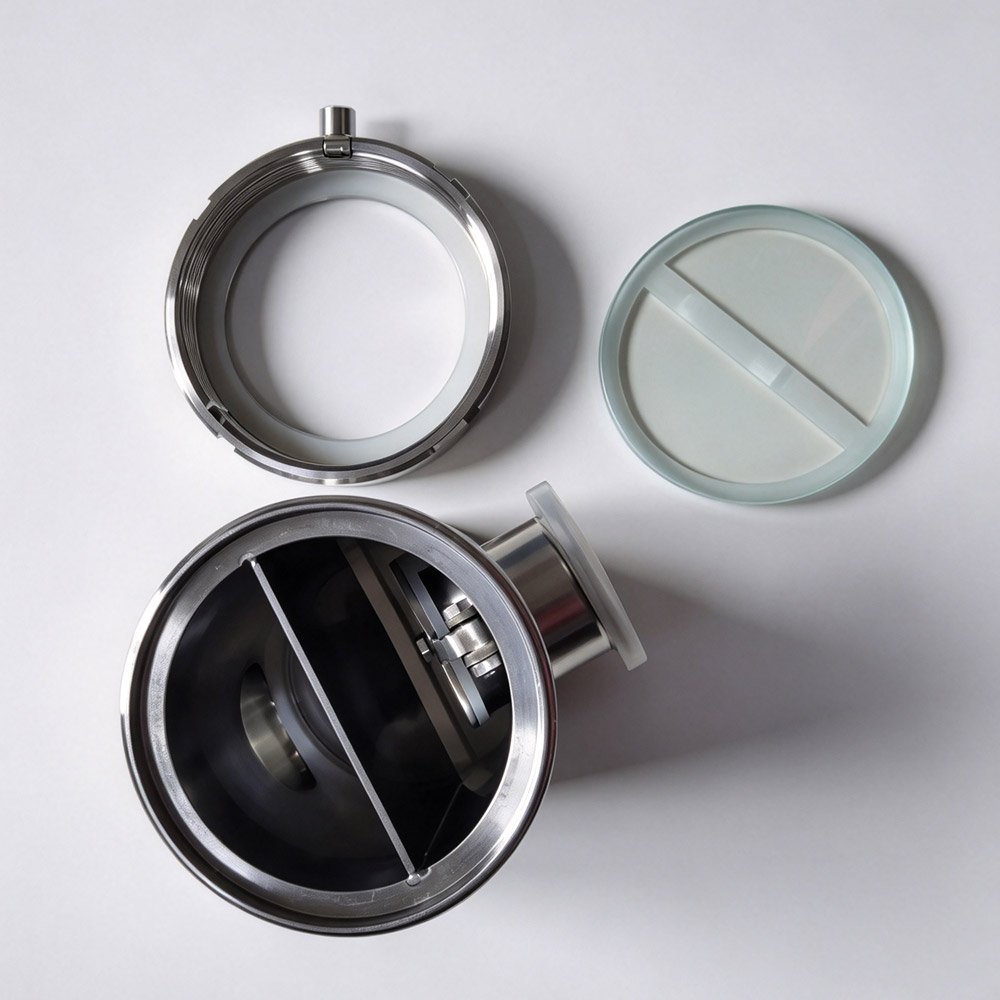
A sanitary air break fitting is used in process arrangements where an air break or separation point is required. When combined with a sight glass, the fitting can also provide a visual reference for observing liquid movement or discharge, depending on how the unit is installed.
However, an air break fitting, an air gap, and a backflow prevention device are not necessarily the same thing. Understanding the difference is important when selecting a component for a food, beverage, pharmaceutical, fermentation, or other hygienic process system.
What Is a Sanitary Air Break Fitting?
A sanitary air break fitting is a process connection designed for use in an arrangement that incorporates an air break. Its purpose and effectiveness depend on the fitting’s actual internal geometry, the connected equipment, and the installation position.
In a typical hygienic process layout, an air break may be considered where liquid is discharged from one part of a system into another vessel, tank, or receiving point. The design needs to account for whether the discharge remains physically separated from the receiving liquid and whether the arrangement can prevent an unwanted reverse-flow path.
Some sanitary air break fittings incorporate a sight glass. This provides a viewing section that may help operators observe liquid passing through or around the fitting, depending on the product design and installation.
The term alone does not establish the exact internal flow path or guarantee a particular level of backflow protection. Those details should be confirmed against the component drawing and the intended system arrangement.
Air Break vs. Air Gap: What Is the Difference?
The terms air break and air gap are related, but they should not be used interchangeably without checking the design context.
An air gap generally refers to a physical, unobstructed separation between a discharge outlet and the receiving liquid or the relevant flood-level rim. It is a recognized principle used in backflow prevention because it can interrupt a direct liquid connection.
An air break is a broader term used for an arrangement in which an air separation interrupts or changes a liquid flow connection. The exact meaning depends on the equipment design and the applicable system requirements.
A fitting described as an air break fitting does not automatically create a compliant air gap in every installation. Its suitability depends on factors such as the discharge geometry, mounting position, receiving vessel, possible submergence, and the requirements of the application.
Before choosing a component, clarify the following:
- Is the design intended to provide a physical air gap, an air break, or another form of separation?
- Where is the discharge point located relative to the receiving vessel and its maximum liquid level?
- Can the outlet become submerged during normal operation, cleaning, or an abnormal process condition?
- Does the complete installation meet the backflow prevention requirements for the specific system?
These questions are especially important when a process requires a defined level of contamination protection.
How Does an Air Break Relate to Backflow Prevention?
Backflow occurs when liquid moves in the opposite direction from the intended flow. Depending on the system, it may result from pressure changes, siphoning, an elevated receiving liquid level, or other operating conditions.
If liquid from a downstream vessel can return through an uninterrupted liquid path, the upstream process may be exposed to unwanted contamination or mixing.
A properly designed and installed air gap can help prevent this type of reverse flow by physically separating the discharge from the receiving liquid. Other air-break arrangements may serve a related purpose, but their effectiveness depends on the actual design.
It is important not to assume that every component marketed as an air break fitting provides the same protection as a verified air-gap arrangement or a dedicated backflow prevention device.
For applications involving hygienic separation, hazardous fluids, or regulated water connections, the complete installation should be reviewed against the applicable engineering and regulatory requirements. Product descriptions alone are not sufficient evidence of compliance.
Why Combine an Air Break Fitting with a Sight Glass?
A sight glass provides a viewing section through which operators can observe the process. When integrated into an air break fitting, it may help make the flow or discharge area easier to inspect.
Depending on the fitting design and its installed position, this visual access can be useful for:
- Observing whether liquid is moving through the visible section.
- Checking the general appearance of a discharge during operation.
- Identifying visible changes that may warrant further inspection.
- Supporting routine process monitoring without relying exclusively on an external indicator.
Visual observation has limits. A sight glass cannot by itself confirm microbiological cleanliness, prove that backflow prevention is effective, or establish that the installation complies with a required air-gap dimension.
The glass, seals, connections, and surrounding pipework must also be suitable for the actual process conditions and cleaning procedure.
Where Might a Sanitary Air Break Fitting Be Used?
The suitability of an air break fitting depends on the process layout rather than the industry name alone. Potential applications include hygienic liquid-handling arrangements where an air break or a visible discharge section is required.
Food and beverage processing
A process designer may consider an air-break arrangement where liquid is transferred or discharged between equipment sections and a suitable separation is required. The design must account for the liquid involved, the receiving vessel, cleaning procedures, and any applicable hygiene or backflow requirements.
Dairy and pharmaceutical systems
These applications may require carefully controlled separation between process stages or between process equipment and receiving systems. The fitting’s role should be clearly defined in the piping and instrumentation design, and its suitability must be verified against the relevant requirements.
Fermentation and liquid culture equipment
In fermentation or liquid culture systems, connections around tanks, vessels, and liquid transfer lines need to be selected according to the process flow, contamination-control strategy, and cleaning method.
An air break fitting with a viewing section may be worth evaluating where the intended installation calls for both an air-break arrangement and visual access. It should not, however, be treated as a substitute for a sterile barrier or a validated aseptic connection unless the design has been specifically established for that purpose.
How to Select a Sanitary Air Break Fitting
The right fitting is not determined by nominal pipe size alone. Before requesting a quotation, review the following points with the equipment supplier.
1. Confirm the intended function
Specify whether the requirement is an air break, a defined air gap, visual observation, or a combination of functions. If backflow prevention is a critical requirement, provide the applicable design criteria rather than relying on the product name.
2. Check the body and connection dimensions
Confirm the overall body size, inlet and outlet connection sizes, clamp dimensions, and available installation space. A fitting that matches the pipe diameter may still be unsuitable if its body length or outlet position does not fit the intended layout.
3. Verify material compatibility
Confirm the stainless steel grade and the materials of any wetted components, seals, and viewing elements. Compatibility should be evaluated against the process liquid, operating conditions, and cleaning chemicals. Do not assume that all components have the same material specification simply because the body is stainless steel.
4. Review installation geometry
The position of the fitting relative to the receiving vessel and liquid level may determine whether the intended air separation is maintained. Review the installation drawing and the complete flow path, including possible changes during filling, draining, cleaning, or abnormal operation.
5. Confirm cleaning and maintenance requirements
Check whether the internal geometry can be inspected and cleaned as required by the process. Confirm the suitability of seals and viewing components for the cleaning method, and establish how the fitting will be inspected or replaced.
6. Request drawings and application confirmation
For a non-standard layout, provide the supplier with a simple process sketch showing the upstream line, fitting, discharge point, receiving vessel, and expected liquid levels. This makes it easier to check dimensional compatibility and identify questions that need engineering review before purchase.
Available Stainless Steel Sanitary Air Break Fitting Sizes
Haoqintech offers a 304 stainless steel sanitary air break fitting with a sight glass and Tri-Clamp connections. The available configurations include different body sizes and connection combinations.
| Body size (mm) | Inlet/outlet size (mm) | Clamp size (mm) |
|---|---|---|
| 108 | 25 | 50.5 |
| 108 | 38 | 50.5 |
| 108 | 51 | 64 |
| 133 | 51 | 64 |
| 133 | 63 | 77.5 |
| 159 | 63 | 77.5 |
| 159 | 76 | 91 |
| 159 | 89 | 106 |
| 219 | 108 | 119 |
These dimensions describe the listed configurations. Confirm the required connection standard, installation envelope, and suitability for your process before ordering.
The fitting is intended for application-specific selection. Operating pressure, temperature limits, seal materials, internal construction, and any required compliance documentation should be confirmed with the supplier rather than assumed from the product category.
What to Confirm Before Requesting a Quote
To help identify a suitable configuration, provide the following information where available:
- Required body size and inlet/outlet connection sizes.
- Connection type and clamp dimensions.
- Process liquid and relevant material compatibility requirements.
- Intended installation position and receiving-vessel arrangement.
- Whether the main requirement is visual monitoring, an air break, a defined air gap, or verified backflow prevention.
- Cleaning method and any specific regulatory or engineering requirements.
A drawing or photograph of the intended installation can also help clarify the required geometry.
Final Considerations
A sanitary air break fitting with a sight glass can combine a process connection with a visible section, but its actual function depends on the component design and how it is installed.
Before selecting one, distinguish between an air break and a defined air gap, identify the required level of backflow protection, and verify the connection dimensions and process compatibility. Where compliance or contamination prevention is critical, evaluate the complete installation rather than relying on the fitting name alone.
Haoqintech supplies 304 stainless steel sanitary air break fittings with sight glass and Tri-Clamp connection options. Contact us with your required dimensions and application details to discuss a suitable configuration.