For commercial mushroom producers, choosing between liquid spawn and grain spawn is not simply a question of which method is better.
The right choice depends on production volume, labor requirements, existing equipment, inoculation methods, process control, and future automation plans.
Grain spawn remains widely used because the production process is relatively straightforward and the initial investment can be lower. Liquid spawn, however, offers significant potential for centralized production, sanitary transfer, automated inoculation, and high-volume mushroom cultivation.
For producers expanding an existing spawn facility, the decision may not even be liquid spawn vs. grain spawn. In some cases, both systems can be integrated into the same overall production facility.
This article compares the two methods and explains how liquid spawn is produced, how it is transferred into substrate bags, how automatic inoculation works, and what factors should be considered when designing a commercial liquid spawn production system.
What Is Grain Spawn?
Grain spawn is produced by growing mushroom mycelium on a sterilized grain-based substrate.
Depending on the mushroom species and production method, grains may be prepared, hydrated, sterilized, inoculated, and incubated until the mycelium has colonized the grain substrate.
A typical grain spawn production process includes:
Grain Preparation → Moisture Adjustment → Filling → Sterilization → Cooling → Inoculation → Incubation → Mature Grain Spawn
The mature grain spawn can then be transferred to the final cultivation substrate.
Advantages of Grain Spawn
Grain spawn remains attractive for many mushroom producers because:
- The production concept is relatively simple.
- Initial equipment investment can be lower.
- It is suitable for small and medium-scale operations.
- Many existing mushroom farms already have grain spawn equipment.
- Operators may already have experience with grain-based inoculation.
However, as production volume increases, manual handling and distributed production steps can become important factors when considering further automation.
What Is Liquid Spawn?
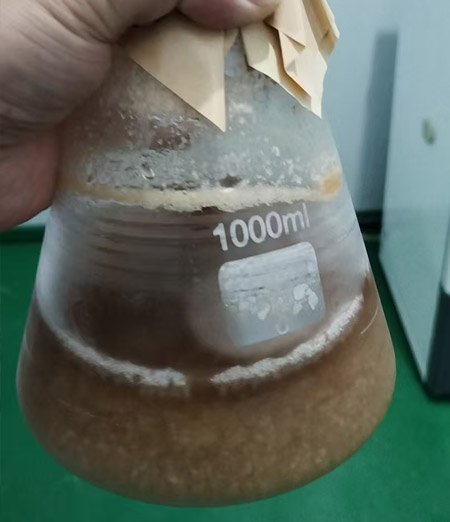
Liquid spawn, also called liquid culture or liquid inoculum in some production environments, is produced by cultivating mushroom mycelium in a liquid nutrient medium under controlled conditions.
Unlike grain spawn, the mycelium grows throughout a liquid culture medium.
A typical liquid spawn production process can include:
Culture Medium Preparation → Direct Steam Sterilization → Cooling → Tube Culture → Shake Flask Expansion → Fermentation Tank → Sterile Air Supply → Pneumatic Agitation → Mature Liquid Spawn
The exact process depends on the mushroom species, culture medium, fermentation conditions, and production requirements.
How Is Liquid Spawn Produced?
A commercial liquid spawn system normally includes several connected process stages rather than simply one fermentation tank.
1. Culture Medium Preparation
The required ingredients are added according to the selected culture-medium formulation.
Depending on the process, ingredients may include glucose, soybean or other protein sources, peptone, amino acids, and other nutrients.
Process water enters the culture tank through a dedicated water inlet.
The formulation and nutrient concentration should be determined according to the target mushroom species and cultivation process.
2. Direct Steam Sterilization
After the culture medium has been prepared, the medium is sterilized using a dedicated steam pipeline.
In the process configuration used in our projects, steam passes through a filter element and enters the tank directly from the bottom.
This provides direct steam sterilization of the culture medium.
The tank jacket is a separate system.
It uses circulating water for temperature control and has independent inlet and outlet pipelines. The jacket does not use steam or air pressure for this process.
Keeping the process-water, steam, and jacket circulation systems properly separated is important when designing the complete process piping.
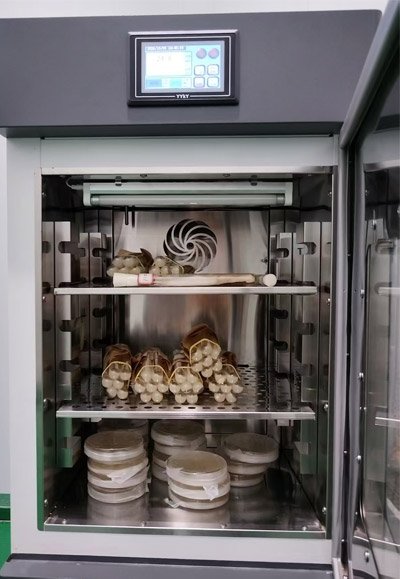
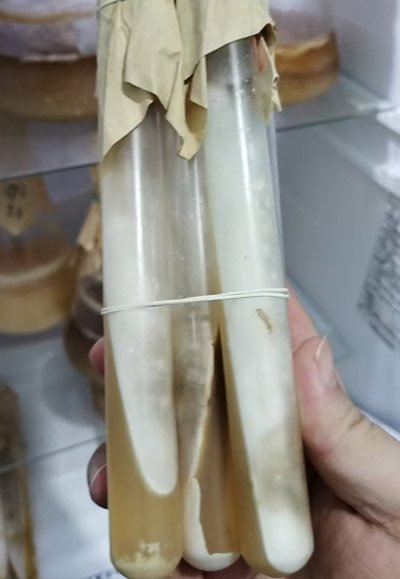
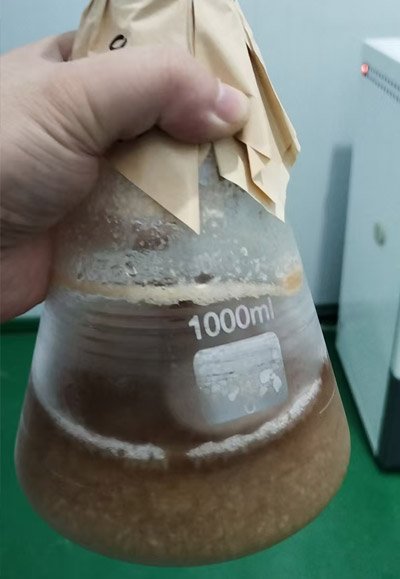
3. Tube Culture and Shake Flask Expansion
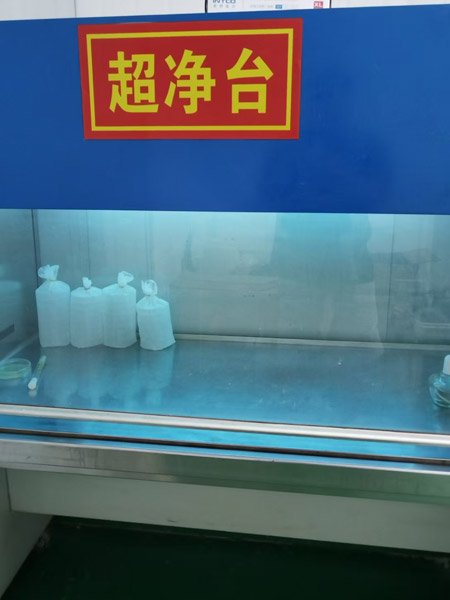
The laboratory culture is handled under aseptic conditions.
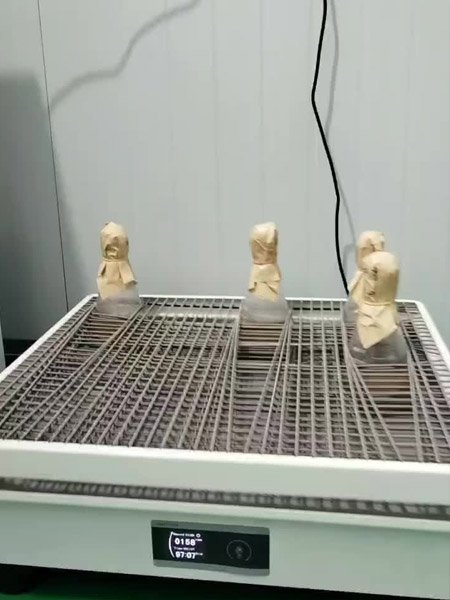
The preserved culture can be transferred into sterilized shake flasks for primary expansion.
After the required expansion period, the liquid culture can be transferred into a larger sterilized and cooled fermentation tank.
The exact culture time depends on the mushroom species, culture medium, inoculum condition, temperature, and other process parameters.
4. Fermentation Tank
The fermentation tank provides a controlled environment for further liquid culture expansion.
The process can involve:
- Controlled temperature
- Sterile air supply
- Pneumatic agitation
- Pressure control
- Sanitary piping
- Controlled exhaust
The tank does not necessarily require a mechanical agitator.
In the process configuration described above, filtered air enters the tank from the bottom through a filter element.
The airflow provides aeration and pneumatic agitation within the liquid culture.
Air leaves through the top exhaust pipeline through a one-way check valve.
This allows the culture environment to be controlled while maintaining a defined air-flow path.
5. Mature Liquid Spawn
After the required fermentation process is completed, the liquid spawn is ready for transfer to the inoculation system.
At this stage, the fermentation tank becomes part of a larger production chain:
Liquid Culture → Sanitary Transfer → Automatic Inoculation → Substrate Bags → Incubation
This connection between liquid spawn production and substrate inoculation is one of the major differences between a small laboratory-scale liquid culture process and a commercial liquid spawn production system.
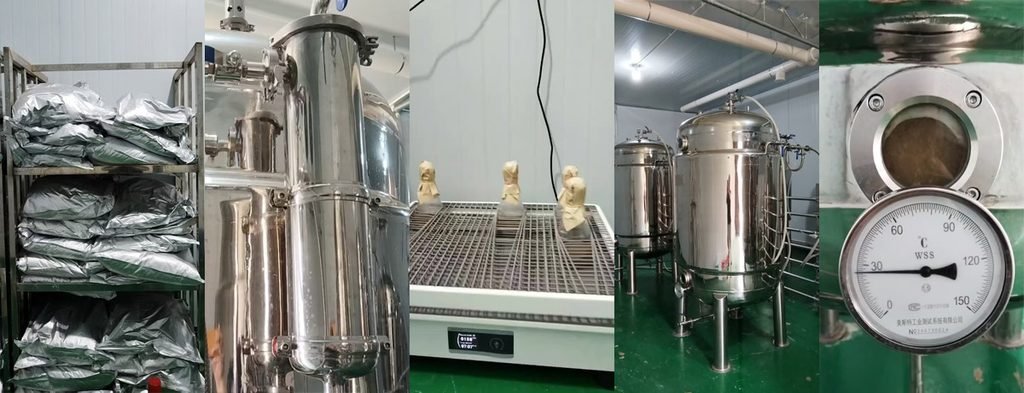
Liquid Spawn vs. Grain Spawn: Key Differences
| Factor | Liquid Spawn | Grain Spawn |
|---|---|---|
| Culture Medium | Liquid nutrient medium | Grain-based substrate |
| Main Production Equipment | Fermentation tank and supporting system | Sterilization and incubation equipment |
| Inoculation Method | Liquid transfer / automatic inoculation | Manual or mechanical inoculation |
| Automation Potential | High | Medium to high |
| Labor Requirement | Can be reduced through automation | Generally more manual handling |
| Process Control | Centralized | More distributed |
| Transfer Method | Sanitary piping | Manual or mechanical transfer |
| Scalability | Well suited to high-volume systems | Suitable from small to large operations |
| Initial Investment | Generally higher | Generally lower |
| Best Fit | Commercial and automated production | Traditional and smaller-scale production |
Neither method is universally better.
The appropriate solution depends on the production scale, existing facility, labor availability, target automation level, and future expansion plans.
Advantages of Grain Spawn Production
Grain spawn can be a practical choice for producers who are building or operating a relatively simple spawn production facility.
Lower Initial Investment
A grain spawn production line may require less specialized equipment than a fully automated liquid spawn system.
Suitable for Existing Operations
If a mushroom producer already has grain preparation, sterilization, inoculation, and incubation equipment, continuing with grain spawn may be the most practical option.
Suitable for Smaller Production
For smaller operations, manual or semi-automatic grain spawn production can remain economically practical.
Familiar Production Process
Many mushroom producers and training centers already have experience with grain spawn production, which can reduce the learning curve.
Advantages of Liquid Spawn Production
Liquid spawn becomes increasingly attractive when production volume and automation requirements increase.
High Automation Potential
Liquid spawn can be transferred through sanitary pipelines and connected directly to an automatic inoculation system.
This can reduce unnecessary manual handling during the inoculation stage.
Centralized Production
Instead of preparing and handling large quantities of individual grain spawn containers, liquid spawn can be produced centrally in fermentation tanks.
Suitable for High-Volume Production
A properly designed liquid spawn system can be integrated with high-volume substrate bag production.
Easier Integration with Automated Inoculation
The liquid medium can be transferred directly from the fermentation system to an automatic inoculation machine.
This creates a continuous process:
Fermentation → Transfer → Inoculation → Incubation
Better Suitability for Facility Expansion
For mushroom producers who are already operating a spawn facility and are planning to increase production, liquid spawn can be considered as part of a larger automation upgrade.
How Is Liquid Spawn Inoculated into Substrate Bags?
Liquid spawn production is only one part of the complete system.
The next question is how the mature liquid spawn is transferred into the final mushroom substrate.
A typical commercial process is:
Substrate Mixing
↓
Automatic Bag Filling
↓
High-Temperature Sterilization
↓
Cooling
↓
Liquid Spawn Transfer
↓
Automatic Inoculation
↓
Incubation
The substrate bags must first be prepared, sterilized, and cooled to a suitable temperature.
At the same time, the liquid spawn is produced in the fermentation system.
When both sides are ready, the mature liquid spawn is transferred through sanitary piping to the automatic inoculation system.
The inoculation equipment then distributes the liquid spawn into the prepared substrate bags according to the required process configuration.
After inoculation, the bags are transferred to the incubation room.
This approach can reduce manual inoculation work and make the overall production flow easier to standardize.
Why Automate Liquid Spawn Inoculation?
For a small mushroom farm, manual inoculation may be sufficient.
However, when the number of substrate bags increases significantly, inoculation can become one of the production bottlenecks.
Automation can help address several issues:
1. Labor Requirements
Manual inoculation of thousands of substrate bags can require significant labor.
An automated system can reduce repetitive manual operations.
2. Production Consistency
A properly configured inoculation system can help maintain a more consistent inoculation process.
3. Higher Throughput
Automatic inoculation can be integrated with automatic substrate bagging and other production equipment to support continuous or high-volume production.
4. Sanitary Process Design
Liquid spawn can be transferred through sanitary piping rather than repeatedly handled manually.
5. Easier Future Expansion
An automated system can be designed around the expected production capacity of the facility, allowing additional equipment or process modules to be considered as production grows.
Can Liquid Spawn and Grain Spawn Be Produced in the Same Facility?
Yes.
A mushroom production facility does not necessarily need to choose only one method.
Depending on the production strategy, it may be possible to operate:
Grain Spawn Production
For traditional or specific production requirements.
Liquid Spawn Production
For automated and high-volume inoculation.
Combined Production
Some facilities may use both systems according to different production requirements.
The appropriate configuration depends on:
- Mushroom species
- Production volume
- Substrate type
- Existing equipment
- Available space
- Labor availability
- Automation requirements
- Future expansion plans
For an existing mushroom facility, this can be particularly important.
Instead of completely replacing the existing production line, a new liquid spawn system may be integrated into the facility as part of a gradual automation upgrade.
What Determines the Size of a Liquid Spawn System?
One of the most common mistakes when planning a liquid spawn project is selecting the fermentation tank size first and trying to design the rest of the system afterward.
The tank capacity should be evaluated together with the entire production process.
Important factors include:
1. Target Substrate Production
How many substrate bags are produced per day?
2. Liquid Spawn Dosage
How much liquid spawn is required for each substrate bag?
3. Fermentation Cycle
How long does one liquid spawn production cycle take?
4. Tank Working Volume
The useful working volume of the fermentation tank must be considered rather than simply using the nominal tank volume.
5. Inoculation Schedule
The timing of liquid spawn production and substrate sterilization/cooling should be coordinated.
6. Production Reserve
A commercial system may need additional capacity to provide flexibility during maintenance, production fluctuations, or future expansion.
Therefore, a 500 L, 1,000 L, 2,000 L, or larger fermentation tank should not be selected only based on the nominal number.
The complete process should be calculated first.
Real Project Example: 1,000 L Liquid Culture System for Black Fungus Production
A practical example can help explain how liquid spawn production is connected with large-scale mushroom substrate production.
In one of our project applications in Guangxi, China, the system was used for black fungus (Auricularia) production.
The project included:
- Liquid culture tank: 1,000 L
- Approximate liquid spawn capacity: enough for nearly 30,000 substrate bags per tank under the specific production process
- Daily substrate production: approximately 28,000 bags/day
- Substrate bag weight: approximately 1.4 kg per bag
The important point is not that every 1,000 L system will produce exactly the same number of bags.
The actual production capacity depends on the liquid spawn dosage, fermentation cycle, mushroom species, substrate formulation, inoculation process, and production schedule.
The project demonstrates how a liquid culture system can be connected with high-volume substrate preparation and automatic inoculation.
For producers planning a similar system, these production parameters should be evaluated together rather than selecting individual machines independently.
How to Design an Automatic Liquid Spawn Inoculation System
A complete automatic liquid spawn system normally requires more than a fermentation tank.
Depending on the project, the system may include:
Liquid Culture Section
- Culture preparation tank
- Liquid culture / fermentation tank
- Temperature control system
- Sterile air filtration
- Exhaust filtration
- Sanitary transfer piping
Substrate Production Section
- Raw material mixing
- Automatic bag filling
- Sterilization
- Cooling
- Inoculation preparation
Automatic Inoculation Section
- Liquid spawn transfer
- Sanitary piping
- Automatic inoculation equipment
- Flow or dosage control
- Bag handling system
Supporting Systems
- Clean working environment
- CIP/SIP requirements where applicable
- Process water
- Steam
- Compressed air
- Waste discharge
- Electrical and control systems
The final configuration should be designed around the customer’s actual process rather than using one standard machine configuration for every project.
What Information Is Needed Before Quoting an Automatic Liquid Spawn System?
Before preparing a quotation, it is useful to understand the existing facility and the target production requirements.
For an existing mushroom producer, we normally recommend confirming:
- Target substrate bags per day
- Substrate bag size and weight
- Substrate formulation
- Required liquid spawn dosage per bag
- Target liquid spawn production capacity
- Existing fermentation or liquid culture equipment
- Existing sterilization equipment
- Current grain spawn production process
- Required automation level
- Available installation space
- Existing steam, water, compressed air and electrical systems
- Whether liquid spawn and grain spawn will both be produced
Photos, videos, facility drawings, and basic production information can also help the engineering team understand the existing process before recommending equipment.
This is particularly important when upgrading an existing mushroom spawn facility.
When Should a Mushroom Producer Consider Liquid Spawn?
Liquid spawn may be worth considering when:
- Substrate production is increasing
- Manual inoculation is becoming a bottleneck
- Labor requirements are becoming difficult to manage
- The producer wants to introduce automatic inoculation
- The facility is expanding
- More centralized process control is required
- The producer wants to connect fermentation directly with substrate inoculation
- A new commercial mushroom production line is being planned
However, liquid spawn is not automatically the right solution for every producer.
For smaller operations with limited production volume and existing grain spawn equipment, grain spawn may remain the more practical choice.
The objective should be to select the production method that matches the actual process and business requirements.
Liquid Spawn vs. Grain Spawn: Which One Should You Choose?
A simple decision framework is:
Choose Grain Spawn When:
- Production volume is relatively small or moderate
- Initial investment needs to remain low
- Existing grain spawn equipment is already available
- Manual or semi-automatic inoculation is acceptable
- The production team already has strong grain spawn experience
Consider Liquid Spawn When:
- Production volume is increasing
- Automatic inoculation is a major goal
- Labor reduction is important
- Centralized liquid culture production is preferred
- Sanitary liquid transfer is required
- The facility is being expanded or upgraded
Consider Both When:
- The existing facility already produces grain spawn
- A new liquid spawn line is being added
- Different mushroom products require different production methods
- The producer wants flexibility during the transition to automation
The best solution is therefore not always a choice between two completely separate technologies.
In many commercial projects, the more important question is:
How should the entire spawn production and inoculation process be designed around the target production capacity?
How Haoqintech Supports Liquid Spawn Production Projects
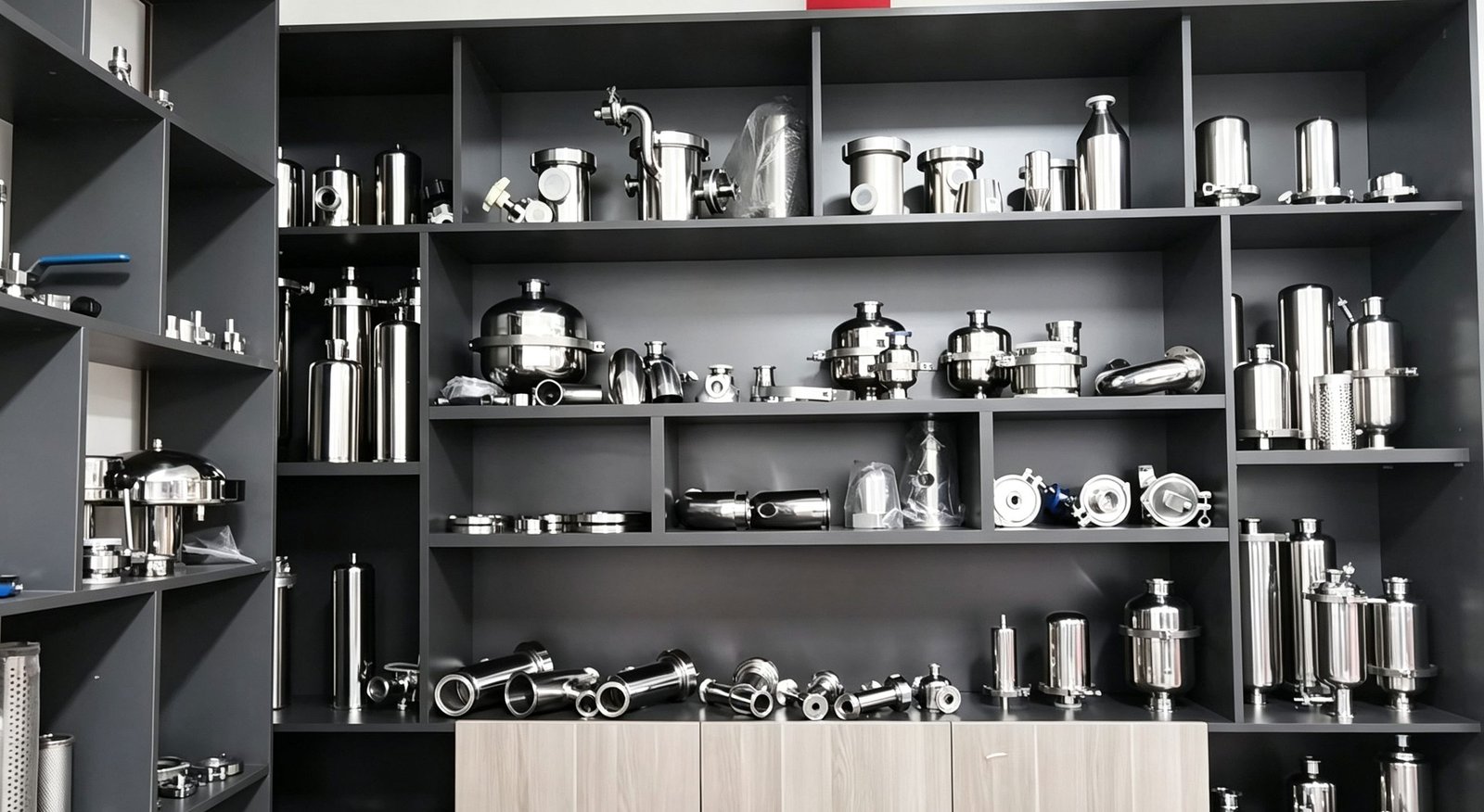
Wenzhou Haoqin Technology Co., Ltd. supports mushroom liquid culture and sanitary process projects from individual equipment to complete process-system planning.
Depending on the project requirements, our engineering support can include:
- Liquid culture and fermentation tanks
- Sterile air filtration
- Sanitary piping
- Liquid spawn transfer systems
- Automatic inoculation systems
- Tank cleaning and CIP solutions
- Process filtration
- Supporting sanitary components
- Equipment integration
- Installation and commissioning
- Technical training
For existing mushroom producers, the objective is not necessarily to replace every existing machine.
We can first review the current production process and identify which section is limiting production capacity, then evaluate how liquid culture, sanitary transfer, and automatic inoculation can be integrated into the existing facility.
Frequently Asked Questions
Is liquid spawn better than grain spawn?
Not necessarily.
Liquid spawn offers advantages in automation, centralized production, sanitary transfer, and high-volume inoculation, while grain spawn can offer lower initial investment and a simpler production approach.
The right choice depends on the production requirements.
Can liquid spawn be used for automatic inoculation?
Yes.
Mature liquid spawn can be transferred through sanitary piping to an automatic inoculation system and then introduced into sterilized and cooled substrate bags.
Can a facility produce both liquid spawn and grain spawn?
Yes.
Depending on the facility layout and production requirements, liquid spawn and grain spawn production can be integrated into the same overall mushroom production facility.
How large should a liquid culture tank be?
There is no single suitable tank size for every project.
Tank capacity should be calculated based on target substrate production, liquid spawn dosage, fermentation cycle, working volume, inoculation schedule, and future expansion requirements.
How many substrate bags can a 1,000 L liquid culture tank support?
In one of our Guangxi project applications, a 1,000 L liquid culture tank could provide enough liquid spawn for approximately 30,000 substrate bags under the specific production process.
This should not be treated as a universal capacity ratio because actual results depend on the production process.
Can an existing grain spawn facility be upgraded to liquid spawn production?
Yes.
An existing facility can potentially add liquid culture, fermentation, sanitary transfer, and automatic inoculation systems without necessarily replacing every existing production section.
The actual solution depends on the current equipment, facility layout, production capacity, and automation goals.
What information is needed for a liquid spawn system quotation?
The most useful information includes target bags per day, bag size, substrate type, current production process, existing equipment, liquid spawn requirements, desired automation level, and available facility space.
Photos, videos, or a simple layout of the existing facility can also help with preliminary system planning.
Planning to Upgrade from Grain Spawn to Liquid Spawn Production?
If you are expanding an existing mushroom spawn facility or planning a new liquid culture production line, the first step is to evaluate the complete production process rather than selecting individual machines.
Share your target production capacity, substrate type, current equipment, and desired level of automation with our engineering team.
We can help evaluate the liquid culture, fermentation, sterile air, sanitary transfer, and automatic inoculation requirements for your project.
Complete Liquid Spawn Production and Automatic Inoculation Process
This video shows the practical production flow from liquid culture preparation and fermentation to substrate preparation, sterilization, liquid spawn inoculation, and incubation.