Introduction
This article presents a real liquid mushroom spawn fermentation system project completed by Haoqintech in Guangxi, China.
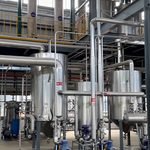
The project includes multiple stainless steel process tanks together with process piping, valves, filtration components, pressure gauges, sight glasses, and a plate heat exchanger. These components were assembled as part of an integrated process equipment system for liquid mushroom spawn production.
Rather than showing a single standalone fermentation tank, this project provides a practical look at how different stainless steel vessels and process components can be connected and arranged as part of a complete fermentation system.
The equipment details presented in this article are based on the actual project and reflect Haoqintech’s hands-on experience with stainless steel fermentation equipment, sanitary components, process piping, and system integration.
Project Snapshot
| Item | Details |
|---|
| Project Type | Liquid Mushroom Spawn Fermentation System |
| Location | Guangxi, China |
| Equipment Type | Stainless Steel Process Equipment |
| Main Equipment | Process Tanks, Piping, Valves, Filters, Pressure Gauges, Heat Exchanger |
| Project Stage Shown | Equipment Assembly and Installation |
| Supplier | Haoqintech |
1. Stainless Steel Process Tanks
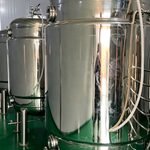
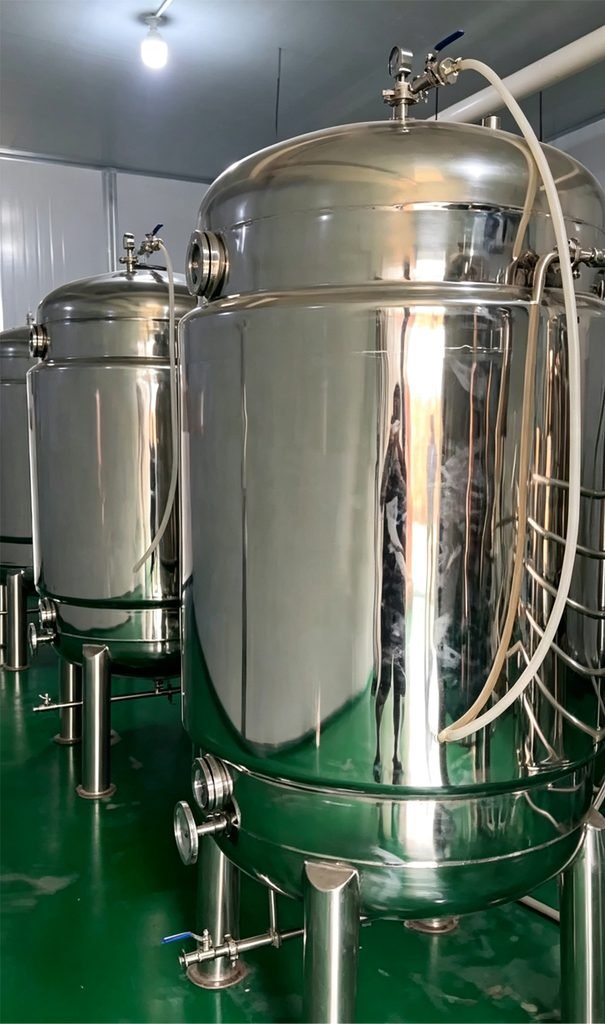
The main equipment arrangement includes several vertical stainless steel tanks in different sizes and configurations.
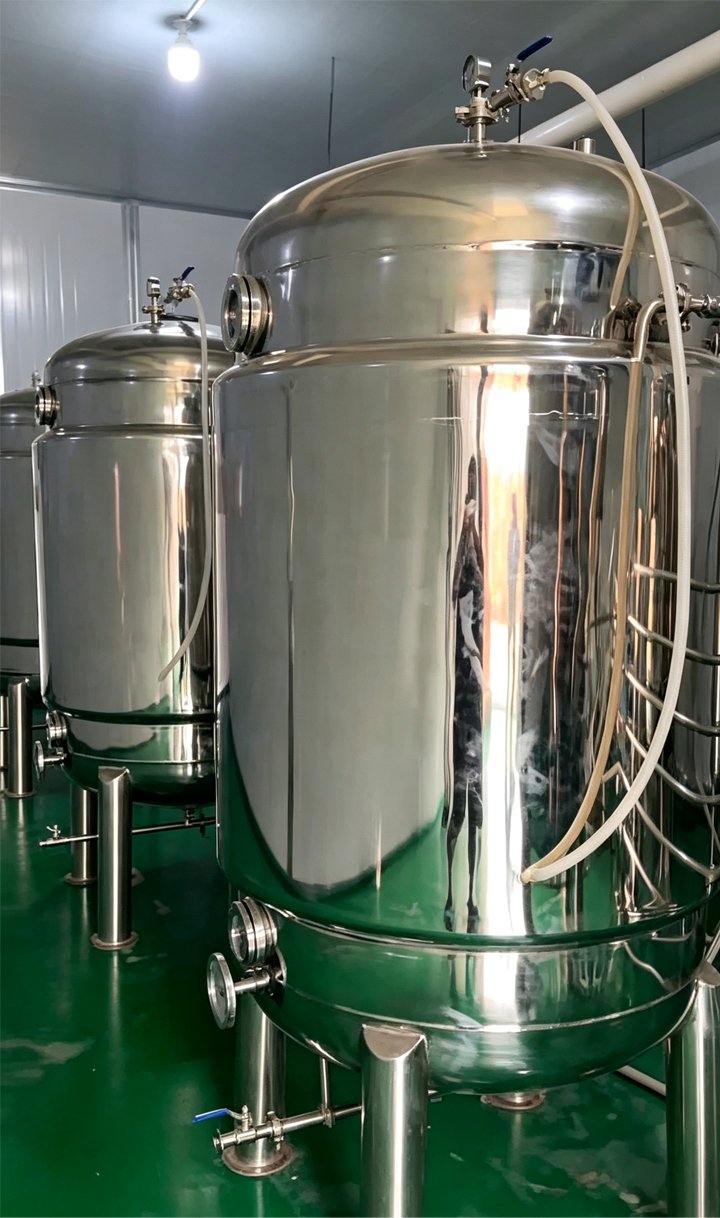
At the beginning of the project footage, two large vertical stainless steel tanks can be seen standing on support legs. The vessels include top manholes and multiple process connections.
Additional vessels appear throughout the equipment arrangement, including smaller tanks and conical-bottom process vessels.
Different tank configurations can be selected according to the requirements of the process, equipment capacity, installation space, and overall system design.
Features visible in the project include:
- Vertical stainless steel tanks
- Support legs
- Top manholes
- Sight glasses
- Process connections
- Conical-bottom vessels
- Bottom outlet piping
The specific function of each vessel depends on the process design and equipment configuration.
2. Stainless Steel Process Piping
Stainless steel process piping connects the tanks and supporting equipment throughout the system.
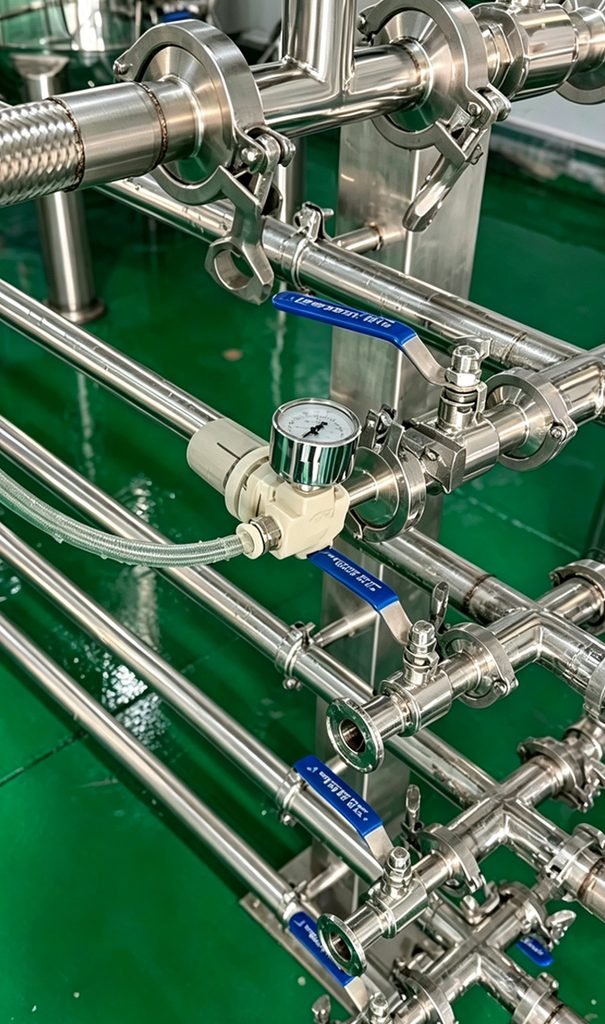
The project includes vertical pipe sections, horizontal pipe runs, elbows, valves, and connecting components arranged around the process tanks.
The piping layout is an important part of equipment integration because it connects individual vessels and components into a coordinated system.
In practical equipment projects, piping design also needs to consider equipment accessibility, maintenance, connection requirements, and the available installation space.
3. Valves and Valve Manifolds
Multiple stainless steel valves can be seen throughout the system.
One section of the project shows a vertical valve manifold with several blue-handled valves. Individual valves are also installed at different points along the process piping.
Valves allow different sections of the system to be controlled or isolated according to the process requirements.
The type, quantity, and arrangement of valves depend on the equipment configuration and the customer’s process requirements.
4. Filtration Components
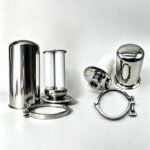
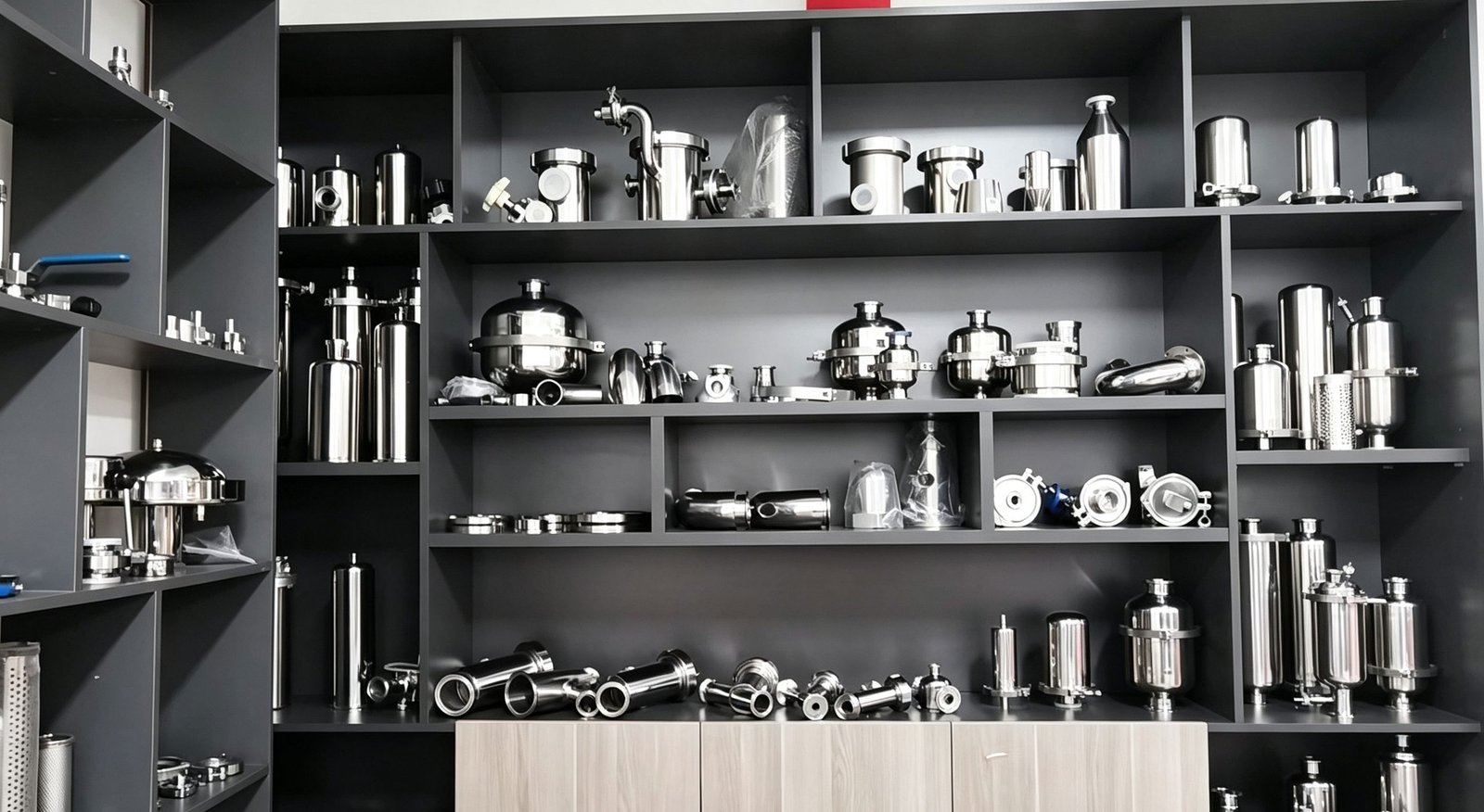
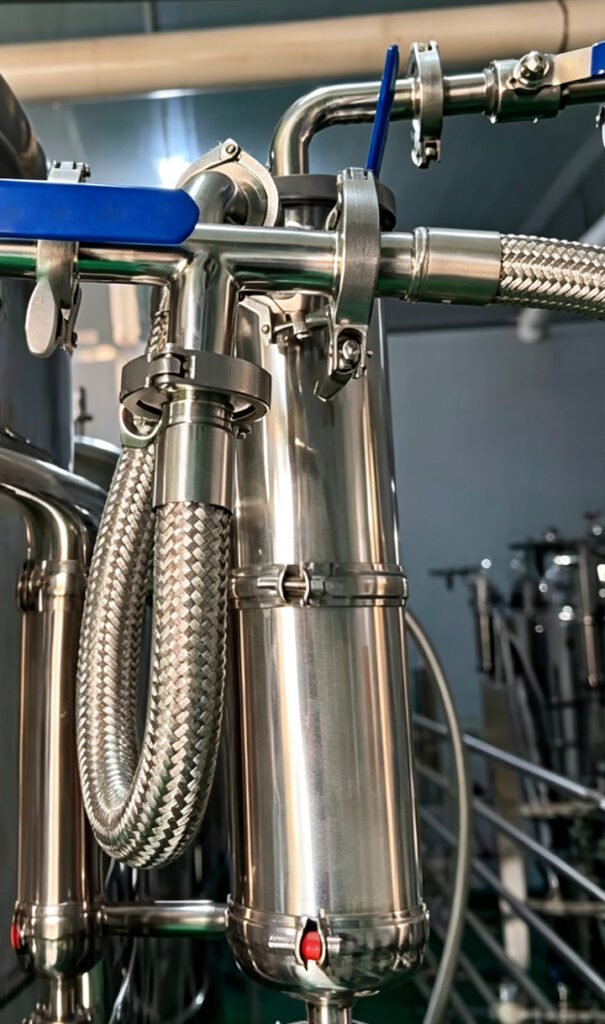
Several stainless steel filter housings are visible near the process tanks and within the piping arrangement.
Filtration components can be incorporated into process systems to provide filtration at selected points, depending on the process requirements and system configuration.
The appropriate filter housing and filter element should be selected according to factors such as the process medium, filtration requirements, connection type, flow requirements, and equipment design.
For this reason, filtration is best considered as part of the complete process system rather than as an isolated component.
5. Pressure Gauges and Process Monitoring
Pressure gauges are installed at selected points of the equipment.
A pressure gauge provides a direct indication of pressure at the relevant vessel or process connection, allowing operators to monitor pressure conditions during operation.
The appropriate gauge specification depends on the equipment design and operating requirements.
Pressure monitoring is one of the supporting functions that can be incorporated into a complete fermentation and process equipment system.
6. Sight Glasses and Equipment Access
Several vessels in the project are equipped with sight glasses and manholes.
Sight glasses can provide visual access to the relevant section of a vessel or process line, depending on the equipment design.
Manholes provide access for inspection, maintenance, cleaning, or other required operations.
These components are practical considerations when designing stainless steel process equipment because equipment accessibility and inspection can be important during both installation and operation.
7. Conical-Bottom Process Tanks
Several conical-bottom stainless steel vessels can be seen in the equipment arrangement.
The conical geometry provides a sloped lower section of the vessel and can be incorporated into process equipment depending on the intended application and discharge requirements.
The project footage shows bottom outlet piping and valves connected to these vessels, demonstrating how the vessel design is integrated with the downstream piping system.
The exact operating function of each vessel depends on the process specification.
8. Plate Heat Exchanger and Supporting Equipment
A plate heat exchanger can also be seen in the equipment arrangement together with associated stainless steel piping.
Heat-transfer equipment can be integrated into a process system when temperature control or heat exchange is required.
The actual operating function and configuration of the heat exchanger depend on the specific process design.
Its presence within the equipment arrangement demonstrates that the system incorporates not only fermentation vessels, but also supporting process equipment.
9. From Individual Components to a Complete Fermentation System
One of the most important aspects of this project is the relationship between the individual components.
A complete fermentation system is more than a single stainless steel tank.
In this project, the equipment arrangement includes:
- Stainless steel process tanks
- Process piping
- Sanitary valves
- Filter housings
- Pressure gauges
- Sight glasses
- Conical-bottom vessels
- Plate heat exchanger
- Supporting connections and structures
These components are arranged and connected as part of an integrated equipment system.
The quality of individual components is important, but their compatibility, connection, layout, and integration within the complete system are equally important.
This is where practical equipment engineering experience becomes valuable.
10. Liquid Mushroom Spawn Fermentation
Liquid mushroom spawn fermentation systems are used in liquid culture and spawn production processes for mushroom cultivation.
Compared with selecting a single vessel independently, a complete system needs to consider the relationship between the fermentation tanks and supporting components.
Depending on the process requirements, a system may include fermentation vessels, piping, valves, filtration components, monitoring instruments, and other supporting equipment.
The final configuration should be determined according to the customer’s production process, capacity requirements, equipment specifications, and operating conditions.
11. A Real Haoqintech Project in Guangxi, China
This project in Guangxi, China represents a practical example of Haoqintech’s experience in stainless steel fermentation and process equipment.
The project is not simply a standalone tank supply. It involves multiple pieces of stainless steel equipment and supporting components arranged together as part of an overall process system.
From the tanks and conical-bottom vessels to the piping, valves, filtration components, pressure gauges, sight glasses, and heat-transfer equipment, the project demonstrates how individual components become part of a larger equipment solution.
For Haoqintech, this type of project experience is important because understanding process equipment goes beyond manufacturing or supplying individual components. It also involves understanding how equipment is connected, arranged, and integrated into a practical working system.
12. From Fermentation Equipment to Broader Process Engineering
Haoqintech began its equipment experience with fermentation and liquid culture systems and has gradually expanded its capabilities into sanitary stainless steel components, filtration equipment, process equipment, and equipment integration.
The Guangxi project is one example of this development.
Our experience with fermentation systems also provides a practical foundation for supporting other stainless steel process equipment projects, including customized vessels, sanitary piping, filtration components, valves, and equipment integration.
Each project has different requirements, so equipment configuration and component selection should be developed around the actual process rather than using a one-size-fits-all approach.
Conclusion
The liquid mushroom spawn fermentation system project in Guangxi, China provides a real example of how stainless steel process equipment can be assembled into an integrated system.
The project includes process tanks, conical-bottom vessels, stainless steel piping, valves, filter housings, pressure gauges, sight glasses, and a plate heat exchanger.
More importantly, it demonstrates that a complete fermentation system is built from the relationship between these individual components.
With practical experience in fermentation equipment, sanitary stainless steel components, process piping, and system integration, Haoqintech continues to develop customized equipment solutions for different process applications.