Liquid mushroom culture and spawn production require more than a fermentation tank alone. The fermentation vessel, sanitary piping, filtration, valves, compressed air treatment and temperature control all need to work together as part of the production process.
Before Haoqintech was established, our team had already been involved in designing and building liquid mushroom culture and fermentation systems.
One of these projects included multiple stainless steel fermentation tanks, sanitary process piping, filters, valves and a compressed air treatment system for liquid edible mushroom culture production.
The project was completed before Haoqintech was established, so only limited project documentation is available today. However, a project video preserved important details of the equipment and production environment.
This article shares what we can confirm from that project and explains how this experience eventually influenced the sanitary products and system solutions we provide today.
Project Overview
The project involved a liquid edible mushroom culture production system built around multiple sanitary stainless steel fermentation tanks.
From the available project footage and our project experience, the system included:
- Multiple vertical stainless steel fermentation tanks
- Mobile stainless steel support frames with casters
- Sanitary process piping
- Sanitary valves and fittings
- Filters installed as part of the fermentation system
- Pressure gauges and process connections
- Sight glasses for visual observation
- Flexible sanitary hoses
- Compressed air treatment equipment
- Air filtration components
- Temperature-control equipment
- A clean and organized production environment
The overall layout was designed around practical liquid culture production, equipment accessibility and hygienic processing requirements.
Stainless Steel Fermentation Tanks
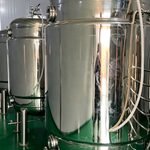
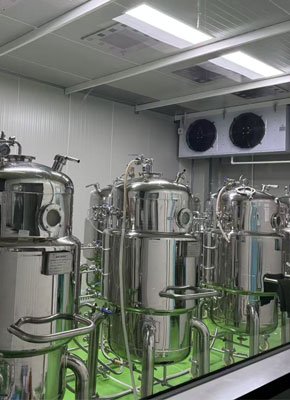
The fermentation tanks were vertical stainless steel vessels installed on mobile support frames.
Several details can be seen in the project footage, including:
- Polished stainless steel surfaces
- Top-mounted process connections
- Pressure gauges
- Sanitary valves
- Sight glasses
- Transfer connections
- Bottom discharge connections
- Stainless steel frames
- Caster wheels for mobility
The mobile design allowed the tanks to be repositioned when necessary, providing greater flexibility for production layout and equipment maintenance.
For liquid culture applications, the fermentation vessel is only one part of the complete process. Its connections and supporting systems are equally important.
Filters Installed with the Fermentation System
An important feature of this project was the use of filters together with the fermentation tanks.
The filters were integrated into the process system rather than being treated as separate standalone components.
Depending on their position and intended function, filtration components in a liquid culture system can be used for applications such as:
- Air filtration
- Process-fluid filtration
- Particle removal
- Protection of downstream equipment
- Supporting hygienic process transfer
The exact filtration specification depends on the process, connection configuration, operating conditions and required level of filtration.
This project experience helped us understand an important principle:
A sanitary filter should be selected as part of the complete process system, not simply by connection size.
Flow requirements, pressure, filtration requirements, materials, gaskets, cleaning procedures and installation position all need to be considered.
Sanitary Process Piping and Valves
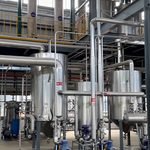
The fermentation tanks were connected through a network of sanitary stainless steel piping.
The system included sanitary components such as:
- Stainless steel process pipes
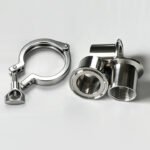
- Tri-Clamp connections
- Sanitary valves
- Filters and strainers
- Flexible sanitary hoses
- Process fittings
These components provided connections between the fermentation vessels and other parts of the production system.
Sanitary clamp connections are particularly useful in applications where equipment needs to be disassembled, inspected, cleaned or maintained.
The project also demonstrated why valves and fittings should be considered together with the equipment they serve.
A valve that is technically suitable by itself may still be inappropriate if its connection, material, gasket or installation position does not match the rest of the system.
Compressed Air Treatment System
The fermentation process also required a suitable compressed air supply.
The project included a compressed air treatment system consisting of equipment such as:
- Screw air compressor
- Post-compression precision filters
- Adsorption dryer
- Refrigerated air dryer
- Air filtration components connected to the process
The purpose of the air-treatment stages was to improve the cleanliness and dryness of the compressed air before it was used by the process.
Compressed air quality can be especially important in fermentation and liquid culture applications because air may be introduced into or otherwise interact with the process.
The air source, filtration, drying, piping, valves and final filtration stage therefore need to be considered as one complete system.
Where sterile or microbiologically controlled air is required, the final air-filtration equipment should be selected according to the actual process requirements and validated procedures.
Temperature Control for Liquid Culture
Temperature control is another important consideration in liquid mushroom culture.
The project included temperature-control equipment associated with the fermentation process and production environment.
Maintaining an appropriate and stable process temperature can help provide consistent conditions for liquid culture production.
The exact temperature-control method depends on the fermentation vessel design, production scale, process requirements and site conditions.
For a complete fermentation system, temperature control should therefore be considered together with the vessel, cooling or heating equipment, process piping and control system.
A Clean and Organized Production Environment
The fermentation equipment was installed in a clean and organized production environment.
The project footage shows:
- Stainless steel fermentation tanks arranged along the production area
- Clean wall panels
- Easy-to-clean flooring
- Industrial ventilation and cooling equipment
- Organized sanitary process piping
- Clearly arranged valves and process components
The production environment was designed around practical hygienic processing and equipment operation.
We do not describe this historical project as a certified GMP cleanroom unless the relevant certification and documentation are available.
Instead, the focus is on what can actually be seen and confirmed: a controlled, organized production environment built around sanitary stainless steel equipment.
Why Mobile Fermentation Tanks Matter
The use of mobile fermentation tanks was another practical feature of the project.
Compared with permanently fixed vessels, tanks mounted on casters can provide additional flexibility for:
- Production layout changes
- Equipment access
- Cleaning and maintenance
- Process-area organization
- Equipment repositioning
The exact choice between mobile and fixed installation depends on the production workflow and facility requirements.
In this project, mobility was incorporated into the equipment design to support practical operation.
What This Project Taught Us About Sanitary Components
One of the most valuable lessons from projects like this is that individual components cannot be considered independently.
A fermentation system may include:
Fermentation tank
↓
Air filtration and treatment
↓
Sanitary valves
↓
Process filters
↓
Sanitary piping and fittings
↓
Liquid transfer and downstream processing
Every component needs to match the process and the surrounding equipment.
This practical experience later became an important reason for focusing Haoqintech on sanitary stainless steel components.
From Real Fermentation Projects to Haoqintech
Haoqintech was not originally created simply as a sanitary fittings catalogue.
Before the company was established, our team had already spent years working on liquid culture, fermentation and sanitary processing projects.
During those projects, we repeatedly encountered the same practical problem:
Finding sanitary components that actually matched the equipment design and process requirements was not always easy.
Filters, fittings, valves, tank-cleaning equipment, breathers and other stainless steel components all need to work together.
This experience eventually led to the creation of Haoqintech.
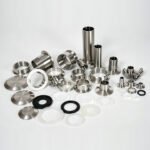
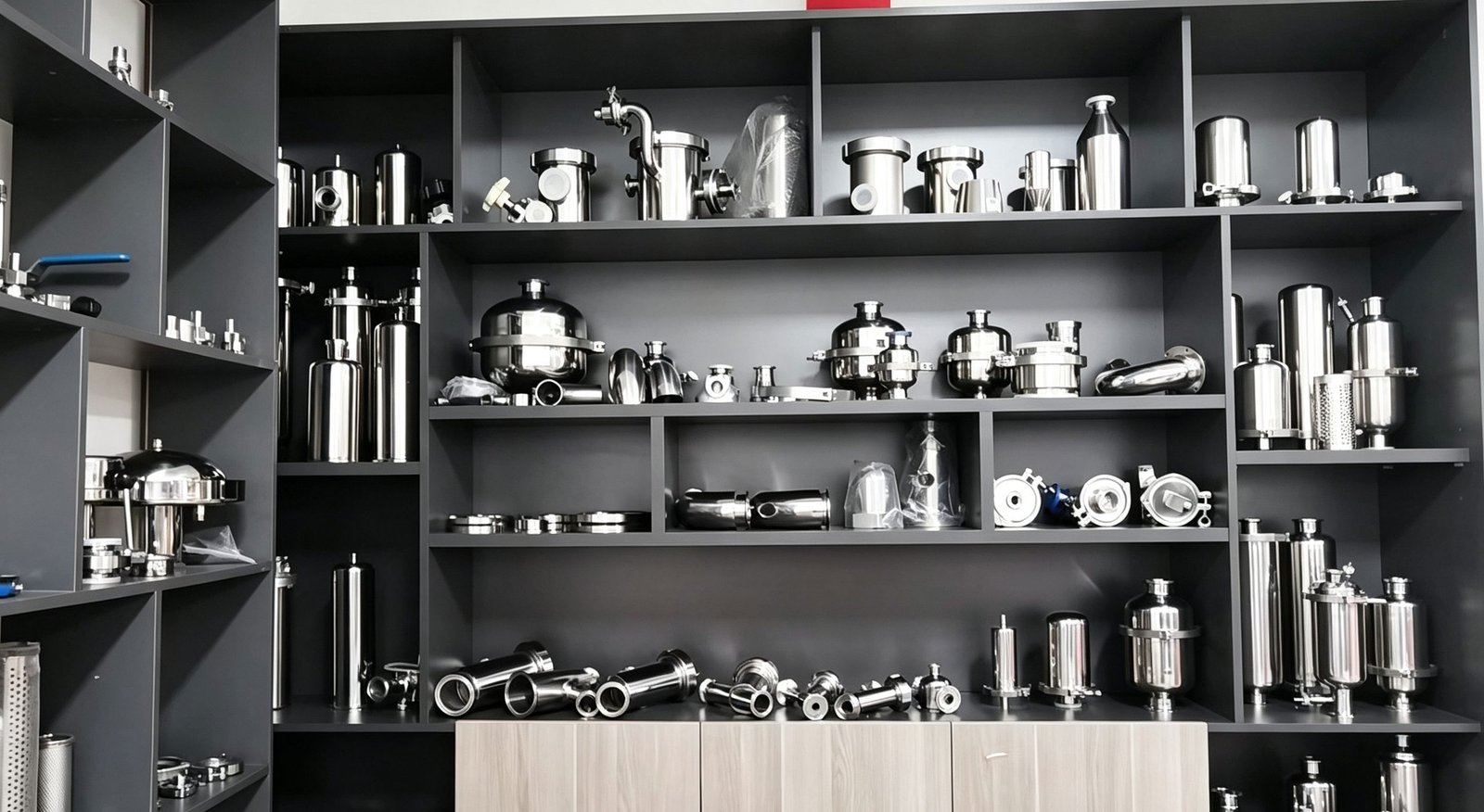
Today, our product range includes:
- Sanitary filters
- Tri-Clamp fittings and connections
- Sanitary valves
- Tank-cleaning equipment
- Breathing and safety components
- Custom stainless steel components
Our goal is not simply to supply individual parts. We use our project experience to better understand how these components are used in real processing systems.
Why Project Experience Matters
A sanitary component may look simple in a product catalogue.
But in an actual processing system, engineers need to consider much more than appearance or connection size.
For example, selecting a sanitary filter may involve:
- Filter type
- Filtration requirement
- Flow rate
- Operating pressure
- Connection size
- Material compatibility
- Gasket material
- Cleaning method
- Installation position
The same principle applies to sanitary valves, fittings, tank-cleaning devices and air-handling components.
Our previous project experience gives us a practical understanding of how these components need to work together.
Project Video
Because this project was completed before Haoqintech was established, we do not have a complete modern project documentation package.
However, the original project video preserves a visual record of the equipment and production environment.
The footage shows the stainless steel fermentation tanks, mobile frames, sanitary piping, filters, valves and other equipment used in the system.
From Project Experience to Sanitary Product Solutions
Today, Haoqintech supplies sanitary stainless steel components for food, beverage, fermentation, liquid culture and other hygienic processing applications.
Our experience covers both individual components and the way those components function within larger systems.
We can support customers with:
- Sanitary filters
- Tri-Clamp fittings
- Sanitary valves
- Tank-cleaning equipment
- Breathers and air-filtration components
- Custom stainless steel components
- Liquid culture system support
- OEM manufacturing
Whether you need a single sanitary filter or components for a larger fermentation system, we can review your application and recommend a suitable configuration.
Conclusion
This project represents an important part of the engineering experience behind Haoqintech.
Although the project was completed before the company was established and only limited documentation remains today, the available video provides a valuable record of the equipment and system configuration.
More importantly, the project reflects the type of practical experience that shaped our current product range.
From stainless steel fermentation tanks and sanitary piping to filters, valves, compressed air treatment and temperature control, successful liquid culture production depends on how the complete system works together.
That experience continues to influence how we design, manufacture and supply sanitary stainless steel components today.
Explore Haoqintech Sanitary Products
Learn More About Our Liquid Spawn System Experience
Contact Haoqintech for Technical Support or a Factory-Direct Quotation