Choosing a filter cartridge involves more than selecting a micron rating. Different cartridges use different materials, structures, and filtration mechanisms, and these factors affect their compatibility with the process, cleaning requirements, and overall filtration performance.
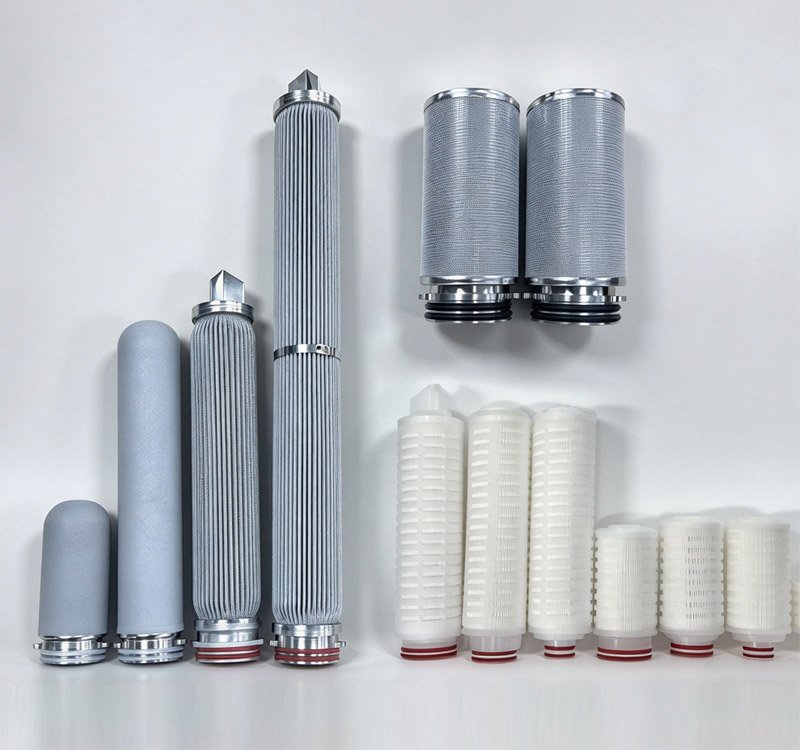
For sanitary processing applications, common options include polypropylene (PP), PTFE membrane, sintered metal, pleated cartridges, activated carbon, and stainless steel filter elements. Some categories overlap: a cartridge can be made from a particular material and use a particular structure at the same time.
Understanding these differences helps engineers and purchasing teams select a cartridge that fits the liquid or gas being processed, the required filtration objective, and the available filter housing.
Understanding Filter Cartridge Types
Filter cartridges can be classified in three main ways: by material, by structure, and by filtration mechanism.
Material describes what the filter element is made from. Examples include polypropylene, PTFE, titanium, and stainless steel.
Structure describes how the filtration medium is constructed. Pleated and sintered elements are two examples. Pleating increases the effective filtration area, while sintering creates a porous structure from particles or fibers bonded through a controlled manufacturing process.
Filtration mechanism describes how the element works. Many cartridges capture particles as fluid passes through the filtration medium. Activated carbon, by contrast, is primarily used to adsorb certain dissolved substances or compounds.
These categories are not mutually exclusive. A PP or PTFE membrane may be used in a pleated design, while a titanium rod filter is commonly manufactured using a sintered porous structure.
This distinction matters when comparing products. Two cartridges made from different materials may serve similar purposes, while two cartridges made from the same material may have different structures and operating characteristics.
PP vs. PTFE Filter Cartridges
Polypropylene and PTFE are widely used in filtration, but they have different material properties and application considerations.
Polypropylene (PP) Filter Cartridges
PP filter cartridges are commonly used for liquid particle filtration in applications such as water treatment and general industrial processing. Their suitability depends on the filter construction, target particle size, chemical compatibility, and operating conditions.
When selecting a PP cartridge, check:
- The required filtration rating and how it is defined.
- Compatibility with the process liquid and any cleaning chemicals.
- Operating temperature and pressure limits specified by the manufacturer.
- Cartridge dimensions and end-connection configuration.
- Whether the cartridge is intended for single use or a defined cleaning and reuse process.
PP is not automatically suitable for every liquid simply because it is a commonly used filtration material. Compatibility should be verified against the actual process conditions.
PTFE Filter Cartridges
PTFE filter cartridges often use a PTFE membrane and may be designed for liquid or gas filtration, depending on the product construction.
PTFE is known for its chemical resistance, but the performance of a complete cartridge also depends on its support layers, seals, housing materials, and membrane design. For membrane filtration, wettability can be especially important. Hydrophobic PTFE membranes, for example, may require specific conditions for liquid filtration.
Before choosing a PTFE cartridge, confirm the intended application, membrane characteristics, chemical compatibility, and operating limits. Do not assume that all PTFE cartridges are interchangeable or suitable for every liquid and gas.
For tank venting and air filtration applications, Haoqintech also offers stainless steel breather filter housings compatible with replaceable pleated PP cartridges. See our 304 Sanitary Breather Filter Housing with 226 Cartridge for an example of a cartridge-based air filtration assembly.
Titanium Rod, Sintered and Stainless Steel Filter Cartridges
Metal filter elements are useful in applications where the process requires a porous metal structure, mechanical durability, or a filtration element that may be cleaned under specified conditions.
However, metal cartridges should not be treated as one uniform product category. Material, pore structure, construction, and cleaning requirements all influence their suitability.
Titanium Rod Filter Cartridges
A titanium rod filter cartridge typically uses a porous titanium element, often produced through sintering. Fluid passes through the interconnected pores while particles are retained according to the element’s filtration characteristics.
Potential reasons to consider titanium include the material’s corrosion resistance in suitable environments and its use in specialized industrial filtration processes. Actual compatibility depends on the fluid composition, temperature, pressure, and other operating conditions.
When evaluating a titanium rod cartridge, confirm:
- The specified filtration rating or pore characteristics.
- Cartridge length, diameter, and end connections.
- Chemical compatibility with the process medium.
- Cleaning method and the manufacturer’s reuse recommendations.
- Operating pressure and temperature limits.
A titanium element should not be selected solely because the process is described as corrosive or high-temperature. The actual conditions must be checked against the cartridge specification.
Sintered Filter Cartridges
Sintering is a manufacturing process used to create porous filter structures. Depending on the material and construction, sintered elements can be made from metals and other suitable materials.
This means that “sintered filter cartridge” describes a type of structure or manufacturing method rather than one specific material. A sintered titanium rod is one example of a sintered filter element.
The pore structure, material, mechanical strength, and cleanability vary by product. When comparing sintered cartridges, look beyond the name and verify the material, filtration characteristics, operating limits, and maintenance requirements.
Stainless Steel Filter Cartridges
Stainless steel filtration elements may use woven mesh, perforated metal, or porous metal structures. These designs do not all perform in the same way.
A mesh element is generally selected according to its opening size and particle-retention requirements. A porous metal element has a different structure and must be evaluated using its own specified filtration characteristics.
Stainless steel may be considered where mechanical strength, material durability, or a defined cleaning process is important. Grade selection also matters: 304 and 316 stainless steel should not be assumed to offer identical corrosion resistance in every process environment.
Before choosing a stainless steel element, identify its construction, material grade, filtration rating, connection type, and cleaning requirements. Also confirm whether the element is designed for repeated use and which cleaning methods are permitted.
Pleated Filter Cartridges: Why Structure Matters
Pleated filter cartridges use folded filtration media to increase the effective filtration area within a given cartridge envelope.
A larger effective area can be beneficial for flow capacity and contaminant-holding performance, but actual results depend on the media, pleat geometry, fluid properties, and operating conditions. Pleated construction alone does not guarantee a particular flow rate or service life.
Pleated cartridges can use different filtration media, including PP and PTFE-based materials. Therefore, “pleated” describes the structure, not the material.
When comparing pleated cartridges, consider the filtration medium, effective area, required filtration rating, pressure drop, compatibility, and cartridge dimensions. The housing must also accommodate the cartridge’s length, diameter, and end connection.
If a cartridge is being installed in an existing sanitary filter housing, verify dimensional and connection compatibility before ordering a replacement.
For tank venting systems that use replaceable pleated PP cartridges, the filter element should be matched to the housing interface and required air filtration specifications. You can review our 304 Sanitary Breather Filter Housing with 226 Cartridge for a practical example.
Activated Carbon Filter Cartridges
Activated carbon cartridges are different from conventional particle-filtering cartridges because their main function is adsorption.
Activated carbon can capture certain substances on its internal surface, depending on the substance being targeted and the process conditions. It may be used to reduce selected odors, tastes, or organic compounds in suitable applications.
However, activated carbon does not remove every dissolved substance, and its performance cannot be judged by a particle-filtration micron rating alone.
Important selection factors include the target substance, carbon type, contact time, flow conditions, cartridge capacity, and replacement criteria. Where particle removal is also required, a separate particle-filtering stage may be needed.
The treatment objective should be clearly defined before choosing an activated carbon cartridge.
How to Choose the Right Filter Cartridge
The best cartridge is the one that matches the process requirements, rather than the one with the most advanced-sounding material or construction.
Start by identifying what needs to be removed. If the objective is particle removal, establish the required filtration rating and determine whether the application is better suited to a cartridge filter or a sanitary strainer. If the objective is to reduce a dissolved contaminant, an adsorption or other specialized treatment process may be necessary.
Next, evaluate the process medium and operating conditions. Chemical compatibility, temperature, operating pressure, flow rate, and the expected solids load all affect cartridge selection. For reusable systems, cleaning procedures and the manufacturer’s reuse limits also need to be considered.
Finally, check the cartridge and housing as a complete assembly. A suitable filter element must fit the housing and match the connection type, dimensions, sealing arrangement, and operating limits. Selecting a cartridge based on material or micron rating alone can lead to compatibility problems or unsatisfactory performance.
The following table provides a starting point for comparing common cartridge categories.
| Filter type | Typical filtration objective | Key selection considerations |
|---|---|---|
| PP cartridge | Liquid particle filtration | Filtration rating, chemical compatibility, operating limits |
| PTFE membrane cartridge | Liquid or gas filtration, depending on design | Membrane characteristics, wettability, compatibility |
| Titanium rod cartridge | Porous metal filtration | Pore characteristics, material compatibility, cleaning |
| Sintered cartridge | Filtration through a porous structure | Base material, pore structure, operating conditions |
| Pleated cartridge | Particle filtration with increased effective media area | Media type, filtration rating, pressure drop, dimensions |
| Activated carbon cartridge | Adsorption of selected substances | Target contaminant, contact time, capacity, replacement criteria |
| Stainless steel filter element | Filtration using mesh or porous metal | Grade, construction, filtration characteristics, maintenance |
These categories overlap. For example, a titanium rod element may also be classified as a sintered cartridge, and a PP cartridge may use a pleated structure. Compare the actual product specifications rather than relying on the category name alone.
Filter Cartridge Selection for Sanitary Processing Systems
In sanitary processing, cartridge selection should be considered together with the filter housing and the wider process system.
The cartridge must be compatible with the product medium, seals, housing materials, and cleaning procedure. Connection dimensions and installation requirements are equally important, particularly when replacing an existing element or integrating a cartridge into a sanitary stainless steel pipeline.
For a more complete selection, prepare the following information before requesting a quotation:
- Process medium and the substances to be removed.
- Required filtration rating and the basis on which it is specified.
- Normal flow rate and operating pressure.
- Operating temperature and cleaning conditions.
- Required cartridge length, diameter, and end connection.
- Material requirements and whether the element must be reusable.
This information helps narrow the options and reduces the risk of choosing a cartridge that is technically unsuitable for the application.
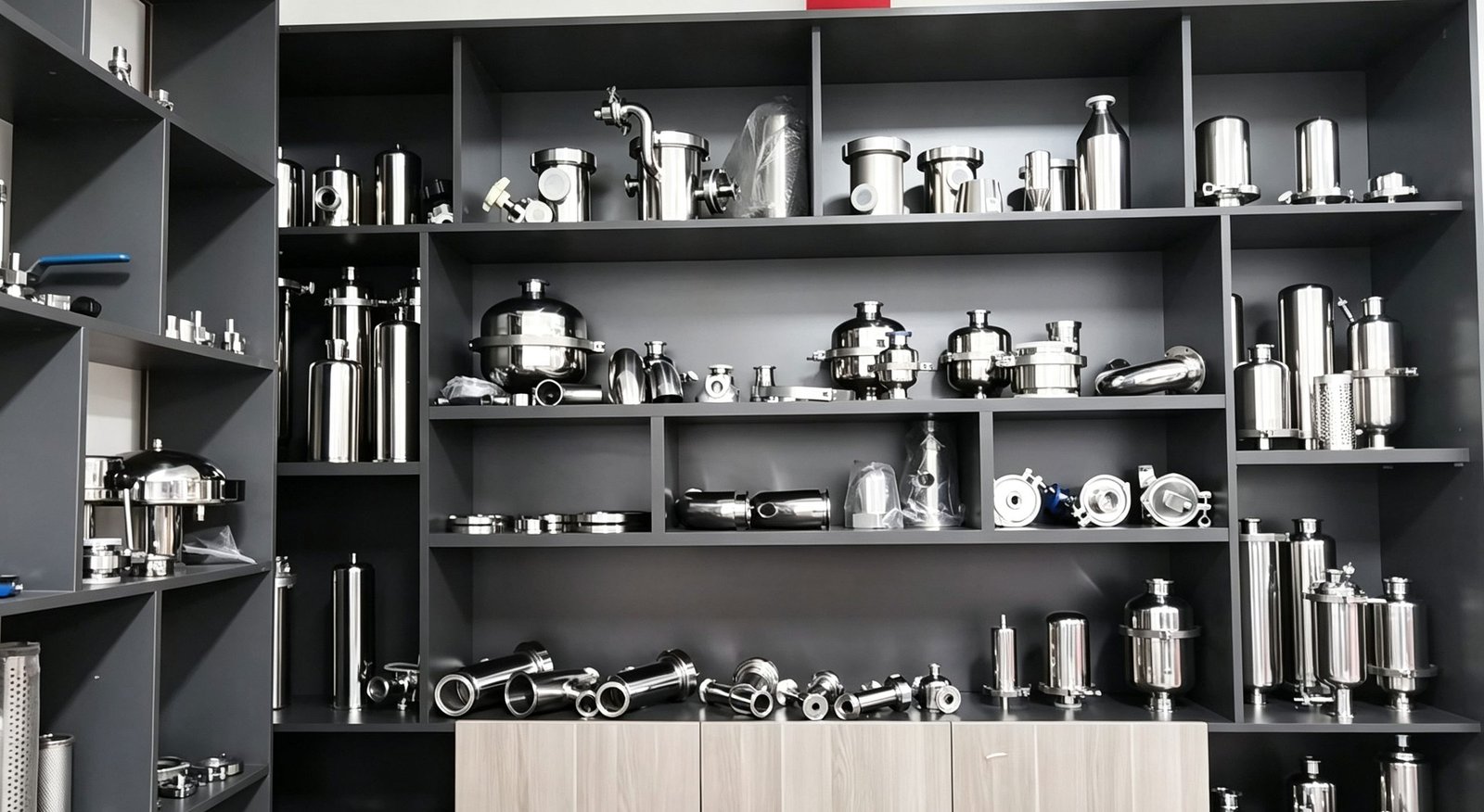
The cartridge and housing should be selected as a compatible assembly. For a closer look at housing structure, cartridge compatibility, and connection requirements, read our guide to sanitary filter housings.
Need Help Selecting a Filter Cartridge?
Haoqintech supplies sanitary stainless steel filtration equipment and related components for hygienic processing applications.
To help identify a suitable filter cartridge or housing configuration, please share the following information:
- Process medium and filtration objective
- Required filtration rating
- Operating temperature and pressure
- Required flow rate, if known
- Cartridge dimensions and end connection
- Whether the application involves liquid filtration or tank air filtration
If you are replacing an existing cartridge, a product photo, drawing, or current specification can also help us review compatibility.
Contact our team to discuss your filtration requirements and request a suitable configuration.